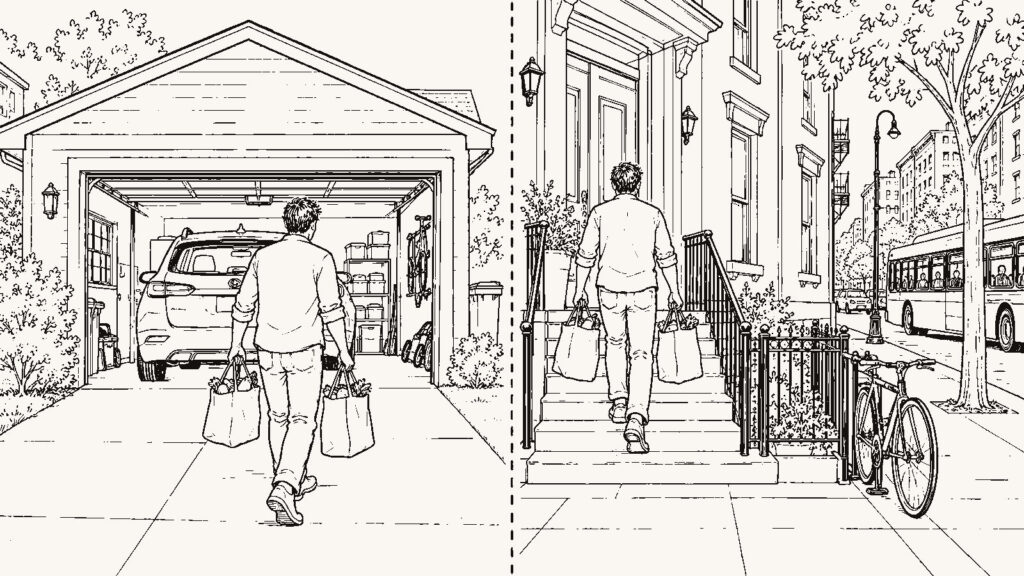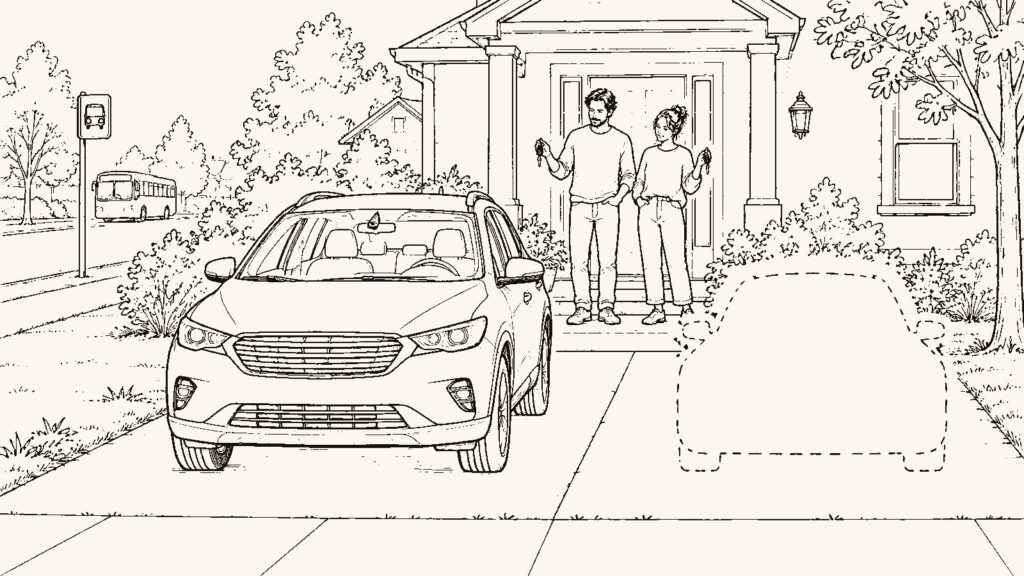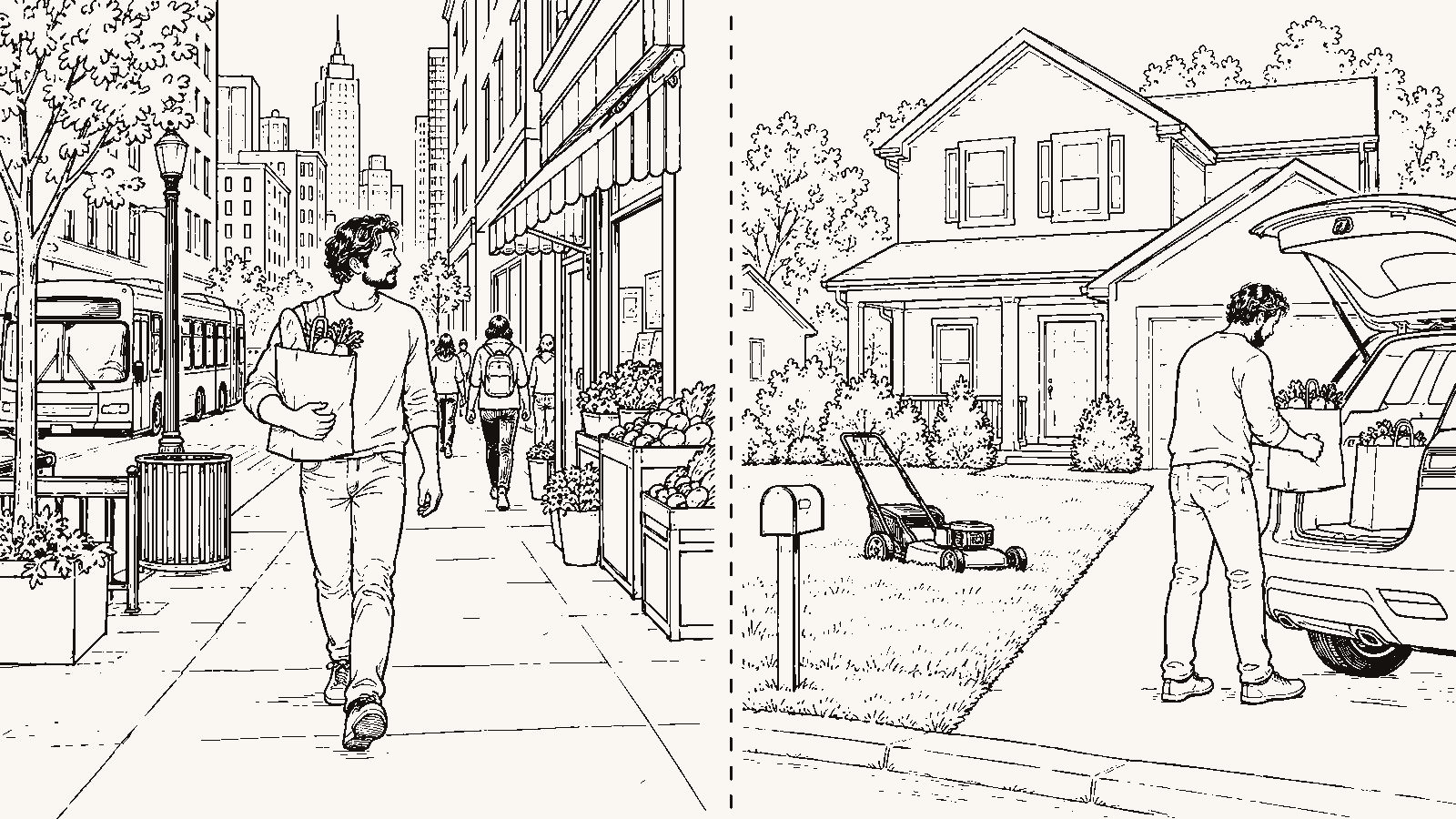
You are not deciding whether the suburbs are better than the city. You are deciding whether your ordinary week, moved from a city address to a suburban one, still gets you the things you are moving for. Every trip you used to walk becomes a drive, and every square foot you gain comes with something to maintain.
The listing shows you the rooms and the yard. It does not show you the Tuesday. The method here is to run that Tuesday twice, once from where you live now and once from the address you are considering, and read the difference.
What are you trading?
Write down what the suburban house gives you. Most lists look alike: a second bathroom, a room that is only an office, a yard, a garage, a driveway, a wall you do not share, a lower price per square foot, quiet at night. All of it is real.
Now write down what the city address gives you that you have stopped noticing. The coffee you walk to. The grocery run you make on the way home without a car. The bus or train that gets you to work when the car is in the shop. The friend three blocks over. The errand you chain onto the walk because it is on the way. The Saturday that is yours because nobody expects you to mow anything.
The suburb keeps that second list and converts most of it into car trips, and it converts your Saturday into maintenance. How much converts depends on the suburb. One with a sidewalk to a main street keeps a few of the walks; one built around the car keeps none. Whether that is a good trade depends on which list you use more. Good for which life, and at what cost?
Run your Tuesday from both addresses
Take a normal week you already lived. Pull up your calendar and your bank statement and list every trip you made: work, groceries, the gym, the pharmacy, the kid’s practice, dinner with friends, the hardware store, the dry cleaner. Next to each one, write how you got there and how long it took door to door.
Now put the suburban address at the top of a second column and run the same list. For each trip, find the exact place you would go from that house, not the nearest one on the map, and check the drive at the hour you would make it. A grocery trip at 5:45 on a Tuesday is a different trip from the same store at 10 on a Sunday morning.
Count three things. How many trips changed from foot or transit to car. How many minutes the week gained in the car. How many trips fell off the list because you would stop making them, and how many new ones appeared, like the drive to the friend who stayed in the city. Those three counts are the decision, and no portal can produce them for you because no portal knows where you go. The exercise costs you an evening, and it is only as honest as your list. If you leave off the four times a week you walk to get coffee because they feel too small to count, the suburban column looks better than it is.
Which trips stop being walks?
In a city, the errand is on the way. You walk past the pharmacy to get home, so the pharmacy takes four minutes. In a suburb built around the car, the pharmacy is a drive, a parking lot, and a drive back, and it is not on the way to anything unless you plan it that way.
Two things tell you how far the suburban address is from that pattern. The first is what workers in that area already do. The U.S. Census Bureau’s American Community Survey reports, for each census tract, how residents get to work and how long it takes them. That is Official record, and you can pull it for the tract around the address at https://data.census.gov/. It tells you what the neighbors do, not what you will do, and a tract number can hide a street where everything is a drive.
The second is a walkability index, which counts nearby businesses and gives the address a score. That is an Estimate. It does not know whether there is a sidewalk between the house and those businesses, whether the road between them has a crossing, or whether any of those businesses is one you would use. Where a city or county publishes a sidewalk layer on its GIS site, that is Official record and answers the sidewalk question. The blog builds this out in What “Walkable” Should Mean When You Are Choosing Where to Live.
The test that answers what both skip is to walk from the front door of the house to the nearest place that sells a gallon of milk and time it. Note whether there is a sidewalk the whole way and a marked crossing at every road. If the walk is eleven minutes with a sidewalk, you have one kind of suburb. If it is a road with no shoulder, you have the other kind, and every errand for the next several years is a car trip. The walk costs you a trip to the address in daylight, and it tells you about one house, so you repeat it at every house on your list.
Does one car still cover the household?
If you left the city with one car or none, the suburban address may need two. The second car is a location cost, so the mortgage calculator leaves it out.
Run the test on the two calendars. Lay two adults’ weeks side by side and mark every hour when both need to be somewhere the other is not. Add school drop-off, practice, the doctor, and the grocery run. If there are more than a few of those hours a week and no bus covers them, the second car is on the list, with its payment, insurance, fuel, and parking. The local transit agency’s route map and schedule, which is Official record, tells you whether the bus is a real fallback from that address; walk to the nearest stop and read off the posted schedule how often it runs on a weekday and on a Saturday. A route that runs every eleven minutes at rush hour and every hour on Saturday is a fallback for the commute and nothing else.
The downside of skipping the second car is a week built around one vehicle, which works until it is in the shop, and then every trip on your list depends on someone else. The downside of buying it is that the money is gone whether you drive it or not. The full method is in How to Know Whether You Need One Car or Two After You Move.
How much of the week goes to driving?
Add up the drive minutes from your two-column list and multiply out the year. For the commute leg, the formula is extra round-trip minutes per day, times commute days per week, times working weeks per year, divided by sixty. At 48 working weeks, 10 extra minutes each way is about 80 hours a year, 20 is about 160, and 30 is about 240. The arithmetic is in Commute Math: What Extra Drive Time Actually Costs You in a Year.
The commute is the trip people price. The errands and the kid activities are the trips they do not, and in a suburb those add up faster because none of them is on the way. Three practices a week at twenty minutes each direction is another two hours in the car before you count the grocery run. If you work from home, the commute leg is zero and those errand and activity legs are the whole number. Put that number on the page next to the extra rooms.
Drive the commute yourself at 7:40 on a weekday, both directions. The map’s drive time is an Estimate. The drive at the real hour is Personal verification, and where the two disagree, believe the drive. The cost is a weekday morning at the address, which for an out-of-state buyer means a trip planned around a Tuesday rather than a weekend.
What does the extra space cost you on Saturday?
A yard is the reason for many of these moves, and it is where Saturday goes. Mowing, edging, leaves, gutters, the driveway, the trees, and whatever the last owner planted that you now own. In a city rental or condo, someone else did some of this, or nobody did and it was not yours.
The county assessor and the county GIS parcel viewer show the lot size, the zoning, and the structures on the parcel, and that is Official record. The seller’s disclosure, where your state requires one, and the county permit records, also Official record, tell you whether the house is on sewer or septic and municipal water or a well, and how old the roof and the heating system are. Septic and well permits usually sit with the county health department; ask the county which office holds them. A house on septic and a well carries two systems the city house never had.
The Consumer Financial Protection Bureau lists maintenance and repairs as a line in the total monthly cost of owning a home, next to principal, interest, taxes, insurance, HOA fees, and utilities; the components are at https://www.consumerfinance.gov/owning-a-home/. That is Official record on what the categories are, and it is silent on your numbers. Get the numbers from the disclosure and the inspection, then get a contractor’s quote for whatever the inspector flags.
Hiring the lawn out gives you the Saturday back and puts a recurring bill on the list. Doing it yourself keeps the money and costs the morning. Both are fine answers. Decide whether you are moving for the yard or for the Saturday, and do it before you close.
What do the HOA and the town expect of you?
A city building had rules you could see. A suburban subdivision has covenants you have to ask for. Get the HOA’s covenants, conditions, and restrictions from the association or the seller before you make an offer, and read what it says about parking on the street, fences, sheds, the color of the front door, and how long a trash can may sit at the curb. That is Official record. The downside of reading it is an evening of small print. The downside of skipping it is finding out from a letter.
The town has its own list. The municipal or county public works site tells you the trash and recycling days, whether yard waste is collected, who plows, and whether the sidewalk in front of the house is yours to clear. That is Official record, and it changes which chores land on you.
Which city habits will you miss, and which will you not?
If you walked to two restaurants and the same grocery store and took the train to work, the suburb replaces all three without much loss. If the drift of a city day, where you change your mind about dinner on the walk home, was most of what you liked, no square footage replaces it.
Last month tells you which one you are. Count how many evenings you left the apartment on foot after dinner. Count how many trips were spontaneous. If the honest answer is one a week, the suburb costs you one evening a week. If it is five, price that.
The suburban house has a version of this too. Stand in the yard at 9 pm on a Friday and again at 7 am on a Saturday. What you hear, whether it is a highway, a leaf blower, a dog, or nothing, is what you will hear every week at those hours, and no listing photo was taken then. Two visits at odd hours cost you a Friday night and a Saturday morning of the scouting trip, and they answer for one street, so plan the trip around them.
Where does the money move?
A lower price per square foot can still come with a higher monthly cost. The larger house heats and cools more space, and the second car has a payment. The commute buys more fuel. The HOA sends a bill, and if the house is on septic, the tank gets pumped. These are the location costs that sit beside the house costs; the full list is in The Real Cost of a Location: What to Calculate Beyond the Mortgage.
Two more facts about the parcel belong in that math. The flood status of the exact property is on the FEMA Flood Map Service Center at https://msc.fema.gov/portal/home, which is Official record and answers whether a lender requires flood insurance; an insurer’s quote for that address answers what water will cost you, and those are different questions. Internet service at the exact address is on the FCC National Broadband Map at https://broadbandmap.fcc.gov/, which is Provider-reported; call the provider with the street address and ask what tier is physically available to that house, because reported and available are not the same word.
If the trade is more house for more driving, make it on purpose. Buying More House Farther Out: When Is the Tradeoff Worth It? puts the square feet on one side of the page and the hours on the other.
What must I verify personally
At the exact address, before you make an offer:
- Walk from the front door to the nearest place that sells milk. Time it. Note whether there is a sidewalk the whole way and a marked crossing at every road.
- Drive to work at 7:40 on a weekday, both directions.
- Drive to each of your five most frequent places at the hour you would go, including the Saturday morning trip.
- Stand in the yard at 9 pm on a Friday and 7 am on a Saturday and listen.
- Walk to the nearest transit stop and read the weekday and weekend schedule posted there.
- Count the cars in every driveway on the street at 6 pm on a weekday.
- Pull the parcel on the county GIS. Confirm lot size, zoning, and that the structures match what you saw.
- Read the seller’s disclosure for sewer or septic, municipal water or well, and the age of the roof and HVAC.
- Get the HOA covenants and read the sections on parking, fences, and exterior changes.
- Check the FEMA flood map for the parcel, then call an insurer with the address.
- Check the FCC broadband map for the address, then call the provider.
What should I ask a local
- What do you do when your car is in the shop?
- Where do you actually buy groceries, and how long does it take on a Saturday morning?
- How long does the lawn take you, and who does it in August?
- Which trip do you make most often that you wish were shorter?
- Where do your kids’ activities happen, and how many nights a week are you driving to them?
- When the highway backs up, what is the alternate route, and how much does it add?
- What has the HOA enforced in the last year?
What should I ask my agent
- How many buyers have you represented who moved from a city to this area in the last two years, and what did they tell you a year later?
- Which of these three streets has the most cars in the driveways at dinnertime, and why?
- Will you drive the commute at 7:40 on a weekday and send me the video?