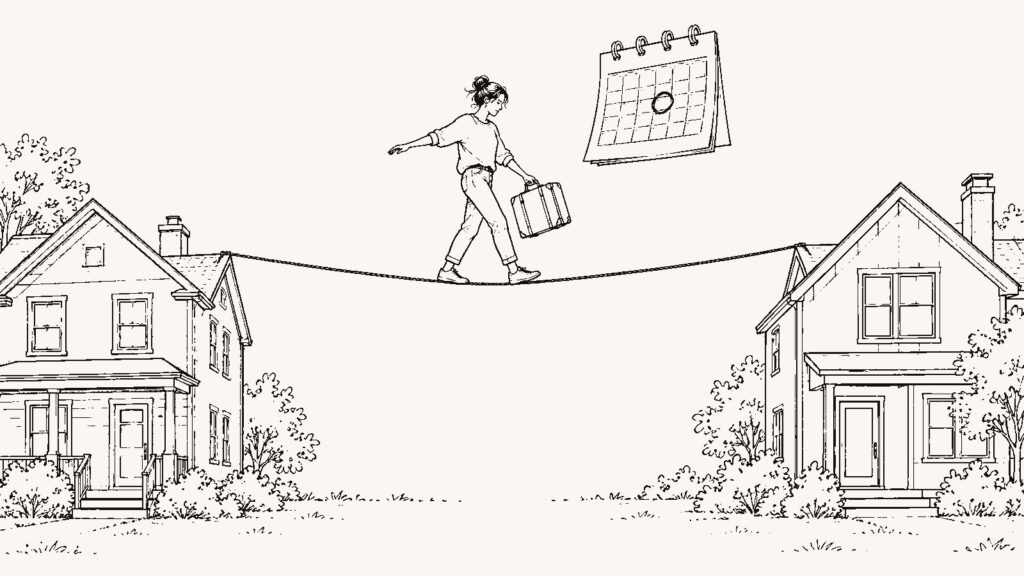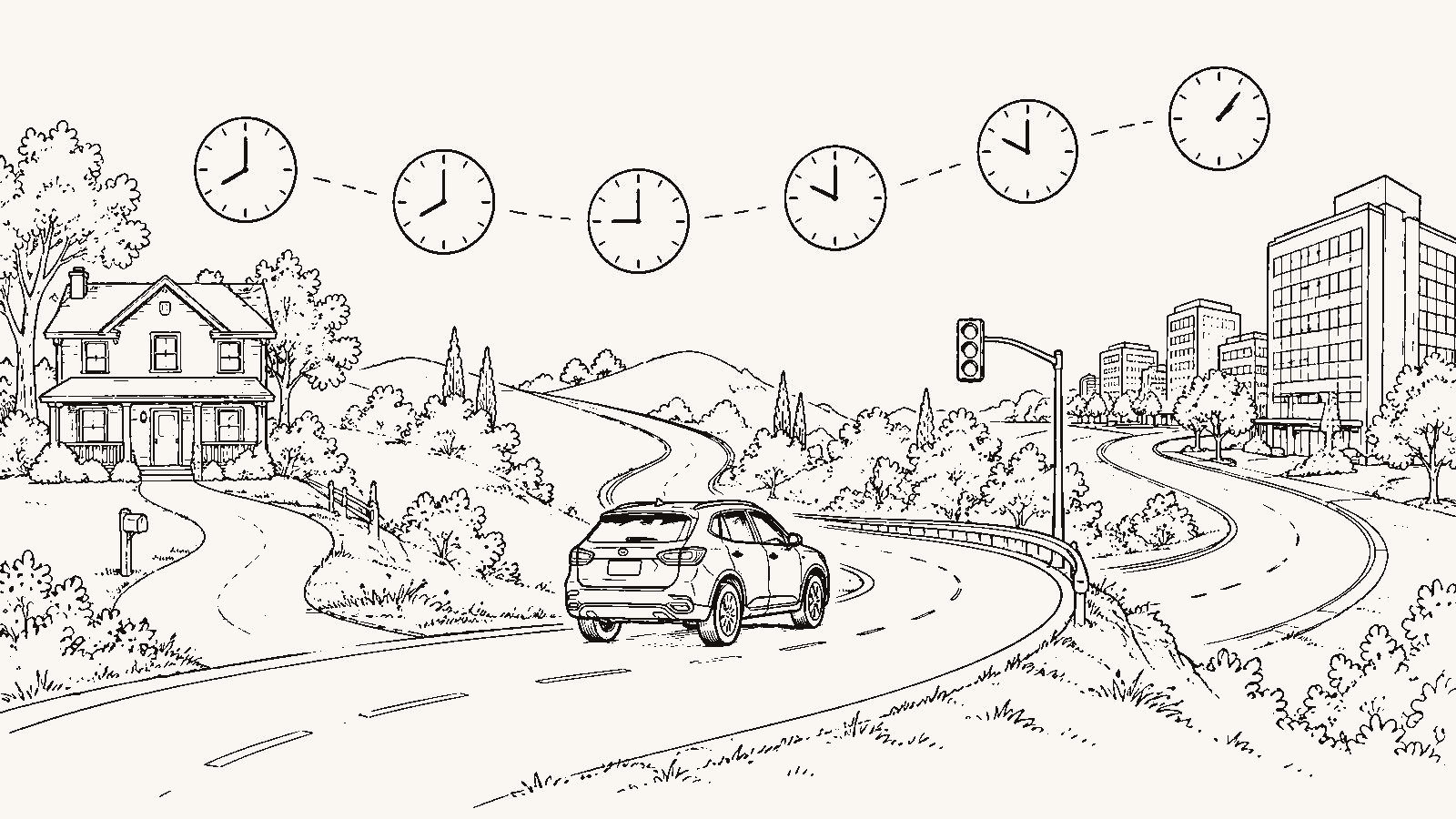
You are deciding whether the hours a longer commute takes out of a year are worth the house, the yard, the district, or the lower payment you get in exchange for them. Whether a 40-minute drive is good or bad on its own is a question this article never asks.
Only one side of that trade shows up on paper. The extra bedroom is in the listing, and the lower payment is on the lender’s worksheet. The hours are nowhere. Nobody sends you a statement for them. This article puts the hours on paper so you can look at both sides at once.
What are you actually deciding?
Say you are comparing two houses. One is 22 minutes from work at the hour you leave. The other is 42 minutes, and it has the third bedroom and a payment that is lower by an amount you can read off the worksheet.
The question is what the 20 minutes cost. The map says 20 minutes. Your week says something else, because you make that drive twice a day, five days a week, for as long as you live in the house and work where you work.
Turn the extra minutes into hours per year
Here is the formula. The rest of this article is about what to plug into it.
Extra round-trip minutes per day x commute days per week x working weeks per year, divided by 60, equals extra hours per year.
For the two houses above: 20 extra minutes each way is 40 extra minutes per day. At 5 days a week and 48 working weeks, that is 40 x 5 x 48 / 60, which comes to 160 hours a year.
The same math at other distances, at 5 days and 48 weeks:
- 10 extra minutes each way is about 80 hours a year.
- 20 extra minutes each way is about 160 hours a year.
- 30 extra minutes each way is about 240 hours a year.
Put 160 hours in terms of the week and it is four 40-hour work weeks. Put it in terms of the day and it is 20 full waking days, if you count a waking day as 8 hours you could spend on something else. Pick the picture that lands, and write it down next to the third bedroom.
The formula is a placeholder until you fill it with your own inputs. Each input moves the answer, and two of them can move it by half.
Which minutes go in the formula?
The map gives you a drive time. That number is an Estimate, produced by a model, usually for the hour you happened to look. If you looked on a Sunday afternoon, the model gave you Sunday afternoon.
The number that belongs in the formula is the drive at the hour you would leave, in the direction you would go, on a weekday. A mapping app’s “depart at” setting gets you closer, and it is still an Estimate. Label it that way and plan with it. Then measure.
Measuring means driving the route from the address to work at the hour you would leave, and back at the hour you would leave work. Do it more than once if you can, because one run tells you about one day. Measuring costs you a trip, or several, and even a good sample misses the rainy Tuesday in October when the drive that averages 42 minutes takes 61. Assume the number has bad days the average hides.
Time each direction separately and add them, because the morning and the evening are often different drives. School traffic, the sun in your eyes, a merge that only backs up at 5:15, and construction that only closes a lane after 7 pm change one direction and leave the other alone.
Check what the route is doing right now. Most states run a 511 traveler information site or a state DOT traffic site (search for your state’s name and “511”). That is an Official record of current incidents, construction, and closures on the corridor, and a corridor with a two-year construction project changes your minutes for two years. The U.S. Census Bureau also publishes average travel time to work by area from the American Community Survey at https://www.census.gov/topics/employment/commuting.html. That is an Official record, and it is an area average. It tells you nothing about your address, your hour, your route, or your direction, so use it to understand the metro and never as your input.
The full method for testing a route is in How to Test a Commute Before You Trust the Map. This article assumes you have a number and shows you what to do with it.
Count the days you drive
Commute days per week is the input that can cut the answer in half.
At 5 days, 20 extra minutes each way is 160 hours a year. At 3 days it is 96. At 2 days it is 64. If you work from home most of the week, a farther house costs you a fraction of what it costs the person who drives in every day, and that is why the farther house can make sense for one household and not for the one next door.
Counting on a hybrid schedule has a catch: the schedule belongs to your employer, and an employer can change it with a memo. Your remote or hybrid policy is Provider-reported information: what the company says today, in writing if you are lucky. Run the formula twice. Run it at the days you have now, and run it at five. If the five-day number is one you could not live with, you are betting the house on a policy you do not control. Decide whether that is a bet you want to make on purpose.
Working weeks per year is the smaller input. 48 is a placeholder. Use your own vacation, your holidays, the weeks you travel for work, and any leave you know is coming. It rarely changes the answer by much, and it keeps the number yours.
Run it for everyone who commutes
If two adults in the house drive to work, you run two formulas, and a farther house can add to one and subtract from the other.
Say the farther house is 20 minutes farther for you and 10 minutes closer for your spouse. At 5 days and 48 weeks, you gain 160 hours of driving and your spouse loses 80, so the household is 80 hours worse off. But the household does not drive. You do, and so does your spouse, and the two of you are having different years. The math cannot settle that between you. It can only put both numbers on the table before you talk.
Run the formula for each person separately, at each person’s hours and days, and write both results down. This can surface a disagreement a single household average would have hidden, which is uncomfortable, and you are better off finding it before the closing than after.
Add the trips that are not the commute
The commute is the biggest repeated trip, and it is one of several. Write down the other places you go from the house more than twice a week: the grocery store, the school or daycare, the gym, the parent who needs help, the church or the field or the rink. This is the five-places test, and the longer version is in The Five-Places Test: Can This Neighborhood Actually Support Your Week?.
For each trip, the formula is the same shape: extra round-trip minutes x trips per week x weeks per year / 60. A daycare 12 minutes farther, twice a day, 5 days a week, 50 weeks a year, is 100 hours. A grocery store 8 minutes farther, twice a week, is about 28 hours. Add these to the commute total.
Add every trip and the number gets big and the exercise gets tedious. Do it for the trips you make more than twice a week and skip the ones you make once a month. The monthly trips do not move the answer. The daily ones can move it as much as the commute does, and they are the ones the listing never mentions.
Put the money on the same page
The hours are the cost the worksheet leaves out. The miles also cost money, and it rides along on the same drive.
Fuel is the line everyone counts. Tolls, if the route has them, come from the tolling authority’s published schedule, which is an Official record, and some authorities charge more at peak hours, which is when you drive. Parking at the destination is a separate line. Wear on the car is easy to ignore until the car needs replacing sooner than it would have. If the farther house means a second car because the transit that worked from the nearer one does not exist out there, that is the biggest line of all.
If you want one number for the per-mile cost of driving, the IRS publishes a standard mileage rate each year at https://www.irs.gov/tax-professionals/standard-mileage-rates. That figure is an Estimate, a generalized allowance for fuel, maintenance, depreciation, and insurance across an average vehicle. Multiply your extra miles per year by it. That is a rough dollar figure for the miles. It is an average. It is not your car, your fuel, your insurance, or your route, so use it to see the size of the cost, then get your own numbers before you decide.
We do not estimate your figures. Run the formula with your own distance, your own car, your own tolls, and your own days, and you land on a number we could not have given you.
Put the hours next to what the house gives you
The farther house is farther for a reason, and the reason belongs on the page too.
Write down what it gives you. The third bedroom. The yard the kids can use. The payment that is lower by the amount on the worksheet. The district you chose. A street where you cannot hear the highway. For many households these are exactly why the move is happening. More house farther out is a real tradeoff, and for some families it is the right one.
Look at both sides at once. On the left: 160 hours a year, or whatever your number is, plus the miles in dollars, plus the daycare and the grocery trips. On the right: what you get for them. The left side arrives every week, in the two worst parts of the day, for as long as you live there and work where you work. If you use the drive for calls or a podcast, the hour is not wasted, but it is still an hour in the car and not in the yard you bought. The right side is there every day too, and it is the reason you are looking.
Before you decide, notice two things the left side does that the right side does not. The extra bedroom is the same size in year five as in year one, while the hours are 160 more every year. And jobs change while houses stay. A commute you accept for the job you have is a bet that the next job is in the same direction, which is reasonable if your kind of work is concentrated in one part of the metro. If it is scattered, the farther house is a bet on a direction you cannot see yet.
None of that decides it for you. Some households look at 160 hours and the flat backyard and take the backyard. They are right for their life. Some look at the same page and see that the yard was never what they were moving for. The fuller version of that comparison is in Buying More House Farther Out: When Is the Tradeoff Worth It?. This article puts the hours on that page, next to the square feet.
What should I ask a local
- How long does the drive to that part of town take at 7:40 on a weekday, really, and how long coming back at 5:30?
- What happens to that road when it rains, when school is in session, when there is a game, or when a lane closes?
- Is there construction planned on that corridor, and for how long?
- Which way do people who live here go to get downtown, and why that way?
A local’s answer is a Local observation. It tells you what the road does on the days the map does not show you. It does not replace your own timed drive, because the local leaves at a different hour and has a different tolerance for sitting in traffic than you do.
What should I ask my agent
- Which route did you time from this address, at what hour, and how many times?
- Have you had buyers who took a longer commute for more house and then moved closer in? What did they tell you?
An agent who has timed the route can tell you the minutes. An agent who has watched buyers reverse the decision can tell you what the minutes turned into. Ask for both.
What must I verify personally
Before you make an offer on the farther house:
- Drive the route from the address to work at the hour you would leave, and back at the hour you would leave work, on a weekday. Write down the minutes for each direction. Do it twice if you can.
- Run the formula with those minutes, the days you commute, and the weeks you work. Run it a second time at five days a week and look at both answers.
- Run it separately for every adult in the house who commutes, at that person’s hours and days.
- Run it for the two or three other trips you make more than twice a week from that address: school, daycare, grocery, the parent, the gym.
- Check your state’s 511 or DOT traffic site for construction on the corridor and how long it is scheduled to last. Check the tolling authority’s schedule for what the route charges at your hour.
- Add the hours into one number. Write it on the left side of a page. Write what the house gives you on the right side. Look at the page before you look at the house again.