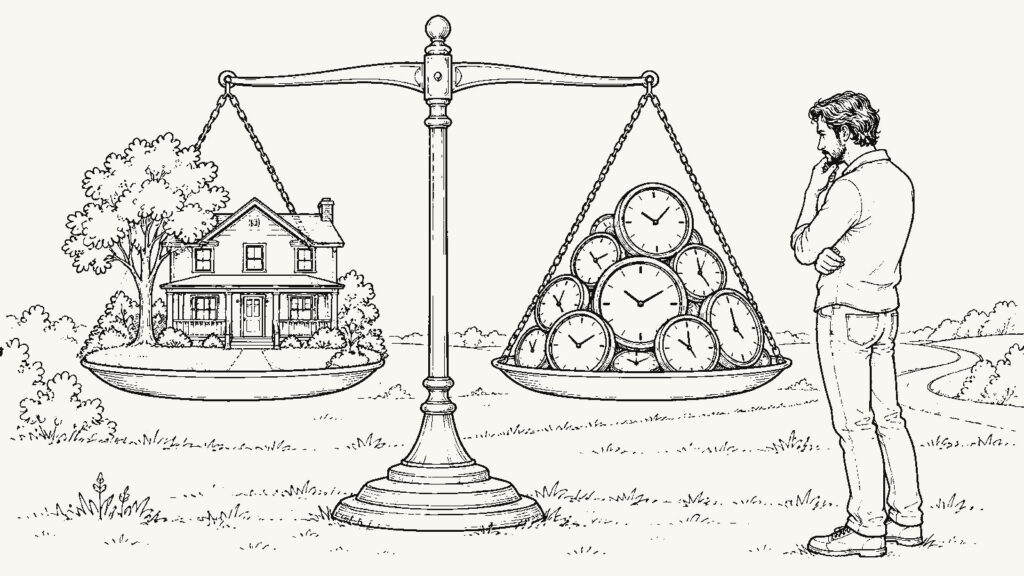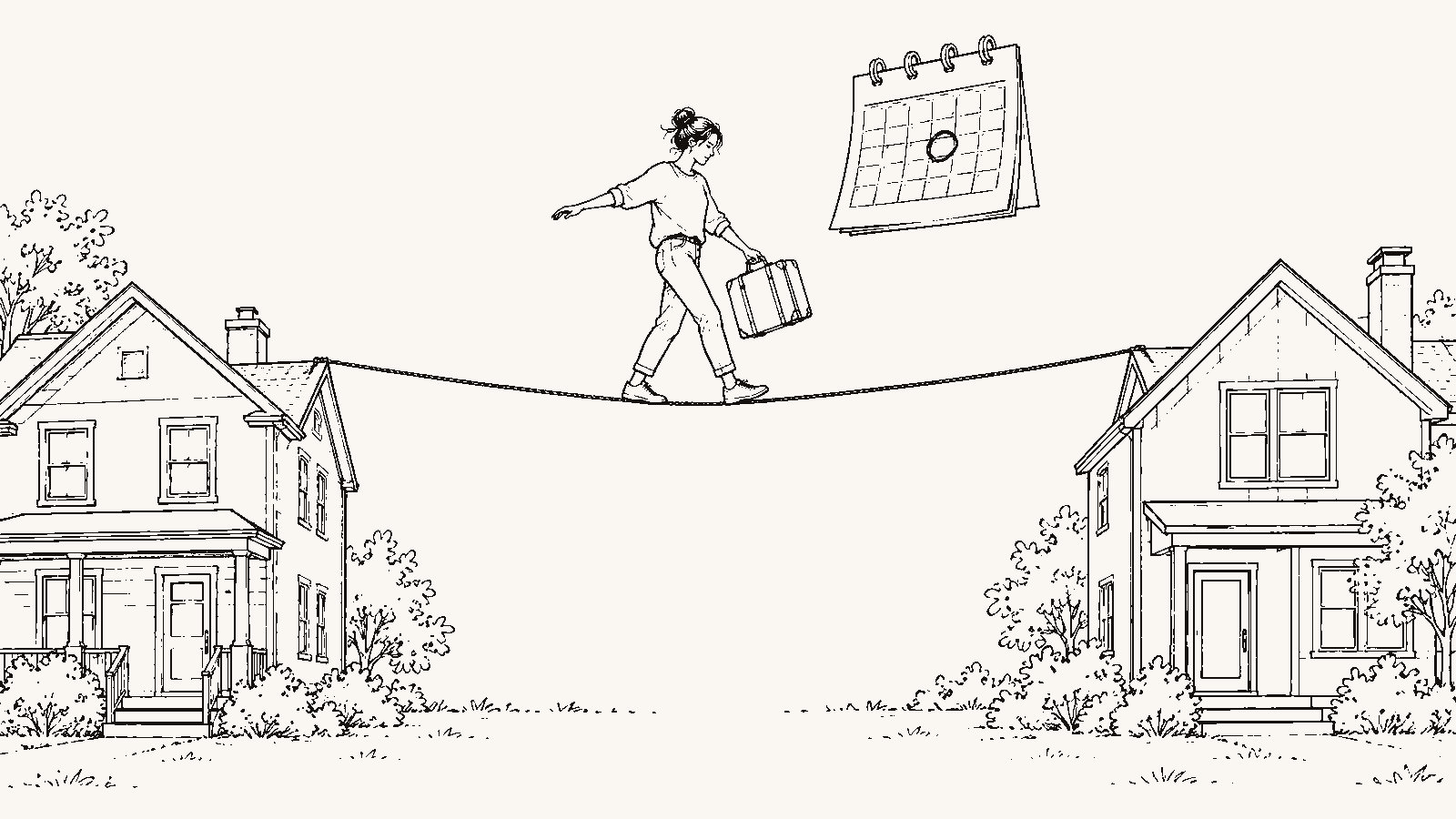
You are not deciding whether to sell first or buy first. You are deciding which failure you can live through: a stretch of nights with no house, or a stretch of months with two.
Every timing plan for a relocation lands on one of those two failures when something slips. Something usually slips. An appraisal comes in low, a buyer’s lender wants one more document, a wire lands after the county office closes, and the date on the contract moves. The plan that works is the one where the slip you get is the slip you already priced.
Put four dates on one page
Write down four dates. The day your sale closes. The day you hand over the keys to your buyer. The day your purchase closes. The day you get the keys to the new house.
Count the nights between the second date and the fourth. That is the gap. If the fourth date comes before the second, count the months between them instead. That is the overlap.
Now move each closing two weeks later, one at a time, and count again. A sale that slips two weeks with no overlap gives you a two-week gap you did not plan for. A purchase that slips two weeks after you have already handed over keys gives you two weeks in a hotel with a truck sitting in a mover’s warehouse. Four dates and two slips give you six numbers. Those six numbers are the decision.
Where is the money to buy?
If the down payment on the new house is equity in the old one, the sale funds the purchase, and the order is set for you unless you borrow to change it. A bridge loan or a home equity line opened before you list can free the equity early. Each one costs interest and fees and adds a payment during the overlap. Each one also depends on a lender who may value a not-yet-sold house lower than you do. Whether a lender will open an equity line on a house that is already listed is that lender’s rule, so the order of those two steps matters and only your lender can tell you which order it allows. That is provider-reported. Get it in writing before you sign a listing agreement.
If the down payment sits in savings, you can buy first without touching the sale. The cost is carrying two mortgage payments, two insurance policies, two utility bills, and two sets of taxes until the old house closes, and a lender that qualifies you on both payments at once. Ask the lender in writing whether you qualify carrying both and for how many months. That number sets how long you can hold a buy-first plan before the overlap becomes the failure. If the savings and the lender’s answer cover more months than you are willing to carry the old house, the gap and the overlap are both choices for you rather than failures. Pick the cheaper one on purpose.
Sell first, buy first, or tie them together
Each of the four plans buys you something and charges you for it. Put each one against the six numbers you wrote down.
If you sell first, you close on the old house, put the proceeds in the bank, and shop with a known number and an offer that carries no home-sale contingency. The gap you counted becomes real: temporary housing, a storage unit, two loads and two unloads instead of one, a household living out of bags, and a deadline that arrives when the temporary lease ends. The pressure now runs toward buying something before that date rather than buying the right address.
If you buy first, you close on the new house, get the keys, and move once, with time to fix what needs fixing before furniture arrives. The overlap you counted becomes real: two payments and every other doubled cost above, possibly a bridge loan or equity line on top, and a lender that has to say yes to all of it. If the old house sits, the pressure runs the other way. You start pricing to make it go rather than pricing to what it is worth. If your buyer walks after inspection, the overlap restarts with a new listing, and you carry both houses until the next buyer closes.
If you buy with a home-sale contingency, your offer binds only if your old house sells by a stated date. It protects your money. It weakens your offer, because a seller with a second buyer can pass over yours, and your state’s standard contract may let the seller add a kick-out clause: if another offer arrives, you get a set number of days to drop the contingency or release the house. Ask your agent to put your state’s standard form in front of you and point to the kick-out language before you write the offer. The form is an official record from your state real estate commission. What a given seller will accept is local observation, so ask your agent what sellers in your target area have done with contingent offers in the last year.
If you close both the same day or the same week, you get one move, no double payment, and no gap. The cost is that two chains have to hold at once: your buyer’s appraisal, your buyer’s lender, your own appraisal, your own lender, two title searches, and a wire that has to land in time to fund the second closing. A one-day slip on either side pushes the truck, and the truck has its own schedule.
What buys you days at either end
A rent-back, sometimes called post-closing occupancy, lets you stay in the old house for a set period after your buyer owns it. The reverse arrangement lets the seller of your new house stay after you own it. Either one can close a gap of days or a couple of weeks. Both cost you: daily rent set in the contract, an addendum your agent drafts on your state’s form where one exists, a conversation with the insurer about who covers what once ownership changes, and, when you are the one buying, your lender’s rule about how soon you have to occupy the house. Ask the lender before you count on it. That is provider-reported, and lenders differ.
The other lever is the closing paperwork itself. Your lender must give you the Closing Disclosure at least three business days before you close, which the Consumer Financial Protection Bureau explains at https://www.consumerfinance.gov/owning-a-home/closing-disclosure/. That is an official record. It also means a fix late in the process can restart that clock. Any back-to-back plan sits on top of that floor, so plan on a closing date holding or moving later, never earlier.
What distance does to the gap
A move across town can sometimes run through a gap with a rented truck and a friend’s garage. A move across state lines puts a carrier’s schedule between your two closings. The mover picks up on one date and delivers inside a window, and if the new house is not yours yet when the truck arrives, your belongings go into storage-in-transit, a mover service with its own charges and its own paperwork.
The Federal Motor Carrier Safety Administration’s Protect Your Move site at https://www.fmcsa.dot.gov/protect-your-move covers what an interstate mover has to give you in writing, how estimates work, and your rights when things go wrong. That is an official record. The terms of your own mover’s storage, the delivery window, and whether and when storage-in-transit converts to permanent storage under different terms are provider-reported, and you get them in writing before you fix a closing date. A gap that is fine for you in a furnished rental is a different gap for a truckload of furniture in a warehouse two states away. How to check the mover itself is a separate question, covered in How to Vet an Interstate Moving Company Before You Give It Your Belongings.
Run the normal Tuesday in the middle of the gap
Pick a Tuesday halfway through the gap you have written down, and answer these questions from wherever you will be sleeping that night.
Where do you sleep, what does that address cost per night with a minimum stay, and does it take the dog. Where do the kids go to school, and will the district enroll a child from a hotel or a short-term rental address. Where does your desk go. What does the internet look like at that address if you work from home. Where are the boxes, and what does it cost to get one thing out of storage when you need it in week two.
Price the temporary address the same way you would price a house: near the five places you will need to reach, at the hour you will reach them. A furnished rental thirty minutes from the new job during the gap costs you thirty minutes a day. A gap you plan this way is a known cost. A gap you discover on the day the sale closes is the same nights at whatever price is left.
If the gap starts to look like months rather than weeks, you are no longer planning a gap. You are deciding whether to rent first, which is a different decision with its own tradeoffs, covered in Should You Rent Before You Buy When Relocating?.
Which side of the market slips here
What sellers accept and what slips at closing is local. In some markets sellers routinely pass over contingent offers; in others they accept them because that is what most buyers bring. In some markets rent-backs are ordinary and run for weeks; in others agents rarely write them. None of that is on a portal. It comes from an agent’s closed transactions and from people who have closed recently. Treat it as local observation, and ask more than one person.
Ask your agent how many of the last ten closings moved from the contract date and why. Ask whether the slips came from appraisals, lenders, inspections, or a buyer’s own sale. That tells you which side of your plan to protect. An agent who cannot answer has not been watching closely enough to help you here, and you want to learn that before you sign.
What the sale date can change on your taxes
The date you close on the old house can change what you owe. IRS Publication 523, Selling Your Home, at https://www.irs.gov/publications/p523, sets out the ownership and use tests that decide whether you can exclude gain on the sale, measured over the five years ending on the sale date. That is an official record. A closing a few weeks earlier or later can fall on the wrong side of a two-year mark or a year boundary. Ask a tax professional with both dates in hand before you agree to a closing date. Reading the publication yourself costs nothing, and the closing date is one of the few things in this plan you can move on purpose, so move it with the tests in front of you.
Where this fits in the budget
The gap and the overlap are line items. Temporary housing, storage, double payments, a bridge loan, and the second load on the truck all belong in the same budget as the deposits and the scouting trips, laid out in Relocation Budget: Costs That Happen Before, During and After Closing. We do not estimate your numbers. We tell you which ones to write down, and the gap calendar tells you how many nights and months to multiply them by.
What must I verify personally
Before you sign a listing agreement or write an offer:
- Write the four dates on one page: sale closes, keys handed over, purchase closes, keys received. Count the nights of gap or months of overlap. Move each closing two weeks and count again.
- Ask your lender, in writing, whether you qualify carrying both payments, for how many months, and whether it will open an equity line or bridge loan on a house that is listed. Ask what happens to the purchase loan if the sale closes late.
- Read the contingency and kick-out language on your state’s standard form before you write an offer. Ask your agent to show you the form, not describe it.
- Get the mover’s storage-in-transit terms, charges, and delivery window in writing before the closing dates are set.
- Price the temporary address near your five places: nightly rate, minimum stay, pets, parking, internet, and whether the school district enrolls a child from that address. Call the district with the address.
- Call your insurer with both addresses and both dates. Ask what changes on a vacant house and on a house occupied by a former owner after closing.
- Ask a tax professional whether the sale date changes the exclusion under Publication 523.
What should I ask a local
- Which side of a closing usually slips here, and by how long?
- Do sellers here accept home-sale contingencies, or pass over them?
- Are rent-backs common in this market, and for how many days?
- Where do relocating households stay during a gap, and what is the minimum lease?
- Which storage near the new address is climate controlled and month to month?
What should I ask my agent
- How many of your last ten closings moved from the contract date, and what moved them?
- Will you write out the kick-out and rent-back terms for me before I sign anything?
- On each closing day, who holds the keys, and at what hour do I get them?