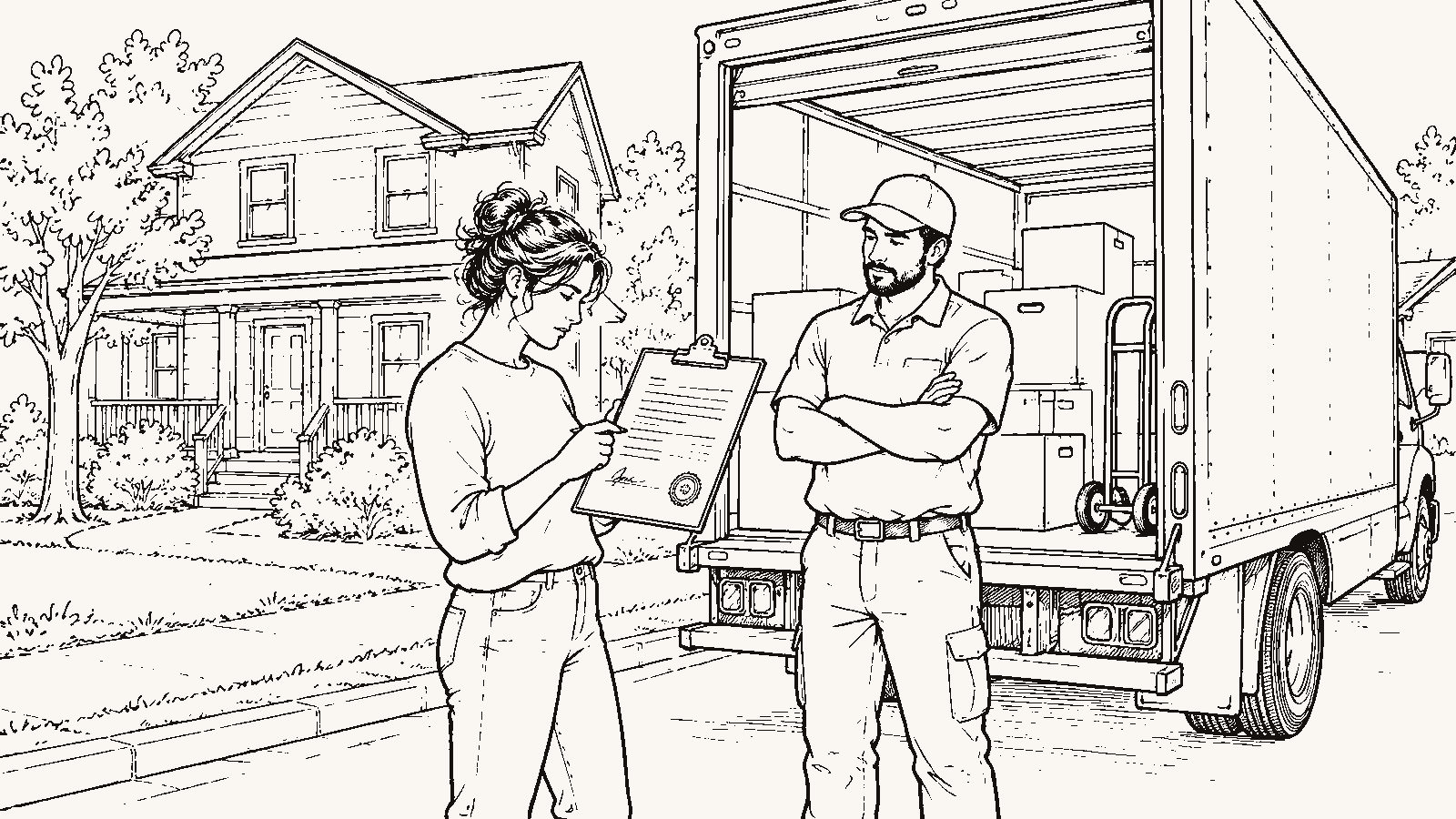
You are deciding who gets custody of everything you own for several days across state lines, and on what written terms. The price on the quote is the smallest part of that decision, because the quote is not what you will be holding when a truck sits at the curb of your new address and the driver names a number you never agreed to.
An interstate mover works under federal rules. The Federal Motor Carrier Safety Administration registers the companies, sets what they must hand you in writing, limits what they can demand at delivery, and keeps the complaint database where the last customer wrote down what went wrong. Every one of those records is public and free to look up. Pull them before you sign anything.
Are you hiring a mover or a broker?
Ask this first, because it changes who is accountable. A carrier owns or controls the trucks and crew that carry your goods. A broker sells the job and hands it to a carrier you have never spoken to. FMCSA requires a broker to tell you it is a broker, to work only with registered carriers, and to give you the same rights booklet a carrier must give you. FMCSA’s Protect Your Move page on movers versus brokers, at https://www.fmcsa.dot.gov/protect-your-move, states the rule. Official record. Whether the person on the phone follows it is yours to check.
The way to check is the registration record. FMCSA’s Search for a Mover tool, at https://www.fmcsa.dot.gov/protect-your-move/search-mover, returns the legal name, the USDOT number, the MC number, the authority type, and whether the company is registered to move household goods. Official record. If the record says broker and the salesperson said mover, you have learned what you need to know about the salesperson. If the record shows no household goods authority at all, the company cannot lawfully take your shipment across a state line, whatever its website says. If your move stays inside one state, these federal rules do not apply; your state’s regulator does, and which agency that is depends on the state. Personal verification.
Rejecting brokers has a cost. In a tight summer window a broker may be the only company that can find you a truck on your date, and some brokers do hand jobs to sound carriers. The tradeoff is that you will not know which carrier until the truck arrives, and the name on that truck is the name you will be filing a claim against. If you use a broker anyway, get the carrier’s legal name and USDOT number in writing before pickup, run the same lookup on that carrier, and treat the broker’s own assurances as provider-reported.
What does the federal record tell you, and what does it leave out?
Three public records sit behind every USDOT number. Each answers a different question.
The registration record answers whether the company exists as a lawful interstate household goods carrier today. Pull it yourself from Search for a Mover; a screenshot from the salesperson is provider-reported. Check that the status is active, that the legal name matches the name on your estimate, and that the authority covers household goods. Official record.
The SAFER Company Snapshot, at https://safer.fmcsa.dot.gov, answers whether the company is currently allowed to operate and what its inspection and out-of-service history looks like. Enter the USDOT number. Read the operating status line and the out-of-service rates. Official record. A company that is out of service cannot lawfully move you, and a company with a high out-of-service rate has trucks and drivers that fail roadside inspections more often than the national average SAFER prints beside it.
The National Consumer Complaint Database, at https://nccdb.fmcsa.dot.gov, holds what previous customers reported, sorted by category. FMCSA’s mover search also shows complaint counts by year. Read the categories before you read the count. A complaint that goods were held hostage until the customer paid more than the estimate is a different complaint from one about a late delivery. Official record of what was filed; the complaint itself is one household’s account, not a finding. Reviews on the mover’s own site are provider-reported; the company controls what appears there, so treat them as the mover’s claim about itself.
None of those records proves a mover is sound. A clean record proves the company has not been caught, or has not been operating long enough to be. A company registered eight months ago with zero complaints has a shorter history than a company registered twenty years ago with six. The records rule companies out. They do not rule a company in. That part is on the estimate and the paperwork.
Which kind of estimate are you signing?
Federal rules require the estimate to be in writing, to state which kind it is, and to rest on a physical survey of your household goods when your home is within 50 miles of the mover’s or its agent’s location, unless you waive the survey in writing. FMCSA’s consumer guidance also describes virtual surveys done by video. Read the current text of the rule at https://www.ecfr.gov/current/title-49/subtitle-B/chapter-III/subchapter-B/part-375 before you rely on either version. Official record.
A binding estimate is a fixed price for the goods and services listed on it. If you add a piano or a third bedroom of boxes that were not on the survey, the mover can revise the estimate before loading or charge for the additions later. If nothing changes, the price does not change. At delivery the mover can require the binding amount before unloading.
A non-binding estimate is the mover’s guess at what the shipment will weigh and cost. The mover bases the final charge on actual weight and the services performed. Under FMCSA rules the mover cannot require more than 110 percent of a non-binding estimate before unloading, and it bills any lawful balance beyond that later. Official record. A non-binding estimate that came in far below the others is a guess that costs the mover nothing to make.
A binding-not-to-exceed estimate caps the price at the estimated figure but lets it fall if the actual weight comes in lower. At delivery the mover cannot require more than the cap, and if the truck weighs less than the survey guessed, you pay less.
The tradeoff is that a binding estimate is often higher than a non-binding one for the same shipment, because the mover is pricing the risk of being wrong. A survey costs you an appointment, and it forces you to decide what is going before you feel ready. Waiving the survey saves an afternoon and gives you an estimate built on a phone description of your garage. Take the survey, and take it seriously: open the attic, the shed, the crawlspace, and the closet you have been avoiding, because anything the surveyor does not see is not on the estimate, and anything not on the estimate is the mover’s to price on moving day.
What is your stuff worth to the mover if it breaks?
Under federal law an interstate mover is liable for loss or damage at one of two valuation levels, and you choose which. Read the definitions in Part 375 and in the FMCSA booklet Your Rights and Responsibilities When You Move, at https://www.fmcsa.dot.gov/protect-your-move/your-rights-and-responsibilities-when-you-move. Official record.
Released Value is the default if you sign for it, and it is 60 cents per pound per article. A television that weighs 40 pounds is worth 24 dollars to the mover under Released Value, regardless of what it cost you. It costs nothing extra. The mover must offer it.
Full Value Protection makes the mover liable for the replacement value of lost or damaged goods, subject to the terms in the mover’s tariff, including any deductible and any limit on items of extraordinary value that you did not list. Full Value Protection costs more, and the mover sets the charge. The mover must provide it unless you waive it in writing and select Released Value instead.
Neither level is an insurance policy; valuation is the mover’s liability under federal law. If you want a policy that pays on your terms, ask an insurer, with the pickup and delivery addresses in hand, whether your homeowner policy covers goods in transit and what a transit policy would cover. Personal verification.
The tradeoff is money for coverage, and the decision depends on what is on the truck. A household of secondhand furniture and a household of instruments and heirlooms should not sign the same line. Whatever you choose, make sure the estimate and the bill of lading say the same thing, because the paper you sign on moving day is the paper the claim runs on.
Which documents should be in your hand before the truck arrives?
FMCSA requires an interstate mover to give you, before moving day, the booklet Your Rights and Responsibilities When You Move and the brochure Ready to Move, a written estimate that states its type, and information about the mover’s arbitration program for disputes over loss, damage, and certain charges. On or before moving day you get an order for service, and at pickup a bill of lading, which is the contract for the move, and an inventory of what went on the truck. The list is on FMCSA’s Protect Your Move site at https://www.fmcsa.dot.gov/protect-your-move. Official record.
Treat each missing document as an answer. A mover that has not given you the rights booklet is a mover that has skipped a federal requirement before it has touched a single box. If it cannot describe its arbitration program in writing, you will be suing it rather than arbitrating with it when something goes wrong, and a blank or partly filled bill of lading is a contract with the terms to be decided later, by the other side.
Asking for all of this slows the process and can annoy a salesperson who would prefer a deposit and a date. The paperwork is in the federal rules, and a mover that skips it is skipping the law.
What warning signs does FMCSA tell you to watch for?
FMCSA publishes a list of moving fraud warning signs at https://www.fmcsa.dot.gov/protect-your-move/moving-fraud. Official record. Read the page yourself. Each sign below comes with the question that tests it.
The company gives an estimate without a survey. Ask when the surveyor is coming. If the answer is that they do not need to see the house, that answer is the sign.
The company demands cash or a large deposit before the move. Ask how much is due and when, and get the answer in writing on the estimate. An amount you cannot see in writing is an amount you do not pay.
The company has no local address, or its website shows no USDOT number and no licensing or insurance information. Look for the number on the website and on the estimate, then look it up. A related sign is the phone answered with a generic word like “movers” instead of a company name; call the number on the registration record, not the number on the ad, and listen.
The company hands you blank or incomplete documents to sign. Do not sign them. The blanks are where the price gets written after you have signed.
A rental truck arrives on moving day, or a truck with a different name on it than the one on your estimate. This is the moment the two-name test below exists for.
Checking every one of these takes an hour or two and can leave you with fewer companies than you started with. That is the point, and the cost: the companies that pass may have fewer open dates, and the date you wanted may already be gone.
What happens at the curb on delivery day?
Delivery is where an unvetted mover collects, so know the rules before the truck arrives at your new address.
The mover can require payment before unloading, but only up to the amount your estimate type allows: the binding amount for a binding estimate, 110 percent of a non-binding estimate, and no more than the cap on a binding-not-to-exceed estimate. Official record, in Part 375. Have the estimate in your hand and the number already worked out. A driver who will not unload until you pay more than that is holding your goods hostage, which is a specific category of complaint FMCSA tracks.
Check the inventory as goods come off the truck. Note every damaged or missing item on the delivery paperwork before the crew leaves, and keep a copy. A claim filed later for damage you did not note at delivery is a claim the mover can argue happened after the crew left. Checking each item as it comes off slows the unload, and a crew with another stop that afternoon would rather you signed and let them go; once you sign clean, the damage becomes yours to prove.
You have nine months from the delivery date to file a written claim for loss or damage. The mover must acknowledge the claim within 30 days and pay, decline, or make a settlement offer within 120 days. Official record, in Part 375. The clock starts at delivery whether or not the boxes are open, so open the ones with the valuable items first.
If the mover will not resolve the claim, the arbitration program you asked about before signing is the next step, and the complaint database is where you record what happened for the next household. Filing a complaint does not get your goods back or your money returned; it adds to a record that FMCSA and future customers can read. That limit is why the checking happens before pickup.
Run the two-name test
Before any deposit, write down two things from the estimate: the legal name of the company and the USDOT number. Then find the same two things in three more places.
First, the FMCSA registration record. The legal name on the record and the name on the estimate must match. A trade name is fine if the record lists it. A name the record does not list is a company you have not looked up.
Second, the company’s own website and, if you can see one, its truck. The USDOT number must appear on both. FMCSA’s vehicle marking rules, at https://www.ecfr.gov/current/title-49/section-390.21, require an interstate carrier to display its USDOT number on its vehicles. Official record.
Third, the bill of lading on moving day. The carrier named on the bill of lading is the carrier you have a contract with, and it must match the first two.
Any place the name or number changes is the place your legal remedy changes too. If the estimate came from one company and the bill of lading names another, run the full lookup on the second company before a single box goes on the truck, and be prepared to send the truck away. Sending a truck away on moving day costs you the day and possibly the deposit. Loading your household onto a truck you have not vetted costs you the right to know who has it.
What should I ask a local
Which movers have you, or people you know, used for a move into this area, and would you use them again? What went wrong? Local observation, and one household’s experience.
Does this street or building have limits a mover needs to know about? Narrow roads, a long carry from the truck to the door, stairs, an elevator that must be reserved, a parking permit, or HOA move-in hours. Each of these can appear as a charge the mover adds on the day if the surveyor did not know about it, so ask before the survey and put the answers on the estimate.
Is there a local agent of a national van line here, and has anyone dealt with that agent directly? The agent’s own record is what you look up, because the agent’s name may be what is on the bill of lading.
What should I ask the mover
Are you the carrier or a broker? What are your USDOT and MC numbers? Will the truck at my house carry your name? Is this estimate binding, non-binding, or binding-not-to-exceed, and where on the page does it say so? Was it based on a physical or virtual survey of my house, and if not, what did you assume about the garage, the attic, and the storage unit?
Which valuation level is on this estimate, and what will the bill of lading say I selected? What is your arbitration program, and where is it described in writing? Under this estimate, what is the most you can require me to pay before you unload at delivery?
Each answer is checkable against the record or the paperwork. “We have been doing this for thirty years” is not.
What must I verify personally
At the pickup address, before you pay a deposit: look up the USDOT and MC numbers on FMCSA’s Search for a Mover and confirm active household goods authority and a matching legal name. Pull the SAFER snapshot and read the operating status. Search the complaint database for the name and the number and read the categories. Schedule the survey and walk the surveyor through every space that holds something you are taking. Get the rights booklet, the written estimate with its type stated, the valuation selection, and the arbitration information, all before moving day.
At the pickup address, on moving day: read the bill of lading before you sign it. Match the carrier name and USDOT number to the estimate and to the truck. Read the inventory and write your own exceptions on it. Keep copies of everything that leaves with the driver.
At the delivery address: have the estimate and the bill of lading in your hand and the maximum payable amount already calculated. Check every item against the inventory as it comes off the truck. Note damage and shortages on the paperwork before the crew leaves. Open the boxes that matter first, and file any written claim within nine months.
The records are free and take an hour. The truck holds everything you own. Spend the hour before you hand over the key to the house you are leaving, and read The Relocation File: Documents to Gather Before You Move at https://beforethekey.com/blog/the-relocation-file-documents-to-gather-before-you-move/ for where the mover’s paperwork belongs, What to Do During the Last 30 Days Before an Interstate Move at https://beforethekey.com/blog/what-to-do-during-the-last-30-days-before-an-interstate-move/ for the calendar around it, and Relocation Budget: Costs That Happen Before, During and After Closing at https://beforethekey.com/blog/relocation-budget-costs-that-happen-before-during-and-after-closing/ for where the mover fits among the other costs of the move.