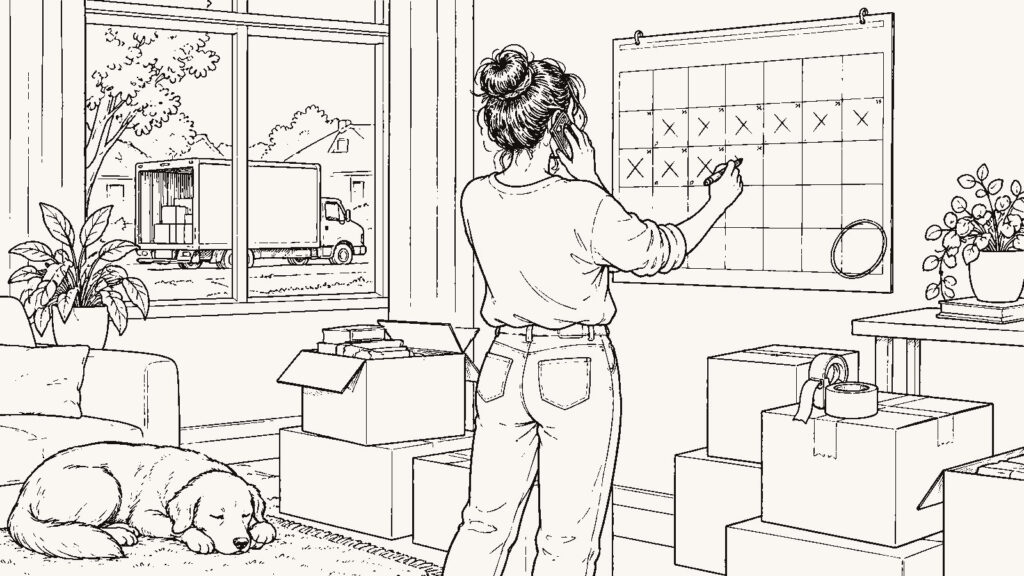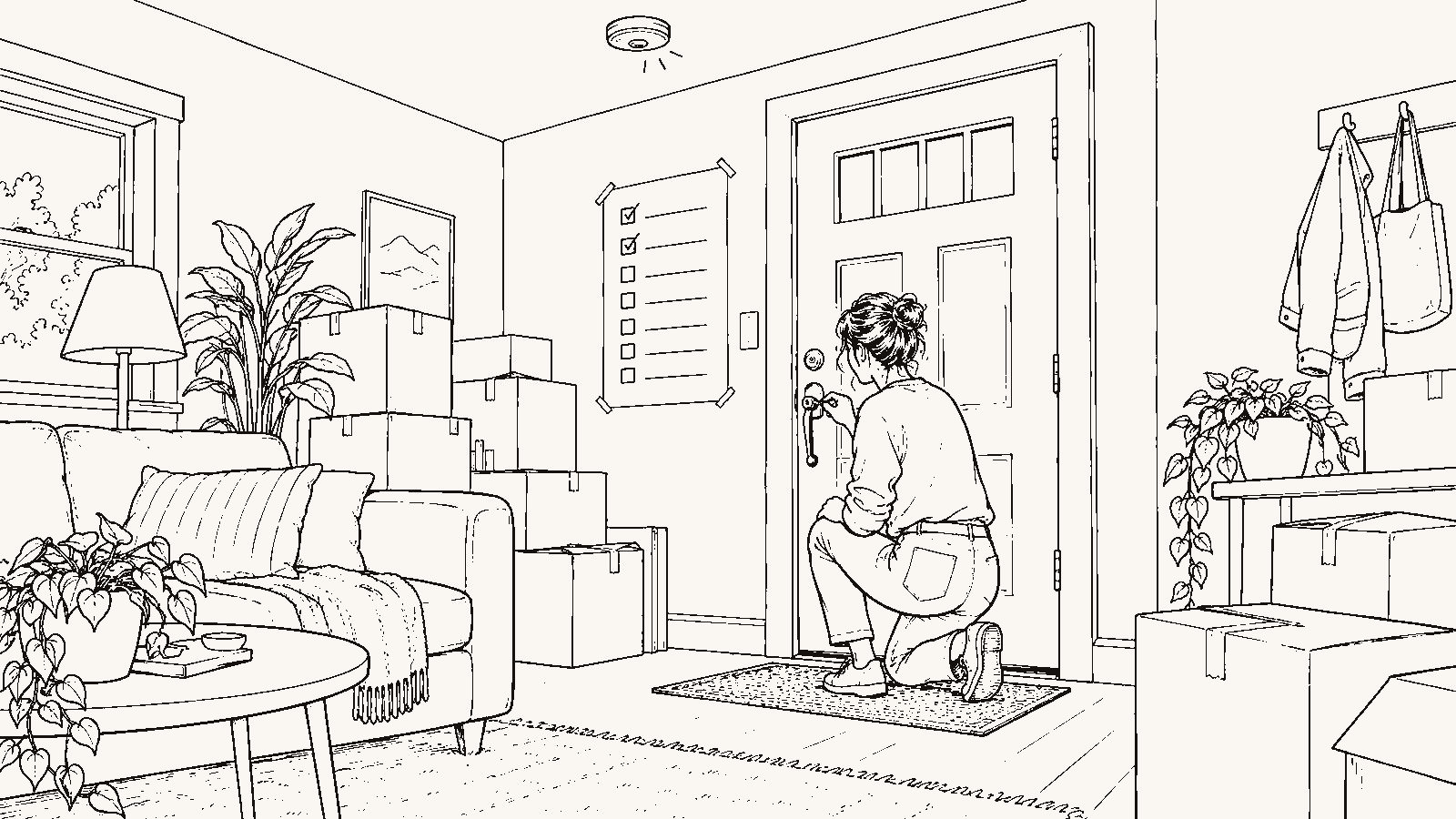
You are deciding what you have to prove about this house and this address in the first seven days, while the clocks the mover and the state started are still running and your own habits have not set. Everything else in the boxes can wait, and these cannot.
Every trip before this one was a scouting trip. You drove the commute on a Sunday and stood in the backyard once. Now it is Tuesday, you live here, and this is the first normal week you have ever spent at this address. It is also the last week in which several of the mistakes you could find are still cheap to fix.
We do not tell you how to unpack. The moving sites do that. This is a list of what to verify, in the order the clocks run.
Day one: find the things you will need at two in the morning
Before the second load is through the door, find the main water shutoff and turn it. Then turn it back. A valve that has not moved since the last owner bought the house may not move for you, and you want to learn that on a dry afternoon rather than with water on the kitchen floor. Find the gas shutoff and look at it without turning it; you only close gas in an emergency, and turning it back on can require the utility. Open the breaker panel, plug a lamp into an outlet in each room, flip breakers until the lamp goes out, and correct the labels. This costs you an hour in a crawlspace and a utility closet while the kitchen is still in boxes. Skip it and you do the same search in the dark, with a problem in progress.
Press the test button on every smoke alarm and carbon monoxide alarm in the house. The U.S. Fire Administration says to test smoke alarms monthly and replace the units every ten years (Official record). If you cannot find a manufacture date on the back, treat the alarm as unknown and replace it, which may mean a bill for alarms you did not budget for. Check the water heater while you are up: the U.S. Department of Energy recommends a setting of 120 degrees Fahrenheit and explains the tradeoff between scald risk at higher settings and other concerns at lower ones (Official record). Walk one exit route from every sleeping room with the door closed behind you, so that you have done it once with the lights on.
Delivery day: check the inventory before you sign
When an interstate mover delivers, the crew hands you the inventory and asks you to sign. Sign it last. Check every numbered item against the list as it comes off the truck, and write any damage or missing number on the paperwork before your name goes on it. Photograph damaged boxes with the inventory number visible. Checking against a list slows delivery, the crew wants to leave, and you will feel the pressure to sign and get on with it. Slow down anyway.
The clock that starts on delivery day is federal. FMCSA’s “Your Rights and Responsibilities When You Move” says you have nine months from delivery to file a written claim for loss or damage on an interstate move, and the mover must acknowledge the claim within 30 days and pay, deny, or make a settlement offer within 120 days (Official record). Nine months sounds long. A signature on a clean inventory is the mover’s evidence that the dent happened later, so the claim is won or lost in the driveway.
If your move stayed inside one state, these federal timelines do not apply; your state regulates the mover, and FMCSA’s Protect Your Move site points you to the state contacts (Official record). If you drove a rental truck, the claim is against whoever loaded it, which is you. If you chose the mover the way “How to Vet an Interstate Moving Company Before You Give It Your Belongings” describes, the paperwork should be in order. Read it anyway. Vetting does not sign the inventory for you.
The clocks the government starts
Some of these clocks started the day you changed your address, before you had found the breaker panel.
File a change of address with the U.S. Postal Service at usps.com so first-class mail forwards while you update everything that still carries the old street (Official record). Forwarding is temporary; the site tells you how long. It costs a small identity-verification fee online, and then a stream of yellow-labeled envelopes reminding you what you have not updated yet.
Every state sets its own deadline for a new resident to get a driver license and register a car, and several count in weeks (Official record, from the state). Find your state’s motor vehicle agency through USA.gov, read the deadline, and book the appointment in week one, because the appointment slot is often the slowest part. That is a morning at an office plus fees, and some states want proof of residency you have not received yet, such as a utility bill; ask what documents count before you go.
The IRS records a change of address on Form 8822 (Official record). If you receive Social Security benefits, update your address through your my Social Security account (Official record). Neither is urgent on day one. Both cost you a missed notice with a deadline in it if you forget for a year.
Register to vote, or update your registration, at vote.gov, which routes you to your state’s process (Official record). States set their own cutoffs before an election, so the week you move is the week to do it. That takes a few minutes, or in some states a form to print and mail.
Services: prove they are live at the address
“Utilities, Internet and Services: What to Arrange Before Moving Day” covers arranging. Week one is for proving.
Call each utility and ask which date it has for the account switching from the seller to you. That date should match your closing date, and if it does not, one of you is paying for the other’s water. The calls involve holding. Look up the trash and recycling schedule for the address on the city or county site (Official record), put the bins out on that day, and see whether they come back empty. If they come back full, you have learned the site’s schedule is stale, at the price of a week’s trash.
Test the internet in the room where you work, at the hour you work, on a wired connection. Write the number down. If the house has no wired jack, test on Wi-Fi standing next to the router and treat that number as the ceiling, not what the back bedroom gets. The FCC National Broadband Map shows what providers report at the address (Provider-reported); the number on your screen is what got installed (Personal verification). If those differ, the fix is a second technician visit, and the time to schedule it is now, while the installer’s work order is fresh.
A neighbor can tell you which day the truck comes, where it wants the bins, and whether the mail carrier delivers to the box or the door (Local observation). That saves you a week of watching the street. It is also one household’s memory, which is why it carries the label it does; check it against the city site.
The week, run for real
You planned this move around a Tuesday you had only imagined. Now you run it.
Drive to work at the hour you leave, and drive home at the hour you leave work, on a weekday, both directions. Do it twice. “How to Test a Commute Before You Trust the Map” gives the method; the first week gives you the answer. Run the five places next: the grocery store, the school, the gym, the pharmacy, the parent’s house, whichever five you wrote down when you chose this area. Make each trip on the day and at the hour you would normally make it. Those trips eat several hours of week one at the moment the house needs you most.
Nothing you learn this week changes the purchase. If the 25-minute commute is 40, you cannot unbuy the house. What the first week buys is the chance to change the route, the hour you leave, the grocery store, or which side of the house the kids sleep on, before any of it is a habit. You will keep going to the first store that worked even if it is the wrong one, and by March the wrong store is where you shop.
Stand in the backyard at nine on Friday night and again at eight on Saturday morning. Note what you hear and where cars park. A neighbor can tell you whether that Friday was typical (Local observation). Decide which bedroom faces which side while the beds are still in pieces. It costs you two evenings outside when you would rather be inside, and what you hear settles the floor plan, nothing larger.
The paper you signed
Change or rekey the locks. Anyone who held a key before closing, including every agent who opened the lockbox, may still hold one, and a seller who hands you every key on the ring still cannot tell you how many were cut. Ask the locksmith how many new keys he made; that is now the whole count. A locksmith visit is money in a week already full of spending. A stranger’s key that works is the alternative.
Find the inspection report and put every item marked for follow-up on a calendar. Read the seller’s disclosure again now that you live in the house; a line that meant nothing during the contingency period means something once you know which window sticks. If a home warranty came with the sale, read its enrollment window and claim procedure now, because a water heater that fails in month two is a bad time to learn that the plan wanted registration in week one. Only the warranty document can tell you its deadline; we cannot. This costs you an evening with closing paperwork instead of the kitchen, and a calendar that now has repairs on it.
The tradeoff, plainly
A first week spent on this list is a week of paper plates and a family living out of boxes longer than it wanted to. That is a real cost, and you should hear it from us before you feel it. The other side: the mover’s claim clock runs whether you noticed the dent or not, and the state’s license deadline runs whether you read it or not. The habits you form in week one form around whatever you tested first. Unpacking fast buys comfort now. Verifying first buys the ability to act while acting is still cheap. Neither is free.
“How to Rebuild Your Weekly Routine After a Relocation” picks up where this list ends, with the grocery store, the doctor, the gym, and the friends you have not made yet.
What must I verify personally
Day one, at the address:
- Turn the main water shutoff off and back on.
- Locate the gas shutoff without turning it.
- Open the breaker panel and correct the labels with a lamp.
- Check the water heater setting.
- Press the test button on every smoke and CO alarm; replace any without a readable date.
- Walk one exit from each bedroom.
- Book the locksmith.
Delivery day:
- Check every inventory number off the mover’s list before you sign.
- Write damage on the paperwork and photograph it with the number visible.
Days two through seven:
- Drive to work and back at the real hours, twice.
- Make each of your five trips on its normal day and at its normal hour.
- Run a wired speed test in the work room at the hour you work.
- Put the bins out on the day the city or county site says.
- Look up the state’s license and registration deadline and book the appointment.
- File the USPS change of address, IRS Form 8822, Social Security if it applies, and voter registration.
- Stand in the backyard at nine on Friday and eight on Saturday.
- Calendar the inspection follow-ups and read the warranty’s claim rules.
What should I ask a local
- Which day trash and recycling actually go out, and where the truck wants the bins.
- Whether the mail carrier delivers to the box or the door, and roughly when.
- What the street does on a Friday night and a Saturday morning.
- Where water stands after a hard rain.
- Which route out of the neighborhood people avoid in the morning, and why.
- Who they call for a plumber, and whether they have needed one.
Sources
- FMCSA, Your Rights and Responsibilities When You Move: https://www.fmcsa.dot.gov/protect-your-move/your-rights-and-responsibilities-when-you-move (Official record)
- FMCSA, Protect Your Move: https://www.fmcsa.dot.gov/protect-your-move (Official record)
- U.S. Postal Service, Change of Address: https://www.usps.com/manage/forward.htm (Official record)
- IRS, About Form 8822, Change of Address: https://www.irs.gov/forms-pubs/about-form-8822 (Official record)
- Social Security Administration, my Social Security: https://www.ssa.gov/myaccount/ (Official record)
- Vote.gov: https://vote.gov/ (Official record)
- USA.gov, State motor vehicle services: https://www.usa.gov/state-motor-vehicle-services (Official record; the deadline itself comes from your state’s agency)
- U.S. Fire Administration, Smoke alarms: https://www.usfa.fema.gov/prevention/home-fires/prevent-fires/smoke-alarms/ (Official record)
- U.S. Department of Energy, Lower water heating temperature: https://www.energy.gov/energysaver/savings-project-lower-water-heating-temperature (Official record)
- FCC National Broadband Map: https://broadbandmap.fcc.gov/ (Provider-reported)
Related: How to Vet an Interstate Moving Company Before You Give It Your Belongings, Utilities, Internet and Services: What to Arrange Before Moving Day, How to Test a Commute Before You Trust the Map, How to Rebuild Your Weekly Routine After a Relocation