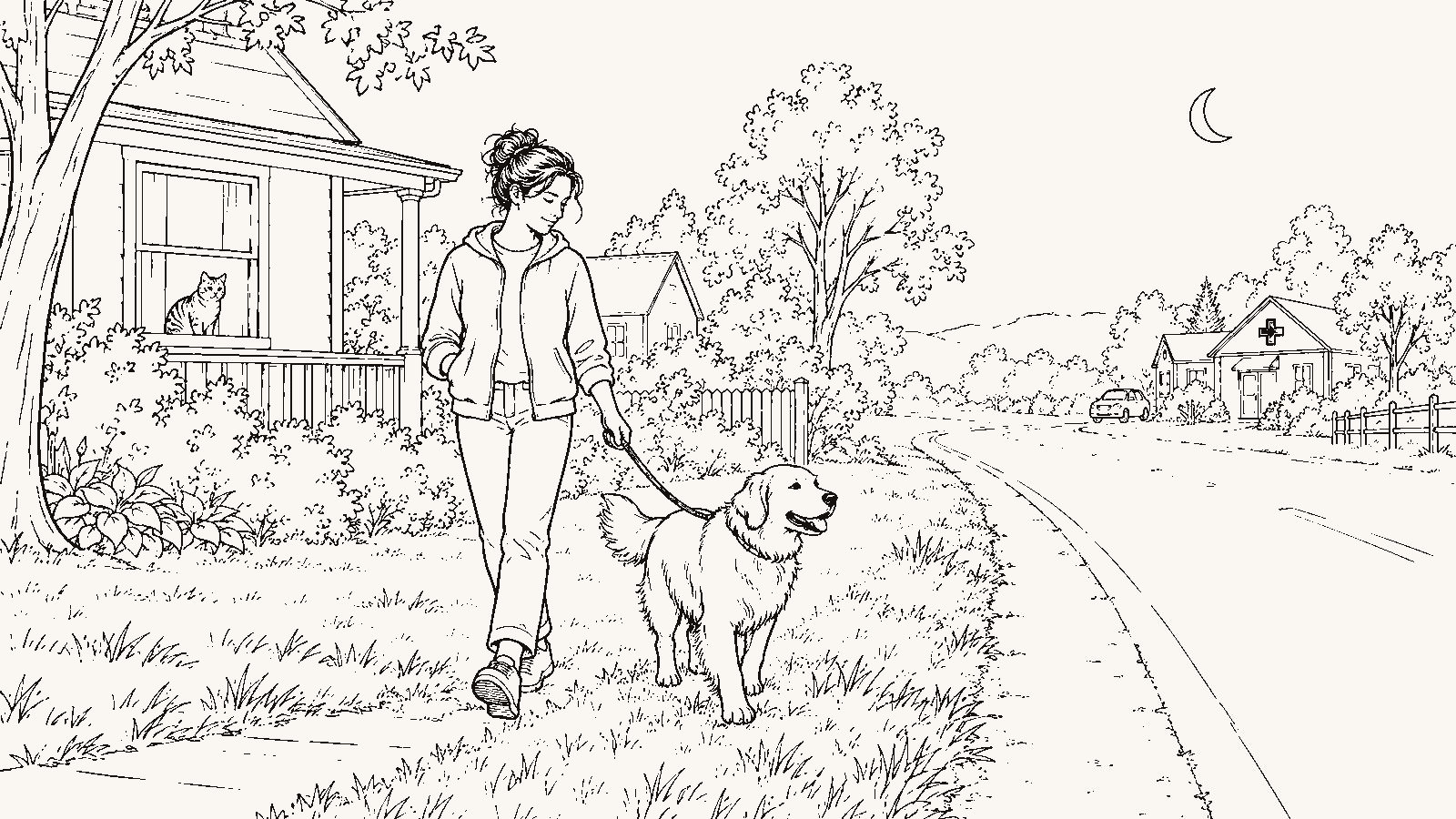
You are deciding whether this address works for the animal’s ordinary week as well as yours, and what each of you gives up so the other gets it. The crate and the drive are a different problem, and every moving site already covers them.
The questions that do the damage are the ones nobody asks until the truck is unloaded. Whether a dog of that breed is allowed in that county. Whether the 6:30 am walk has a sidewalk. How long the drive to an emergency hospital takes at 2 am. Whether the shelter takes cats when the county evacuates. Each of those is checkable before you make an offer, and each one can change which address you look at.
Is the animal allowed at this address at all
Start with the rule that overrides the listing. A city or county animal ordinance can limit how many dogs and cats live at one address and ban specific breeds. It also decides whether you can keep chickens or a horse on the lot. The ordinance is an official record, and you read it yourself in the municipal code, which cities and counties publish on their own websites or through a service like Municode at https://library.municode.com. Search the code for “animal” and read the whole chapter. You also have to read the right code. An address with a city mailing address often sits in the unincorporated county, where the county ordinance applies and the city’s does not. The county property record shows which jurisdiction the parcel is in. Check that before you read anything else, or you will spend an hour on rules that do not apply to you.
Recorded covenants for a subdivision can limit how many animals you keep and which breeds, and ban fences in the front yard, and they bind you whether or not the seller mentions them. The county register of deeds holds the recorded covenants, which makes them an official record; the HOA’s current rules and fine schedule come from the association, which is provider-reported. Ask for both in writing before the offer, and ask the agent to put a covenant review inside the contingency period. That costs you a few days and possibly a document fee. A covenant you find after closing costs you a dog.
If you rent, the lease is the rule. The landlord’s pet terms are provider-reported until you have them in writing, and “pets okay” in a listing tells you nothing about weight limits, breed lists, pet rent, or deposits. Get the terms as a lease clause, not a text message. That takes a negotiation before you sign, and a landlord who will not put the terms in writing can change them later.
An assistance animal is a different case. Under the Fair Housing Act, a housing provider generally has to consider a reasonable accommodation for an assistance animal even where pets are otherwise restricted, and HUD explains what a provider can and cannot ask in its guidance at https://www.hud.gov/program_offices/fair_housing_equal_opp/assistance_animals. That is an official record, and it is also a process with paperwork and a request the provider evaluates, so it does not make a pet policy disappear on move-in day. Read the guidance, then ask the provider in writing how it handles requests, before you sign anything.
What does the state require when the animal crosses the line
Every state sets its own rules for animals entering it. Most require a current rabies vaccination for dogs, and many require a certificate of veterinary inspection signed within a set number of days before travel. Horses and livestock carry more rules, and a few species are banned outright in some states. USDA APHIS keeps a page for interstate pet travel at https://www.aphis.usda.gov/pet-travel that points to each state’s requirements, and the state veterinarian’s office in the destination state holds the record. Both are official records. If the office does not pick up, the state page the APHIS site links to says the same thing in writing. The cost is scheduling. A certificate has a clock on it, so you book the vet appointment against the moving date, and if the closing slides, the certificate can expire before you cross the state line.
Local licensing starts the same week. Many cities and counties require a license within a set number of days of arrival and require proof of rabies vaccination to get it. The ordinance you read in the first section names the deadline. Miss it and the first contact you have with animal control is a fine.
Does the animal’s Tuesday work from this front door
Run the animal’s normal Tuesday the way you run your own. The dog goes out at 6:30 in the morning and again at 9 at night, every day, in whatever weather that address gets. From the front door, where does that walk go? Stand at the door and name the route. Is there a sidewalk, or is the walk on the shoulder of a road with no streetlight? Does the leash ordinance require a leash everywhere, and where is the nearest legal off-leash area? How hot is the pavement at 5 pm in July? How dark is 5:30 in January? If the animal is a cat that never goes out, this section collapses to the rules and the vet, and you can skip the walk.
A yard changes the answer, and less than the listing photo suggests. A fenced yard means the 9 pm walk can be a 9 pm door. It also means fence rules. Many covenants set fence height and material and ban fences forward of the house, and a corner lot may have two front yards. The county code and the covenants you already pulled answer this. A big lot with no fence is a big lot you cannot use off leash, and fencing it is a cost and a permit question you should price before you fall for the acre.
The other half of the animal’s Tuesday is the hours it spends alone. If your commute grows from 20 minutes to 45, the dog is alone 50 more minutes a day, and on a bad-traffic Tuesday in October it is more than that. The math is the one you run on yourself in Commute Math: What Extra Drive Time Actually Costs You in a Year. The dog does not get a vote. Dog daycare and a midday walker fill the gap, at a monthly cost and only if they exist within a drive you would make twice a day from the address. Look them up before you decide the longer commute is fine.
Where is the vet, and where is the vet at 2 am
Add the animal’s places to your five. A general practice that accepts new patients, within a drive you would make at 5:30 on a weekday. A 24-hour emergency hospital, and the real drive time at night. For a horse or livestock, a veterinarian who serves that area at all, because in some rural counties the nearest large-animal practice is a long way off and may not take new clients. Whether a practice accepts new patients and what hours it keeps are provider-reported facts, and the practice tells you if you call. The emergency drive is personal verification. Drive it at night, from the address, and time it, because the map’s 25 minutes is the daytime number. That means giving up one evening of the scouting trip to a drive you hope never to make again.
The rural address with the fenced acre may put the emergency hospital 50 minutes away. The dense address near work may have three emergency hospitals in 15 minutes and no yard. Neither is right in general. Write down which one you are moving for.
What lives here that can hurt the animal
Parasites and wildlife vary by county, and the animal’s medication and daily routine vary with them. The Companion Animal Parasite Council publishes prevalence maps for heartworm, Lyme, and other tick-borne diseases by county at https://capcvet.org/maps/. That is an estimate, built from reported test results. It tells you what to ask a local vet about, not what your dog will get. The state wildlife agency is the official record for which species live in the area. Ask it whether coyotes, venomous snakes, or alligators are part of the address. Then ask a neighbor, because the agency’s map covers a county and the neighbor’s answer covers the street. The neighbor’s answer is local observation, one person’s memory of one yard, so ask two.
Heat and cold belong in the same check. A short-nosed dog in a place where July afternoons stay hot into the evening has a different Tuesday than the same dog in a mild climate, and the walk moves to 5:30 am whether you like the hour or not. The mild-climate address has its own price, and that number is already on your page. The cost of the hot one is the animal’s schedule becoming your schedule.
What will the address cost because of the animal
Skip the figures, because they change by address and by animal. Know the categories. A homeowner insurer may ask whether a dog lives at the house and what breed, and some insurers decline or exclude certain breeds. Some states limit that practice; the state insurance department is the official record for whether yours does, and the insurer’s own answer is provider-reported. Call the insurer with the address and the breed before you are under contract, because an insurer that declines the house after the appraisal is a closing problem. A rental adds pet rent and a deposit. A covenant adds fines, licensing adds a fee, and daycare, boarding, and a walker are recurring costs that scale with your commute. Put every category on the same page as the mortgage, since that is the page the decision lives on.
What happens to the animal in an emergency
If the address sits in a hurricane, wildfire, or flood area, the animal is part of the evacuation. The county decides which public shelters take animals, and the ones that do often limit species and require carriers and vaccination records. Ready.gov lays out how to plan for animals at https://www.ready.gov/pets, and the county emergency management office is the official record for which local shelters take animals. Ask before you buy, because the answer is the difference between leaving with the dog and leaving without it. The answer can also change after you close, so the call you make before the offer is the first call and you make it again each year.
Good for which life, and at what cost
Lay the two addresses side by side. The fenced acre, no HOA, no breed rules, quiet road: easy on the animal, and it costs a 45-minute commute the dog spends alone, an emergency hospital 50 minutes away, a boarding kennel that books up, and coyotes in the back field. The townhouse near work: easy on you, and it costs pet rent or a covenant with a 40-pound limit, a 9 pm walk on a lit sidewalk instead of a yard, and a summer schedule set by the pavement. Both are real lives. Pick one on purpose, with the cost written next to it.
The animal’s five places belong in the same test as yours. Run them together in The Five-Places Test: Can This Neighborhood Actually Support Your Week?, and when you arrive, rebuild the animal’s routine alongside your own using How to Rebuild Your Weekly Routine After a Relocation.
What should I ask a local
- Where do you walk the dog after dark here, and is that where you would tell a new neighbor to walk one?
- Which emergency vet did you use last time, and how long did the drive take at that hour?
- Do you see coyotes, snakes, or alligators on this street, and in which months?
- Does the HOA enforce its animal rules, and what does the first letter look like?
- Where do you board, and how far ahead do you have to book for a holiday?
- How hot is this sidewalk at 5 pm in July?
What should I ask my agent
- Have you had an out-of-state buyer whose animal was refused by an HOA, a landlord, or an insurer, and what happened to the deal?
- Will you get the recorded covenants and the current HOA rules before I write the offer, and confirm which jurisdiction’s animal code applies to the parcel?
- Will you put a covenant review inside the contingency period?
What must I verify personally
Before you make an offer on this address:
- Pull the county property record and confirm whether the parcel is inside the city limits or in the unincorporated county. Read the animal chapter of the code that applies.
- Get the recorded covenants and the association’s current rules in writing. Read the animal section and the fence section.
- If you rent, get the pet terms as a lease clause.
- Open the USDA APHIS interstate pet travel page, find the destination state, and call the state veterinarian’s office with the species and the moving date.
- Walk the 6:30 am route and the 9 pm route from the front door, on the days you visit.
- Drive from the address to the nearest 24-hour emergency hospital at night and time it. Call two general practices and ask whether they accept new patients.
- Call the homeowner insurer with the address and the breed.
- Check the CAPC map for the county, then ask the state wildlife agency and a neighbor what lives on this street.
- Call the county emergency management office and ask which shelters accept animals.