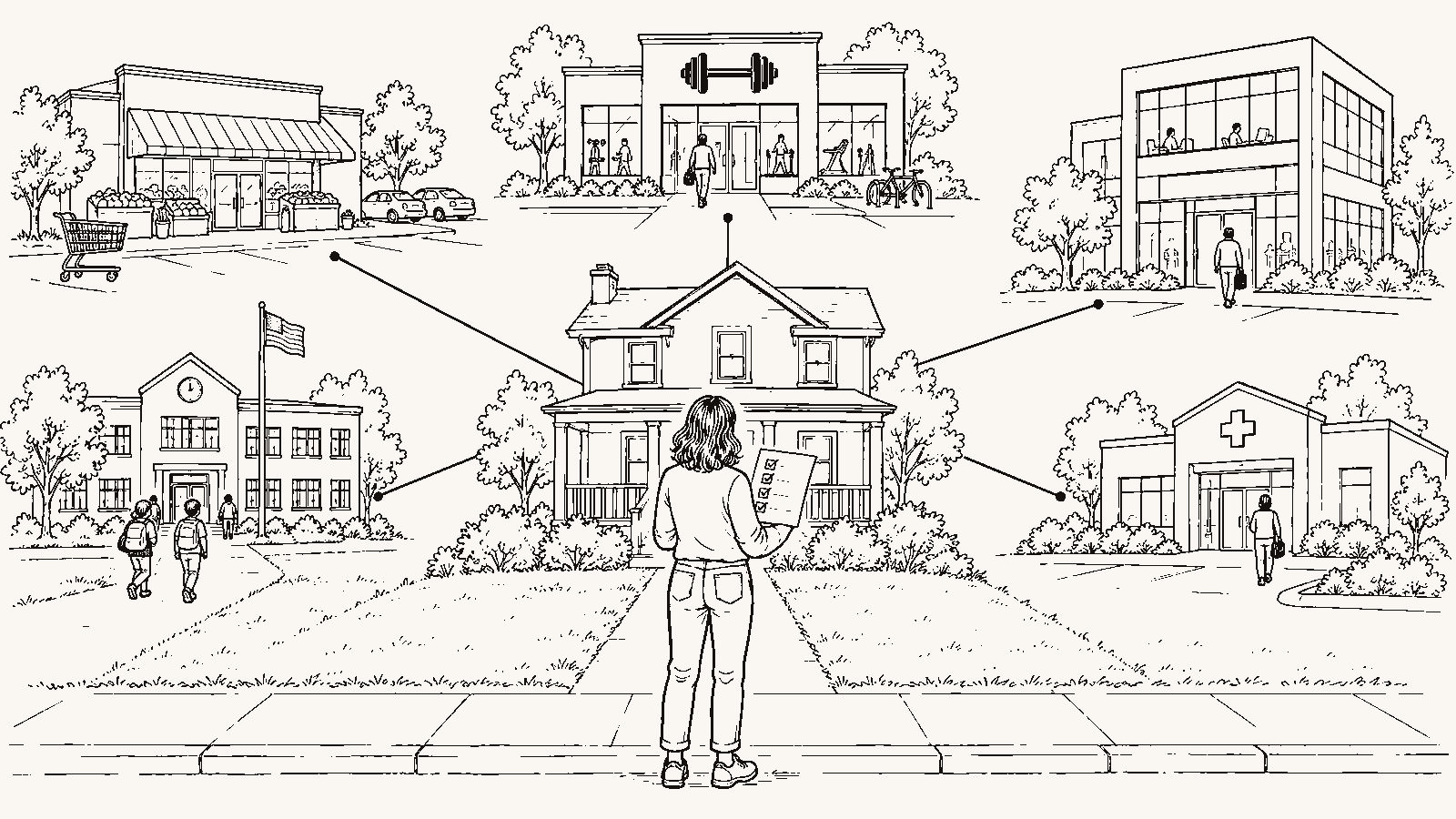
You are not deciding whether this neighborhood is a good one. You are deciding whether the five places your week already depends on are reachable from this address at the hours you go, and what each trip costs you on the day it does not go as planned.
A listing tells you what is near the house. It does not know where you buy groceries or which daycare has a spot. The five-places test puts your own week on one sheet of paper and reads it against one address. It takes an afternoon, and it asks for more honesty than you may want to give on a first look at a house you already like.
What does the sheet measure?
Every article on this blog measures a place against the ordinary week. This one is the measurement itself. Write down the five places you go most in a normal week besides home. A common list: work, the grocery store, school or childcare, one recurring appointment such as the doctor or the gym, and one person you see every week. The list may have four places or seven. Each entry is a place you go repeatedly, on a schedule the rest of the week bends around.
Then answer the same questions for each one from the candidate address. How far is it at the hour you go? How often? In which direction? What happens to the time when the day changes? The answers go on one sheet, and the sheet is what you read.
Write down the five places, with addresses
Categories lie. Addresses do not. “A grocery store” is not the store you will use. The one you like may be the one across town from the house, and the one three minutes away may be the one you avoid. For each place on your list, find the exact address you would drive to from this house. If you do not know yet which doctor or which daycare, write the nearest one that has an opening and label it a guess so you remember to replace it. The hours and location of a clinic or a daycare come from the provider’s own site or a phone call, which is Provider-reported, and you confirm the hours before you count on a 5:30 pickup.
The honest version of the list has a cost. It may show you that three of the five places belong to one person’s job and the other adult in the house is not on it at all. It may show you that the place you go most is one you would rather not count, like a parent’s house across the county. Write it down anyway. A sheet that flatters the house does not help you.
How often do you go to each one?
A trip you make five times a week weighs more than a trip you make once a month. For each place, write the number of round trips in a normal week. Then multiply: one-way minutes, times two, times trips per week. A 20-minute drive is 40 minutes a week for a weekly appointment and 200 minutes a week for a five-day commute. Same distance, five times the cost. The multiplication turns a list of places into a week.
Frequency also tells you which places to check hardest. Spend your scouting hours on the daily trips. A once-a-month drive that runs long is an annoyance. A daily drive that runs long is about 240 long drives a year at 48 working weeks.
Run each trip at the hour you would make it
A mapping app gives you a drive time. That is an Estimate, and the app does not know which hour you are asking about unless you tell it. Set the departure time to the hour you would leave, on a weekday, and note the number. Then treat that number as a guess until you have driven it. The 7:40 commute, the 2:50 school pickup, the grocery run at 5:45 on a weeknight, the Sunday morning drive to church. Each one has its own hour, and the road at that hour is the road you are buying.
If you are still hundreds of miles away, the departure-time setting is the tool you have. When you make the scouting trip, drive the daily routes at the real hour in the real direction. Write the minutes you drove next to the app’s number. The gap between the two columns is the first thing the sheet teaches you. The cost of this step is that it eats most of a scouting day, and the drives are not the part of the trip that feels like house hunting.
The commute deserves more than one pass, and it has its own article: How to Test a Commute Before You Trust the Map. For the annual cost of the difference between two commutes, see Commute Math: What Extra Drive Time Actually Costs You in a Year.
Which direction is each place from the house?
Put the house in the middle of a map and mark the five places. Then count the directions. Five places along one road are one life. Five places in five directions, each 20 minutes out, are a different one. In the first case an errand chains onto the commute and the grocery run passes the pharmacy. In the second, every trip is its own drive, and what you are close to is a highway.
No listing shows spread, because the listing does not know where your places are. A house that sits 20 minutes from everything looks fine on any one drive and only reveals itself when you add up the week. The house along the corridor often costs something for that convenience: a higher price per square foot, a smaller lot, a shorter driveway, or a bedroom window facing the road that makes it convenient. Decide which side of that trade you are moving for.
What breaks the advertised time?
Every drive time on the sheet is the time on a normal day. Ask what changes it, and check each answer against a source.
Where your state runs a 511 traveler information service, it lists construction and closures on state routes. The Federal Highway Administration describes the 511 system at https://www.fhwa.dot.gov/trafficinfo/, and each participating state runs its own site or phone line. That is an Official record. Check each of your five routes for a project, and find out how long the project is scheduled to run, because a road that is torn up this month may still be torn up when you close.
NOAA’s U.S. Climate Normals at https://www.ncei.noaa.gov/products/land-based-station/us-climate-normals report the normal precipitation and snowfall for a station near the address. That is an Official record of the climate, and it says nothing about what a specific storm does to a specific road. For that you need a Local observation: a neighbor who can tell you which of your five routes floods at the underpass or closes when it snows.
The district’s bell schedule and transportation page are an Official record of when school lets out and where the buses run. Look at which of your five routes passes a school within 30 minutes of dismissal. A route that is fine at 2:15 can be a different route at 2:50.
Your own hours can move too. A remote job that becomes hybrid, or a shift that starts at 6 instead of 8. Ask your employer in writing, and treat the answer as Personal verification you repeat before you close. The cost of asking is that you may not like the answer, and the sheet will change.
Which trips could you make without the car?
For each place, ask whether you could get there without the car at the hour you go, and whether you would. The transit agency’s published schedule is an Official record of which routes run near the address and how often. It also gives the last return trip, which matters if the trip home is after 9. A route that exists on the map and runs once an hour is not the same as one that runs every ten minutes. Sidewalks and crossings on the actual walking route are Personal verification, so walk it.
Then be honest about February. A grocery store that is a 12-minute walk in April is a drive in the rain, so count it as a car trip on the sheet. This step finds the one or two trips that leave the car in the driveway. Each one you cross off changes what the household needs from a second car and from parking. What the word walkable should mean for your own errands has its own article: What “Walkable” Should Mean When You Are Choosing Where to Live.
Whose five places are these?
A household has more than one list. The other adult has a job, a gym, a friend, a parent. A child in an activity has a field or a studio that becomes a twice-a-week trip. A parent who needs rides adds a pharmacy and a clinic to someone’s week. Ask every adult in the house to write his own five places, then lay the sheets side by side on the same map.
The two lists may point in opposite directions. When they do, the house that fits one person’s week is a daily tax on the other’s, and the sheet is where you find that out instead of finding it out in the car in October. The cost of doing this is a conversation some couples would rather skip, because one list often wins, and the sheet makes it plain which one.
Which places will move in the next two years?
Mark the places on the list that will change. A child who changes schools in two years. A job that has talked about moving its office. A parent who may move closer, or may need more visits. A daycare you will leave when the child starts kindergarten. Each of these is a place on the sheet with a date attached, and the drive after the date may look nothing like the drive before it.
You cannot verify the future, and the sheet should not pretend to. Note which entries are stable and which are guesses, and weigh the house on the stable ones. A house chosen for a drive that ends in eighteen months is a house chosen for eighteen months.
Read the whole sheet at once
Now look at the sheet as one thing. Five addresses, weekly minutes for each, a direction for each, a note on what breaks each drive, a mark on which could be done without the car, and a date on the ones that will change. Total the weekly minutes, then count the directions and the car-free trips.
Then ask the comparison question: good for which life, and at what cost? A house that puts all five places within 15 minutes along one road gives you back hours every week and costs you square footage or quiet. A house that puts them in five directions gives you the square footage or the quiet and costs you a week that runs entirely on the car and breaks whenever one drive runs long. Neither answer is wrong. The sheet shows you the minutes so that you decide on purpose, before you own the drives.
The Census Bureau’s American Community Survey publishes travel-time-to-work tables for the area at https://data.census.gov/, and the Federal Highway Administration’s National Household Travel Survey at https://nhts.ornl.gov/ describes regional travel patterns. Both are Official records of other people’s weeks: they tell you whether long commutes are common in this area, and nothing about whether your Tuesday works from this address.
What must I verify personally
Before you make an offer on this address:
- Write your five places with exact addresses, not categories, as you would drive them from this house.
- Write trips per week, the hour, and the direction for each one.
- Set the mapping app’s departure time to the real hour for each trip and record the estimate. Label it an estimate.
- On the scouting trip, drive the daily routes at the real hour in the real direction. Write your minutes next to the app’s.
- Multiply one-way minutes by two by trips per week. Total the week.
- Mark the five places on a map around the house. Count the directions.
- Check the state 511 site for construction on each route and note the scheduled end date.
- Read the district bell schedule and mark which routes pass a school within thirty minutes of dismissal.
- Look up the transit schedule from the address to each place. Note the frequency and the last return trip.
- Walk the one trip that looks walkable. Note sidewalks and crossings, and carry something back.
- Ask every other adult in the house for his five places. Lay the sheets side by side.
- Mark the places that will change within two years.
What should I ask a local
- Which of these five drives is worse than the map says, and at what hour?
- What does this road do when it rains, when it snows, and when school lets out?
- Where do you buy groceries, and why not the closer store?
- Which of these trips do you or your neighbors make without a car, and would you do it every week?
- Is there construction on any of these routes, and how long has it been going on?
What should I ask my agent
- Have you driven these five routes at these hours, and will you do it on video for me?
- Which addresses on my list put all five places in the same direction?
- Have you had buyers here who bought for the house and later told you the drives wore them down?