You are deciding whether to make an offer on a house at one address, or to walk away from it while you still can. The visit answers what the tour cannot: does an ordinary week run from this driveway, and what does it cost you on the days it does not?
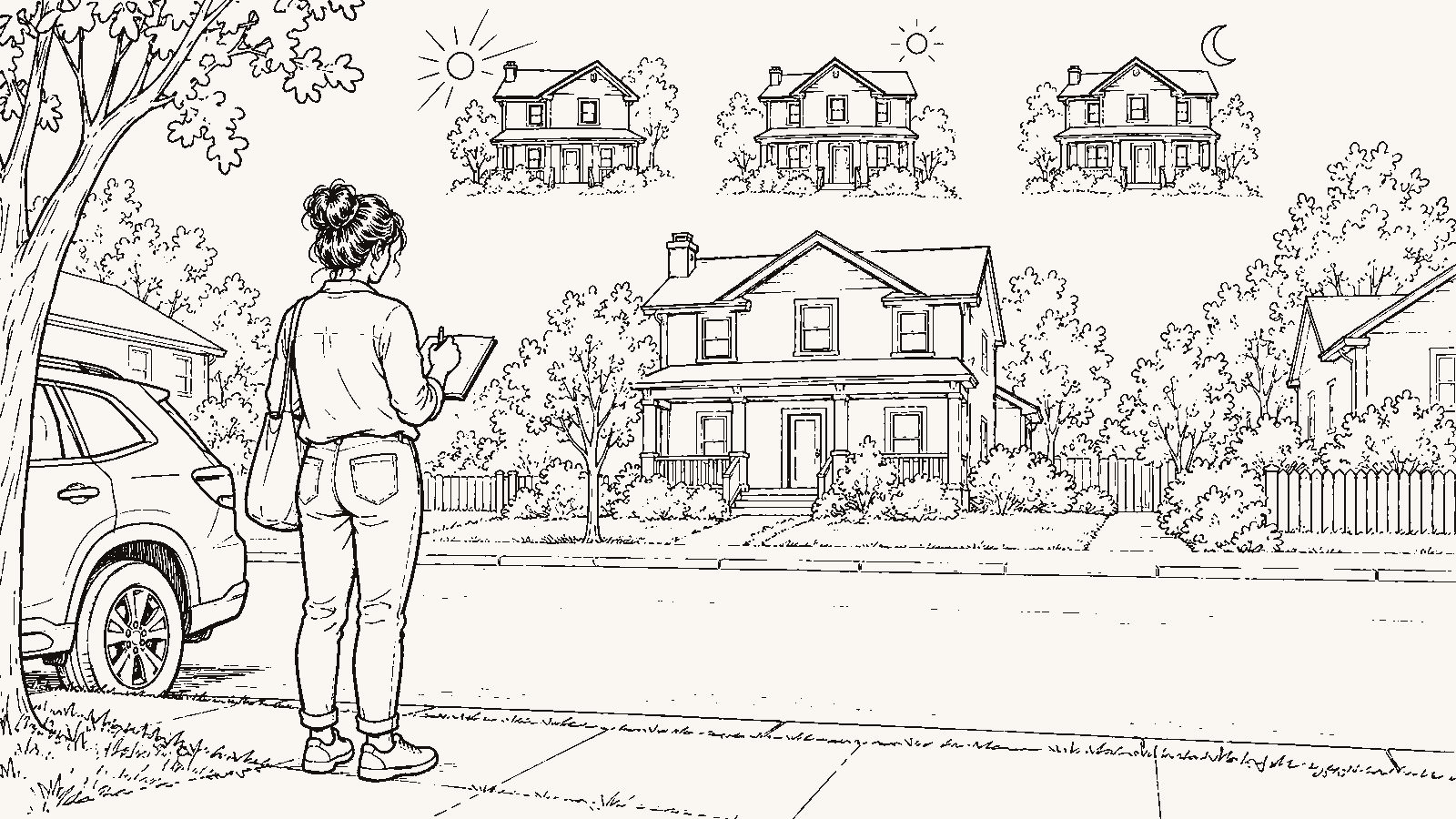
The house tour cannot answer that. You answer it by standing on the street at three different hours and driving the trips you make every week, then writing down what you found before you let yourself like the kitchen.
Why “vibe” is a real signal and a bad record
You get a feeling within a minute of pulling onto the street. Keep it. The feeling is your brain reacting to sound, traffic, light, the condition of the four nearest houses, and how many people are outside. You got it at 2 pm on a Saturday, though, the hour the seller chose and the hour the listing photos show. Two weeks later you remember “quiet” and forget that school was out that day.
The scouting trip turns the feeling into a record. You make the same observations at the same hours at every address you are considering, and you write them on one page each. A fixed list can miss the thing you did not think to look for, and that is the cost of using one. You cover the gap two ways: one open question to a person who lives there, and a line at the bottom of every page that says “what surprised me.”
What the trip costs you
A scouting trip costs money and vacation days. In a market where houses go under contract in days, the buyer who visits at three hours can lose the house to a buyer who visited at one. You are trading speed for certainty about the commute, the noise, the water, and the street at the hours no photograph shows. Decide before you go whether you can live with losing this particular house. A buyer who cannot will cut the visit short and skip the night drive.
A visit is also a sample of one day. A quiet Tuesday can be quiet because the district is on break or because the road behind the subdivision is closed for repaving. Before you treat one visit as typical, check the school district calendar (Official record) and the city or county event calendar (Official record) for the dates you were there. If the day was unusual, the page says so.
Do the desk work before you fly
Pull the official records for the exact address before the trip. Then the visit compares what you see with what the records say, instead of trying to do both jobs at once.
The FEMA Flood Map Service Center at https://msc.fema.gov/portal/home shows whether the parcel sits in a mapped flood zone. That is an Official record. It answers whether a lender will require flood insurance, and it does not tell you where water pools in the yard after two inches of rain. The visit covers that part.
The FCC National Broadband Map at https://broadbandmap.fcc.gov/ shows which providers report service at the address and what speeds they advertise. That is Provider-reported. Before you count on any of it, call the provider with the street address and ask which tier is physically available at that house. Then test your own phone at the address when you get there.
The school district’s attendance boundary lookup, where the district publishes one on its website, tells you which school the address feeds into. The district is the source, so this is an Official record. A district can redraw a boundary, so ask the district office whether any boundary change is proposed for the coming year.
The city or county planning department’s agendas and approved site plans tell you what the department has approved for construction within sight of the house. The county assessor or GIS parcel viewer shows the zoning of the lot and the lots around it. Your state department of transportation’s project pages and the city public works department list planned road work. All of these are Official record. Reading them takes an evening, and approved does not mean scheduled, so you still ask the planning office when the shovels go in.
Drive times from a map application are an Estimate, and the listing description and the agent’s remarks are Provider-reported. What a neighbor tells you is Local observation. What you do with your own feet, ears, and phone at the address is Personal verification, and the visit exists to produce that last kind.
Visit one: a weekday morning, 7:15 to 8:30
Start in the driveway. Drive to work at the hour you would leave, all the way to the place you would park. Note the time the map promised and the time it took. Then note what changed it: a school zone, a left turn with no signal, a rail crossing, one lane of a bridge. A commute that runs eight minutes over the estimate on one morning is one morning’s evidence. Drive it again on the second morning if you can. Two runs cost you an hour, and one run can be a fluke.
If you have children, drive from the house to the assigned school at drop-off time and sit in the line. The line is part of the commute on every school day, and the map does not show it. Sit in it anyway. It costs twenty minutes of a morning you would rather spend at the house, and that is exactly why buyers skip it.
On the way back, drive the street itself at 8:15. Count the cars that cut through. Watch the speed. If the street is a shortcut between two arterials, you learn that now, and you learn it every morning if you buy.
Check your phone’s signal in the driveway, in the kitchen, and in the room you would work from. Do it on your own carrier. The seller’s carrier tells you about the seller’s phone. The check has a limit of its own: it covers only the carrier you have today, so if you switch later, you start over.
Visit two: a weekday evening, 5:30 to 7:30
Drive the commute home at the hour you would leave work. Evening and morning can be different drives on the same route, and you have not tested the commute until you have driven both directions.
Then run the errands. Drive from the house to the grocery store you would use, at the hour you would go, and do the whole trip: park, walk in, walk the aisles, drive back. Do the same for the other places on your list from the five-places test: childcare, the gym, the clinic, the parent you check on. The map measures the distance. You are measuring the trip, the parking lot and the light at the exit included. This costs a whole evening at one address, so save it for the addresses that survived the desk work.
Park on the street at 7 pm. If you cannot find a space within a house or two of the front door, write down how far you had to walk. A guest of yours will walk the same distance on any evening that looks like this one.
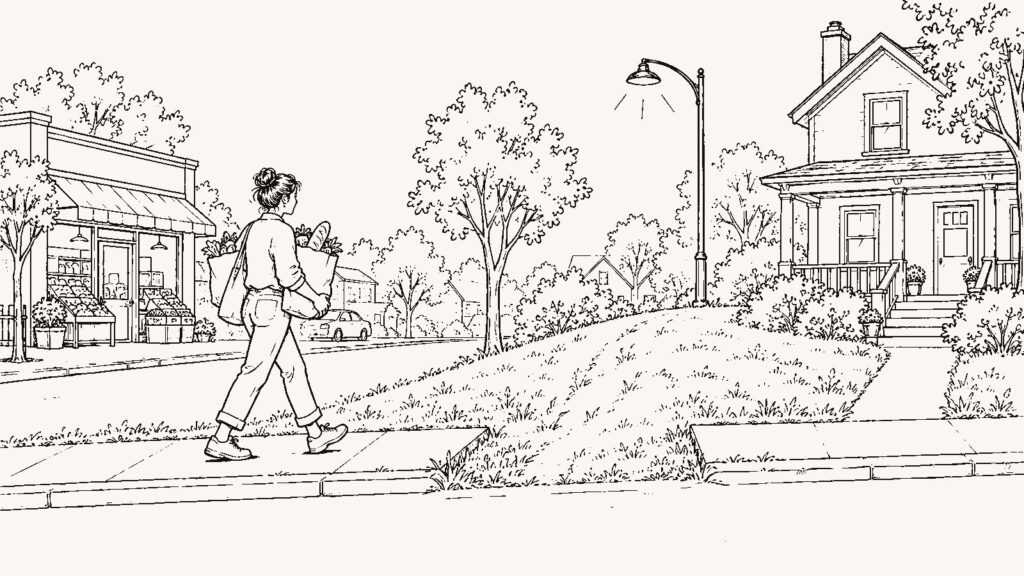
Walk one errand from the front door. A coffee, a gallon of milk, a mailed package, whatever you would do on a weeknight. Time it. Note whether there was a sidewalk the whole way and whether you had to cross anything you would not let a ten-year-old cross. If it was not possible, write that down. It tells you how many of your weekly trips you will drive from this address. The walk costs you half an hour of the evening, and one attempt can miss the shop that closes at 6, so note the hour as well as the result.
Stand outside at 6 pm and listen for three full minutes. Write what you heard.
Visit three: Friday or Saturday, 9 to 11 pm
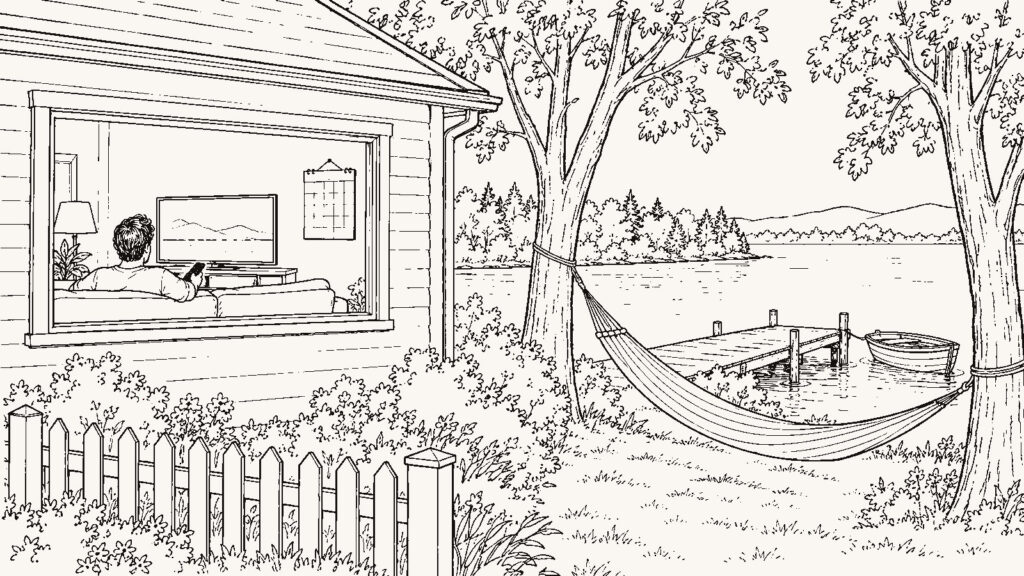
Stand in the backyard. Whatever you hear at this hour is what you will hear on every Friday night you live here, and the listing photos do not show it. Road noise, a bar’s patio two blocks over, a dog, a train horn, the neighbor’s speaker. Write it down without deciding yet whether it bothers you.
Walk the block. Note which houses are lit, how many cars are parked on lawns, whether anything nearby is open late, and which direction the noise comes from. Then drive the nearest arterial in both directions. A road that is quiet at 2 pm on a Saturday can be the route home from everything on a Saturday night.
A fourth visit, Sunday morning, costs one more morning of a short trip. It shows you the block at rest, and whether a church empties onto your street at noon.
Look at the ground and the walls
Water leaves marks. Walk the lot and find the low point. Look at the base of the foundation, the garage floor near the door, the bottom course of siding, and the neighbor’s fence line for staining, silt, or moss. If it rained in the last few days, look for standing water and for the path it took across the lawn. If it has not, ask the neighbor where the water goes in a hard rain. The flood map (Official record) told you whether the lender cares. The ground (Personal verification) tells you whether you will, and the two answers can disagree in either direction.
Look at the four houses on either side
The house you are buying sits between eight houses you are not. Note the upkeep of each: the roof, the yard, the cars, whether the porch light works. Note how many look rented or vacant. Record whether the block is holding steady or turning over. The block is what you are buying, and the block is what you will sell into later. You can record all of this without passing judgment on anyone. One bad year at one house looks like a trend from the curb, so write what you saw and let the pattern across visits and addresses carry the weight.
Then find one vacant parcel within sight of the house and ask the planning department what is approved on it. A field next door is a field until it is a distribution center, and the approval is public before the grading starts.
Write the page before you leave the street
One page per address, filled in on the curb before you drive off. Memory blends addresses together by the second day.
What I heard, at each hour. What I saw on the street. What took longer than the map said, and by how much. What the records said and what disagreed with them. What surprised me. Who would dislike living here, and whether that is me.
The last line is the one that decides. A street that is loud on Friday nights is a bad street for someone who needs quiet and a fine street for someone who is out on Friday nights. The page asks one question: good for which life, and at what cost? Read it against the list of what must improve that you wrote before you started looking. The offer either makes sense or it does not.
What should I ask a local
Find a person outside, on the street or in the yard next door, and ask the questions the records cannot answer. The answers are Local observation, one person’s view, and you weight them that way.
What does this street sound like at ten on a Friday? Where does the water go when it rains hard? What is going in on that empty lot? Which grocery store do you use, and when do you go? What took you longest to get used to here? Who would hate living on this street?
The last question gets the most honest answer, because it lets the person describe the street without defending it.
What should I ask my agent
Will you drive the commute with me at 7:40, or send a live video of it if I cannot be there? What do you know about this street that is not in the listing? What would make you tell me not to buy this one? An agent who has an answer to the third question will say it before you sign. The first question asks for a morning of the agent’s time, so expect a yes only on a house you are serious about.
Three other articles carry parts of this method. How to Plan a Scouting Trip Without Spending the Entire Trip Looking at Houses, at https://beforethekey.com/blog/how-to-plan-a-scouting-trip-without-spending-the-entire-trip-looking-at-houses/, lays out the days so the houses do not eat all of them. Neighborhood Safety Research Without Guesswork, at https://beforethekey.com/blog/neighborhood-safety-research-without-guesswork/, covers reading crime data before you stand on the street at night. How to Test a Commute Before You Trust the Map, at https://beforethekey.com/blog/how-to-test-a-commute-before-you-trust-the-map/, covers running the commute on more than one morning and what to do when the two runs disagree.
What must I verify personally
Before you make an offer on this address:
- Drive to work from the driveway at the hour you would leave, all the way to your parking spot, on a weekday. Drive it home at the hour you would leave work.
- Drive to each of your five places at the hour you make that trip, and do the whole trip, parking included.
- Sit in the school drop-off line at the assigned school at the real hour.
- Stand in the backyard at 9 pm on a Friday and write down what you hear.
- Park on the street at 7 pm on a weekday and note whether there was a space near the door.
- Walk one errand from the front door, time it, and note whether it was possible.
- Check your own phone’s signal in the driveway, the kitchen, and the room you would work from.
- Walk the lot to the low point and look at the foundation, the garage floor, and the fence lines for water marks.
- Pull the FEMA flood map, the FCC broadband map, and the district boundary lookup for the exact address, then write down where what you saw disagreed with what they said.
- Ask the planning department what is approved on any vacant parcel within sight of the house, and when.
- Check the district calendar and the local event calendar for the days you visited, so you know whether you saw a normal week.
- Fill in the page on the curb, and read the last line before you decide.