You are not deciding whether the lake, the trail, the pool, or the downtown is nice. You are deciding whether it shows up in your normal week often enough to be worth what living near it costs you.
The listing says “steps to the greenway” or “minutes from the marina,” and the price carries a premium for it. You pay the premium whether or not you ever go. Whether you will go is a question you can answer before you make an offer, because you already have a year of evidence about yourself.
Count how often you used it last year
Before you price a house for its amenity, count how many times in the past twelve months you used the closest equivalent from the address you live in now. Count visits, not intentions. If the house is near a lake, count the days you spent on any lake last year. If it is near a trail, count the walks that were longer than the dog needed. If it is near a downtown with restaurants, count the dinners out, then count the ones you drove more than ten minutes for. Write the number down before you look at the house again.
The number is yours, and it is different for every household. It is also more honest than the plan for next year. A gym you drove past three hundred times and entered fourteen times tells you what a gym two blocks away will do for you. Two blocks may add a few visits, and you can decide whether a few visits are worth the premium. If you are moving because the current address made the thing hard to reach, say so, then count the times you went anyway: a person who drove forty minutes to a lake twelve times last year has a different count from one who did not go once. The count also breaks when the household changes, so a child who joined swim club in May has a count that starts in May. The cost of counting is that you may not like the number, and a house you love may stop making sense once you have it. That is why you count before the offer and not after the closing.
Is it a Tuesday amenity or a Saturday amenity?
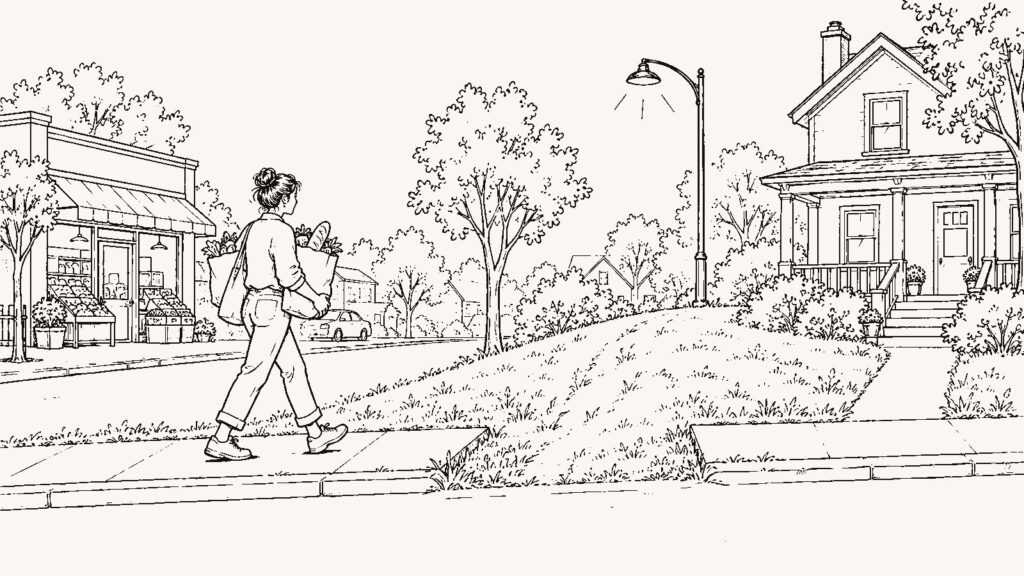
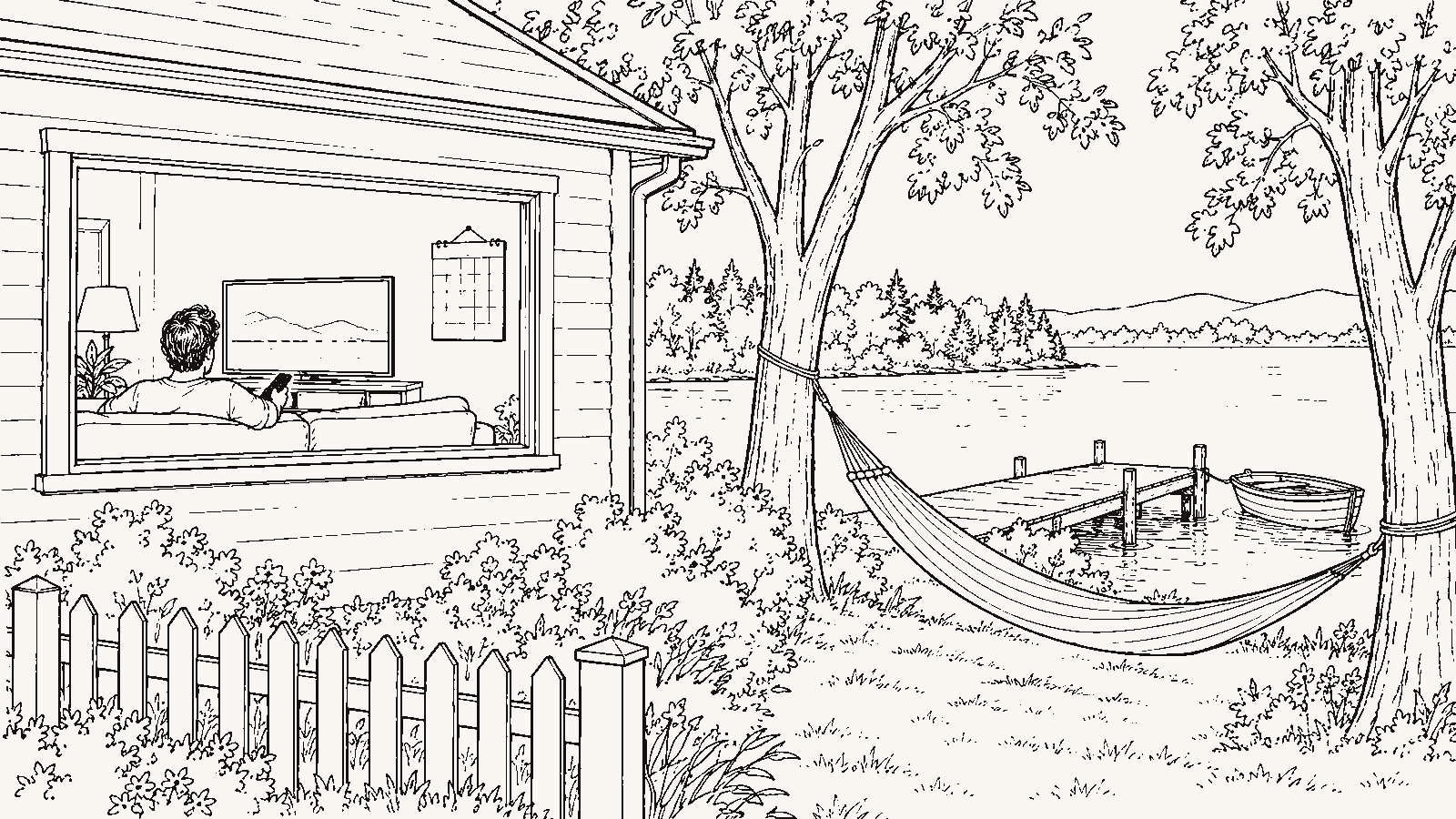
Split every amenity in the listing into one of two kinds. A Tuesday amenity appears in an ordinary week: the pool your kids swim in after school, the trail you run on before work, the coffee shop on the corner, the grocery store and the pharmacy on the walkable block. A Saturday amenity appears a few weekends a season: the lake, the ski hill, the concert venue, the beach.
A Tuesday amenity is part of your week, and it belongs in the five-places test alongside work, school, the grocery store, and the pharmacy. You pay its distance every week, so proximity pays you back every week. A Saturday amenity is a place you visit, and you can visit it from a cheaper address. A lake twenty-five minutes away is a trip you plan, and the count from last year tells you how often you planned one, which is the cost of the cheaper address. A lake at the end of the street gets used on a random Thursday evening because it is there, which is what the premium buys. The count from last year tells you which kind of person you are with this kind of amenity.
How many months a year does it exist?
A community pool has an opening date and a closing date, published by the city or county parks department or by the association that owns it. That is an official record, and the season is often measured in weeks. A reservoir has a pool schedule and a seasonal drawdown; if the U.S. Army Corps of Engineers operates the lake, its district office publishes the schedule, and if a utility or river authority operates it, that operator publishes its own. Both are official records. Federal land has its own calendar: the National Park Service and the USDA Forest Service publish seasonal closures and fees, and Recreation.gov handles permits and reservations where they are required. A trail in a mountain town may close for snow. A beach town has a season, and the town has a different population in and out of it.
Two checks answer the season question from a distance. NOAA’s U.S. Climate Normals give you monthly temperature and precipitation for the nearest station, which is an official record. It gives you a rough count of usable months, and it says nothing about your address. The parks department or association calendar gives you the dates. Divide your last-year count by the number of usable months and you have a rate you can compare across addresses. The catch is that a seasonal amenity changes the neighborhood in season. A lake road that is quiet in February carries boat trailers in July. A beach block that is quiet in November can belong to renters in August. Whichever season you visit on the scouting trip, you are seeing one of two neighborhoods, and a local can describe the other one.
What does “near” mean at 9 on a Saturday?
Near on a map and reachable at the hour are different measurements. A trailhead half a mile away with a lot that fills by 8 on Saturday is a trailhead you reach at 7:30 or not at all. A marina three minutes away with a two-year slip waitlist is a view. A “community pool” may require a membership you are not automatically offered, and a gated park may need a resident permit. A downtown with no residential parking is a downtown you walk to, which is fine if you are walking and a problem if you are carrying a week of groceries.
Time the trip from the door to the amenity at the hour and on the day you would use it, and include the parking search. That is personal verification. If you are visiting in the off-season, a neighbor who has been there in the on-season can tell you what the lot looks like in July, which is local observation. The cost of this check is a Saturday morning of your scouting trip spent sitting in a parking lot, and a scouting trip has only so many mornings. Spend one anyway, because a trailhead you cannot park at is one you stop going to.
Which hour of your week does it land on?
Someone in your house uses the amenity, at some hour. Lay it onto the household’s week and find that hour. The gym at 6 in the morning exists only if 6 in the morning is free, and it is not free if you leave at 6:40 with a child to drop off. The pool after school belongs to the kids, and to whichever parent is home at 3:30 to drive and sit. Dinner downtown on a weeknight is real only if your household eats out on weeknights, which the last-year count already told you.
Do this for each person in the house separately, because an amenity that is a Tuesday amenity for one member is usually a chore for another. The teenager’s rowing club at the lake is a Tuesday amenity for the teenager and forty minutes of driving, twice, for a parent. Both belong on the page. The cost of doing this honestly is that some of the amenities that sold you the house will turn out to land on hours that do not exist, and the house gets less attractive. The gain is that the amenities that survive the check are ones you will use.
What are you paying besides the price?
The premium in the price is the visible cost. The recurring costs are in documents you have to ask for. If an association owns the pool, the clubhouse, the gate, or the dock, its dues pay to run them and its reserve fund pays to replace them. The association’s governing documents, current budget, and reserve study are official records, and the seller or the association provides them under your state’s resale disclosure rules, where those rules exist. Read the budget for what the dues fund. Read the reserve study for what is underfunded, because an underfunded pool becomes a special assessment whether you swim or not.
If the amenity is a club, the membership and any initiation fee are provider-reported numbers you get from the club, along with whether there is a waitlist. If the amenity is a park district, a lake authority, or a resort area, there may be a special district line on the property tax bill; the county’s parcel record or tax bill shows the districts that tax this address, and that is an official record. The last cost is the one the listing never states: for the same monthly payment, the house near the amenity is often smaller or sits on less land than the house fifteen minutes away. That is a trade, and it can be the right one. Put the square feet you give up on one side of the page and the visits from last year on the other.
What does the amenity bring to your street?
Whatever draws you draws other people, and they arrive by car. A venue, a stadium, a festival ground, a popular beach, or a downtown entertainment district has event days, and on event days your street has traffic, parked cars, noise, and sometimes closures. The city’s event calendar is an official record; a private venue’s calendar is provider-reported. Count the event days per year and read the count as days your street belongs to someone else.
A beach or a lake draws short-term rentals to the streets around it. Where the city regulates them, the ordinance is an official record, and some cities keep a registry you can search by address or street. Where there is no ordinance, there is no registry, and the neighbors are the source, which is local observation. Stand at the address on an event day and on an ordinary Tuesday and compare the two. Being near what people want means people come. Some households like the life of a busy block. You have a year of evidence on that too: if you spent last year avoiding crowds, a house that sits in one will not change you.
Will it still be there in five years?
A public park is a line in a city budget, and the budget is a public document. A private gym, a restaurant row, a marina, a golf course, or a ski hill is a business, and businesses close and sell. A view is whatever the zoning allows to be built in front of it. The county assessor’s parcel search tells you who owns the parcel the amenity sits on; the city planning department’s zoning map tells you what can be built on it and on the parcels between the house and the water. Both are official records. A pending development application is public too, and the planning department can tell you whether one has been filed.
None of this predicts what will happen. It tells you what is allowed to happen. The cost of asking is an afternoon with parcel maps and a possible answer you did not want. The cost of not asking is that you pay a premium for a golf course that later becomes a subdivision.
Run the count from the cheaper address
Take the address fifteen minutes from the amenity that does not carry the premium, and run the same checks from there. How long is the trip to the lake, the trailhead, the pool, or the downtown, at the hour, with parking? Does the amenity move from Tuesday to Saturday at that distance, or was it Saturday already? What does the difference buy in space and cost in minutes?
For some households the cheaper address wins, because the count was low and the amenity was a Saturday amenity at either distance. For others the premium wins, because the count was high and the trail at the end of the street turns three runs a week into five. Neither answer is right in general. The count from last year, laid against the premium, the dues, the memberships, and the side effects, decides it for your household, and it decides differently for a family with two kids in swim club than for a couple who likes the idea of a lake.
What must I verify personally
Before you make an offer on a house priced for what it is near:
- Count last year’s use of the closest equivalent from your current address, and write the number down.
- Walk or drive from the door to the amenity at the hour and on the day you would use it. Time it, including the parking search.
- If your visit is off-season, find out what the on-season looks like at that lot and on that street.
- Read the association’s budget line by line for what the dues fund, and the reserve study for what is underfunded.
- Pull the tax bill from the county assessor’s parcel record and find every special district on it.
- Look up who owns the parcel the amenity sits on.
- Read the zoning for the parcels between the house and the view, the water, or the open land.
- Read the event calendar for the venue or the downtown and count the days per year.
- Check whether the city has a short-term rental ordinance and, if it keeps a registry, how many permits are on this street.
- Lay each amenity onto each household member’s week and find the hour it lands on.
What should I ask a local
- How full is the lot on a Saturday morning in July, and what time do you have to get there?
- What happens on this street on event days, and how many of those days are there a year?
- Which months is the pool actually open, and which months is the lake actually full?
- Who on this street uses the trail or the clubhouse every week, and who has stopped going?
- Has anyone tried to build on the parcel between here and the water?
- Where do you go instead when the lot is full or the pool is closed?
What should I ask my agent
- From closed sales, what is the price difference between this house and a comparable one fifteen minutes from the amenity?
- What do the association dues fund, and when was the last special assessment?
- Which of the amenities in the listing are public, which are association-owned, and which are private businesses?
Related reading: The Five-Places Test: Can This Neighborhood Actually Support Your Week?, The Real Cost of a Location: What to Calculate Beyond the Mortgage, and What “Walkable” Should Mean When You Are Choosing Where to Live.
Sources: NOAA National Centers for Environmental Information, U.S. Climate Normals, https://www.ncei.noaa.gov/products/land-based-station/us-climate-normals (Official record). U.S. Army Corps of Engineers, https://www.usace.army.mil/ (Official record). National Park Service, https://www.nps.gov/ and USDA Forest Service, https://www.fs.usda.gov/ (Official record). Recreation.gov, https://www.recreation.gov/ (Official record). Your city or county parks and recreation department, planning department, short-term rental ordinance and registry, and event calendar (Official record). Your county assessor’s parcel search (Official record). The association’s governing documents, budget, and reserve study (Official record). Club and venue pricing and calendars (Provider-reported). Neighbors (Local observation). Your own timed trip at the hour (Personal verification).