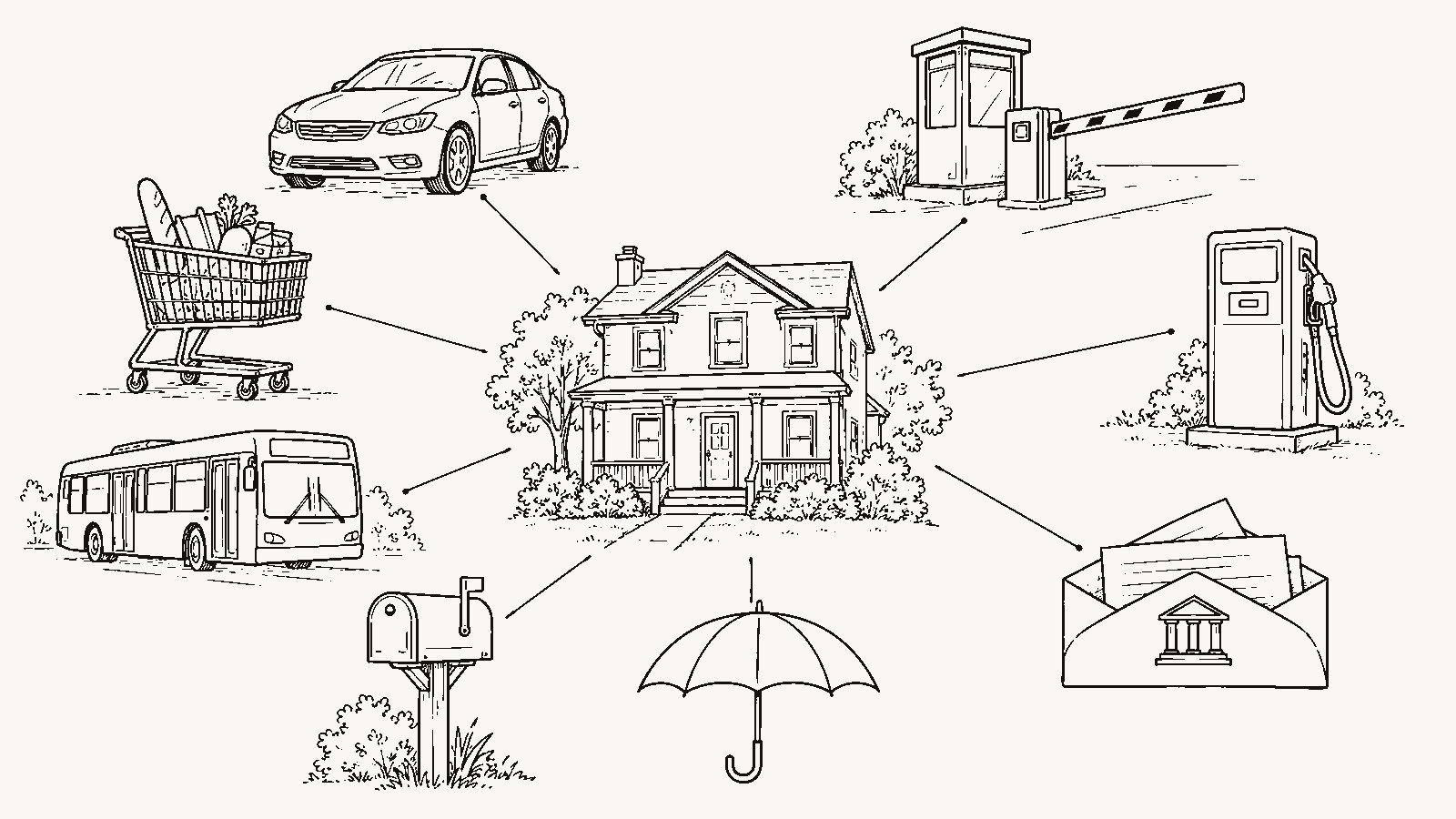
You are deciding whether you can afford the life that runs from this address, and the purchase payment is one line of that number. The house you can afford on that one line and the house you can afford on the full number are often two different houses.
The listing shows a price and, if you are lucky, an estimated monthly payment. That estimate comes from someone who will never pay it. The tax figure is the seller’s last bill, and the insurance figure is whatever the portal plugged in. The commute, the tolls, the second car, the HOA, and the roof are not on the page at all. The sheet below has a line for each of them. We leave those lines blank because the numbers come from the county, the insurer, the utility, and your own car.
Why the purchase payment is only one line
The Consumer Financial Protection Bureau describes a full monthly housing payment as principal and interest, property taxes, mortgage insurance where it applies, homeowner insurance, flood insurance where it is needed, HOA fees, and the utilities, maintenance, and repairs that come with owning the house (Official record: CFPB, Owning a Home, https://www.consumerfinance.gov/owning-a-home/). That is the regulator’s list, and it is longer than the one on the listing.
It is still short. It stops at the property line. A house forty minutes farther out adds fuel, tolls, parking, hours, and sometimes a second car, and a mortgage calculator has no line for any of them. Two houses with the same purchase payment can cost you very different amounts every month, which is the subject of Why Two Same-Priced Houses Can Have Very Different Monthly Costs. The rest of this page builds the number for one address.
Draw the three-column sheet
Take one page and draw three columns.
Column one is housing costs. These follow the house: purchase payment, property tax, homeowner insurance, flood or hazard insurance, HOA dues, maintenance and repairs.
Column two is location costs. These follow the address: utilities, internet, parking, tolls, extra fuel, an additional vehicle, and anything else you pay for every month because of where the house sits.
Column three is relocation costs. These happen once: scouting trips, temporary housing, storage, movers, deposits.
Every line gets a number from a named source, or it gets the word “verify” and stays blank until you have one. A blank on the sheet is honest. A guess on the sheet is how people buy a house they can afford and a life they cannot. Filling it costs you an afternoon of phone calls, to an assessor, an insurer, a utility, an HOA manager, and an internet provider, plus at least one drive at the real hour. Skipping the calls gives you the afternoon back and a sheet full of guesses.
Column one: what follows the house
Property tax at this parcel
Pull the tax record for the exact parcel from the county assessor and the county trustee or tax collector (Official record: the county’s own assessor and tax collector sites; search the county name plus “assessor” and “property tax”). The figure in the listing is usually the seller’s current bill. In some states the assessed value resets when the property changes hands, so your first bill may not match the seller’s. Ask the assessor’s office directly whether a sale triggers reassessment and how the rate is set. The answer takes a phone call, sometimes two, and it can push your monthly number up before you have written an offer. That is cheaper than learning it from the first bill.
Homeowner insurance quoted at the address
Call an insurer with the street address and ask for a quote on this specific house (Provider-reported: the insurer’s quote). Ask what the deductible is for wind, hail, or wildfire if the area has any of those, because a separate percentage deductible changes what a claim costs you. The quote takes a call, needs a house you can describe, and can move at the first renewal. The alternative is the listing’s placeholder, and nobody has agreed to insure the house for that number.
Flood or hazard insurance, separately
Look up the exact property on the FEMA Flood Map Service Center (Official record: FEMA, https://msc.fema.gov/portal/home). The map answers one question only, whether a lender will require flood insurance. The quote answers what the water costs. A standard homeowner policy generally does not cover flooding, and flooding also happens outside mapped zones, so get a flood quote with the address as a separate line even when the map does not require one (Provider-reported: the insurer’s flood quote). The cost is a second quote and a second wait. The rest of the method, including the disclosures and the claim history, is in How to Research Flood Risk Before Buying.
HOA dues, assessments, and the reserve
If the house is in an association, request the governing documents, the current budget, the most recent reserve study if one exists, and any pending or recently passed special assessment, through the seller or the management company (Official record: the association’s own documents). Read them yourself (Personal verification). Dues buy services, and some of them, like exterior maintenance or a pool, may replace costs you would otherwise carry in column one or spend your Saturdays on. A thin reserve is a future assessment with a date you do not know yet. Some sellers and managers push the documents into the contingency period, so asking early means insisting, sometimes more than once.
Maintenance and repairs
Get the age of the roof, the HVAC, and the water heater from the seller’s disclosure where the state requires one (Official record: the disclosure) and from the inspection (Personal verification: the inspection report you paid for). Walk the lot and decide who mows it, and who pays when a tree comes down. A larger lot and an older house cost money and Saturdays. A newer, smaller house inside an association moves some of that cost into dues, and you pay it either way. Write a line for it even if all the line says is “verify at inspection.”
Column two: what follows the address
Utilities and internet at this house
Ask the electric and gas utilities that serve the address for the current rate schedule and, where they provide it, the usage history for that address (Official record: the utility’s rate schedule and account history). Last year’s bills belonged to another household with its own habits, so treat the history as a starting point and expect your own number to land somewhere else. For internet, search the exact address on the FCC National Broadband Map (Provider-reported: the map shows what providers report, at https://broadbandmap.fcc.gov/), then call the provider with the street address and ask what tier is physically available to that house and what it costs (Personal verification). Reported and available are not the same word, and the map has a challenge process because reported information can be wrong.
Commuting, tolls, and parking
Drive the route to work at the hour you would drive it, both directions, on a weekday (Personal verification). Write down every toll on the route and look up its rate on the toll authority’s site (Official record: the state or regional toll authority). Parking at the other end is a monthly line too, so ask the employer or the city for the published rate (Official record: the employer’s or the city’s published rate). Then turn the time into hours. Multiply extra round-trip minutes per day by commute days per week and working weeks per year, and divide by 60. At five days and 48 weeks, ten extra minutes each way is about 80 hours a year. Twenty is about 160. Thirty is about 240. If you want one per-mile figure for fuel, wear, and depreciation together, the IRS publishes a standard mileage rate you can use as a rough multiplier (Estimate: https://www.irs.gov/tax-professionals/standard-mileage-rates). Time and fuel are two different costs, and you pay both. A shorter drive often means a smaller house or a higher price, and that is the tradeoff Commute Math: What Extra Drive Time Actually Costs You in a Year lays out in full.
The second car
Run the five-places test from this address. Write down the five places your household goes most in a normal week, find the address you would actually drive to for each one, and check whether the cars you own can make every trip on the days and hours you make them (Personal verification). If one adult would be stranded on weekdays and no bus or train runs the trip at that hour, a second car goes on the sheet as a monthly line, with its payment, insurance, fuel, and parking. No affordability estimate on a listing includes it, and adding it can price you out of an address you liked. Leaving it off makes the house look cheaper and the Tuesday harder.
Everything else you pay to get somewhere
Transit passes, a parking permit at home, a longer drive to the parent who needs help every other weekend, the airport you now use because the closer one has no direct flight: if the address makes you pay for it every month, it goes in column two. Write it down next to what the same trip costs you from your current address, because the difference is the number you are deciding on. The sheet gets longer and less flattering as you do this.
Column three: what happens once
Scouting trips, temporary housing, storage, movers, and deposits come due before the first mortgage payment does. Get your own quotes. Some expire before you close, and we do not publish figures for these because a figure for someone else’s move is not information about yours. If your plan is to rent first, some of these lines happen twice: two moves, a storage unit, a second set of deposits. You also take on the chance that prices or inventory look different when you are finally ready. Renting first still buys you information and flexibility. Put both sides on the page.
How to read the finished sheet
Add column one and column two, and you have what this address costs you every month. Column three sits beside it, paid once, as the price of arriving.
Now compare it to the number you started with, the listing’s estimate. The gap between them is the part of the decision the portal left off the page.
Fuel, tolls, a second car, and 160 hours a year can eat a lower housing cost farther out. Trips that disappear and a car you do not buy can pay back a higher housing cost closer in. Neither is right for every household: some families are moving for the yard and will happily pay in hours, and some are moving for the hours and will pay in square feet. The sheet shows you what each side costs so that you make the decision on purpose.
What must I verify personally
Before you make an offer on this address:
- Pull the parcel’s tax record from the county and ask the assessor whether the assessed value resets at sale.
- Get a homeowner quote with the street address and ask about wind, hail, or wildfire deductibles.
- Look up the property on the FEMA map, then get a flood quote as a separate line.
- Request the HOA budget, governing documents, reserve study, and any pending assessment, and read them.
- Ask the electric and gas utilities for the address’s usage history and current rate schedule.
- Search the address on the FCC map, then call the provider and ask what tier is physically available and what it costs.
- Drive the commute at the real hour, both directions, and write down every toll and the parking cost at the other end.
- Run the five-places test from the address and decide whether a second car is on the sheet.
- Read the inspection report for the age of the roof, HVAC, and water heater, and for any drainage finding.
What should I ask a local
- What does your electric bill look like in the hottest month and the coldest month, and how big is your house?
- Has the association had a special assessment in the last five years, and what was it for?
- Which road on the way to work do you avoid, and at what hour?
- Did your property tax bill change after you bought?
- Do you pay for parking anywhere you go every week?
What should I ask my agent
- Where did the tax figure in the listing come from, and is it the seller’s current bill or a projection?
- Can you get the HOA documents and reserve study before I write the offer, not during the contingency period?
- What do buyers in this area most often find on the inspection that changes their monthly number?