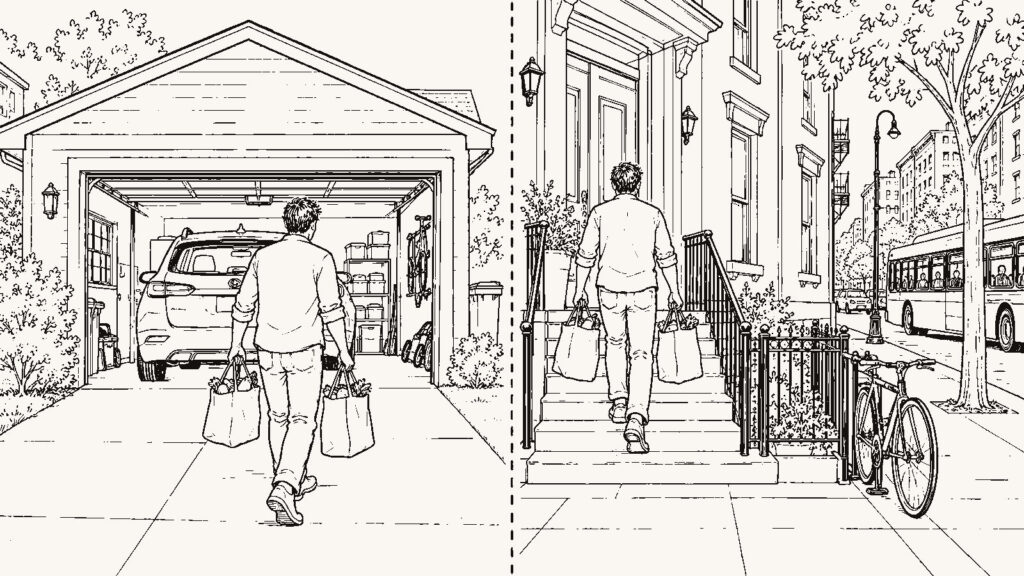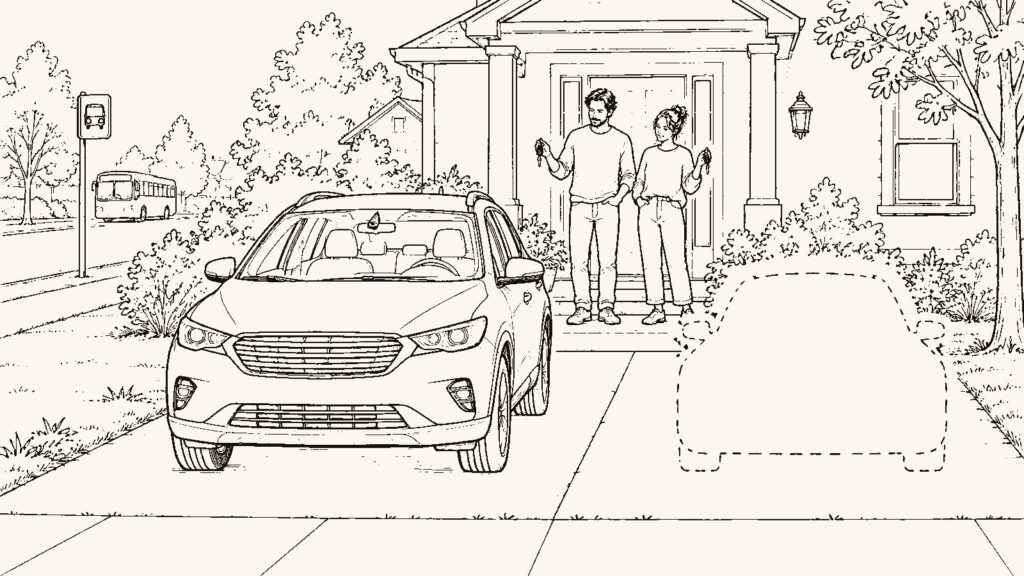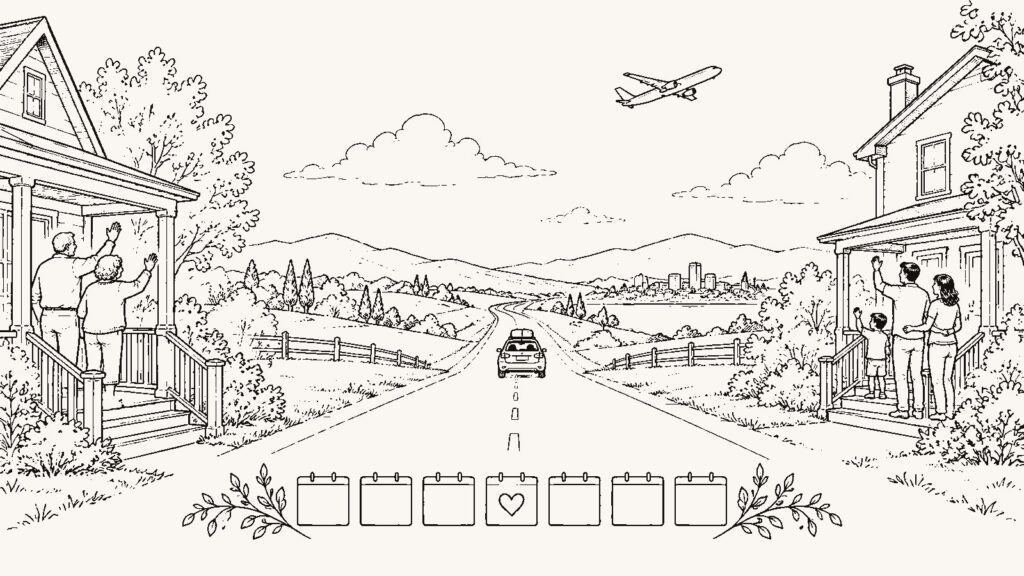
You are deciding whether to sign a lease in the new city before you buy a house there, or to buy on arrival. The answer depends on one thing: how much of your new life you cannot see from where you are standing now.
Renting first is a purchase. What you buy is information, a year of Tuesdays from an address you can leave, and the ability to be wrong cheaply. What you pay is a second move, a storage unit, a second lease with its own deposits and exit terms, two rounds of address changes, and a market that may look different by the time you are ready. Buying on arrival is also a purchase. What you buy is one move and a settled household from the first week. What you pay is committing to an address before you have driven to work from it on a wet Tuesday in October.
Neither is the safe choice. Both cost something. Price both before you pick.
What does renting first buy you?
A year of ordinary weeks from a real address. You learn what the commute does in January, whether the grocery run takes eleven minutes or twenty-six, which side of the highway you keep ending up on, and whether the neighborhood you picked from a map is the one you keep driving through on the way to somewhere else. The cost of that year is that you live it in a place you do not own, with boxes in a storage unit and pictures leaning against walls you cannot nail into.
The ability to leave. If the job ends at the probation review, if the parent you moved to help moves into care, if your spouse cannot find work, or if the household discovers after four months that it dislikes the place, a lease ends on a date and a house does not. The cost is that a lease also ends when you would rather it did not, and the notice period and early-termination terms are set by the landlord and by state law, not by your closing calendar.
Time to choose an agent by the right measure. From a rental you can ask for closed sales in your three target neighborhoods, meet the agent at a house on a Saturday, and watch how he handles an inspection before you depend on him. The cost is that some agents will not put a year of effort into a buyer who is not buying yet, and you may end up with the one who was willing to wait rather than the one you would have chosen.
A commute tested through a full cycle of seasons and school calendars. The cost is that you test it from the rental’s address, which is only useful if the rental sits where you would buy.
What does renting first cost you?
Two moves. Everything a move takes, twice: the days off, the truck, the week of finding where the spatulas went. A second move across town takes the same days off as the first one.
Storage. Whatever does not fit the rental sits in a unit you pay for monthly, and every month you pay for it is a month you are still not sure where you live. Furniture sized for a house does not fit an apartment, and furniture bought for the apartment does not fit the house.
A second lease. Application fees, a deposit, and a contract with a term. If you find the house in month seven of a twelve-month lease, you either pay to leave early or carry rent and a mortgage at the same time. Read the early-termination clause before you sign, and read your state’s landlord-tenant rules, which HUD links by state at https://www.hud.gov/topics/rental_assistance/tenantrights (Official record for the pointer; the rules themselves are set by your state).
Two rounds of everything tied to an address. Driver’s license and vehicle registration on your state’s deadline (Official record; the deadline is on your state motor vehicle agency’s site and varies by state), voter registration, insurance, mail, utilities, broadband installation, and school enrollment. Each one is a small task. Together they are a weekend, done twice.
A market you cannot see from here. Prices and inventory in twelve months may be higher, lower, or the same, and we do not predict which.
A second school change, if you have children and the rental address feeds a different school than the house you eventually buy. The school assigned to an address is set by the district’s attendance boundaries (Official record; look up both addresses on the district’s boundary tool. The school field on a listing is not an assignment).
A household in limbo. Some people settle anywhere in a week. Others cannot feel at home in a place they know they are leaving. Decide which you are before you sign anything.
What does buying on arrival buy and cost?
One move. You unpack once, into the house you will stay in, and the kids enroll once. The cost is that every decision about the address gets made before you have lived a single ordinary week from it.
A settled household from the start. The cost is that you choose the neighborhood, the agent, and the inspector under time pressure, from a distance, on the basis of a scouting trip and a video tour.
The ability to make the house yours from day one. The cost is that if you are wrong about the place, undoing it means selling a house, with the time and transaction costs that carries, rather than waiting out a lease. We do not put a figure on that cost here. Ask your agent what selling in that market involves before you buy.
Write down what you do not know yet
This is the part you can run. Take a sheet of paper and write down every fact about the new place that you do not yet know. “Whether we will like it” is not a fact. “Whether the drive to my mother’s house is 35 minutes on a Sunday and 55 on a Friday at 5” is.
Now sort each unknown into one of two columns.
Column A holds the unknowns you can close from a distance or on a scouting trip. The commute at 7:40 on a weekday. Which providers report service at the address and at what speed, on the FCC National Broadband Map at https://broadbandmap.fcc.gov/ (Provider-reported; call the provider with the street address and ask what tier is physically available). The flood designation for the exact property at the FEMA Flood Map Service Center, https://msc.fema.gov/portal/home (Official record), and what an insurer quotes for it (Provider-reported). The school assigned to the address (Official record, from the district). What the backyard sounds like at 9 pm on a Friday (Personal verification). The scouting trip article, The Neighborhood Scouting Trip: What to Check Before You Make an Offer, walks through closing each one before an offer.
Column B holds the unknowns only living there can close. Whether the job survives its first year. Whether your spouse finds work within a drive you would accept. Whether the commute you tested in June holds in February. Whether the kid who did not want to move settles by spring. Whether you use the lake or the downtown you moved for, or drive past it. Whether the household still likes the place after the novelty is gone.
Now look at the columns. If Column B is empty or holds nothing you would sell a house over, renting first buys you information you could have gotten from a scouting trip, and you pay for it with two moves and a storage unit. If Column B holds even one item that would make you want to leave within two years, renting first is the cheaper way to find out. The second move is the price of not selling a house you bought wrong.
Your neighbor’s list will look different, and so will his answer.
What changes the answer for your household?
Start with whether the reason for the move can evaporate. A job with a probation period, a company on its first year in the city, a remote job that could recall you, a relationship, a parent whose care needs may change. If the reason you are moving can end on its own, the house is the wrong first commitment. The cost of renting under those conditions is a year without settling, and if the reason holds, you moved twice for certainty. If an employer pays for temporary housing for a set number of weeks, that window is your rental clock, and the decision date is set for you.
A house you still have to sell changes the answer too. If your old house has not closed, a lease can absorb the gap between selling and buying. It can also become double housing if the old house sits. How to think about that gap is its own article, Selling One House While Buying Another: How to Think About the Timing. The cost of using a rental as the bridge is that you pay rent while the old house carries its own costs, for a period you do not control.
Children and the school calendar. A rental address assigns a school. If you later buy in a different attendance zone, the child changes schools twice. Renting inside the zone you intend to buy in avoids that, if a rental of the right size exists there. The cost is a narrower rental search, sometimes with nothing in it, and a household that picks a rental for the school and not for the year it will live there. Confirm the assigned school for both addresses with the district (Official record).
Whether rentals exist where you would buy, at the size you need, on the lease terms you need. Some neighborhoods have few rentals at all. Some landlords will not sign for less than twelve months, and a shorter term, where one is offered, may cost more per month. Rent in the neighborhood you would buy in can also run above the monthly payment you would carry there, and that difference is part of the price of the information. Ask a local and ask your agent what is available there and on what terms (Local observation), then check the listings yourself (Personal verification). The cost of renting somewhere other than where you would buy is that the year teaches you about the wrong place.
What the second move costs you in weeks as well as money. Days off work, a second round of finding the pharmacy, the second broadband install appointment, the second afternoon at the DMV. The relocation budget article, Relocation Budget: Costs That Happen Before, During and After Closing, lists what belongs on the page. The cost of skipping the second move is that the first one has to land on the right address.
How much of your life goes into storage, and for how long. A household with a garage full of tools and two large dogs lives differently in a rental than a household with two suitcases and a laptop. Pet rules and unit sizes decide part of this for you. The cost of pushing the household into a rental it does not fit is a year everyone remembers as the bad year.
Homestead and primary-residence filings. Some counties and states offer a property tax exemption for a primary residence, usually on an application filed by a deadline, and a renter does not receive one. Rules and deadlines are set by the county assessor (Official record; check the assessor’s site for the county you would buy in). The cost of missing this is a year of tax you did not have to pay. The cost of chasing it is buying before you are ready to.
Your tolerance for not knowing where the market will be. Renting first means shopping later in a market you have not seen. Some households can hold that uncertainty for a year without losing sleep. Others cannot, and for them the cost of renting first is twelve months of watching listings and wondering. Name which household you are before you decide.
If you rent, rent where you would buy
A lease downtown teaches you nothing about the suburb you intend to buy in. Rent in the neighborhood, or one of the two or three neighborhoods, where you expect to buy, in a home as close as you can get to the type you would buy. Then run the five-places test from that address: write down the five places you go most in a normal week, find the address you would actually drive to for each, and time each trip at the hour you would make it, on a Tuesday, in more than one season. The cost of renting this way is a narrower rental search, sometimes a smaller or older rental than you would have chosen for comfort, and rent that reflects the neighborhood you are testing rather than the cheapest one available.
Set a decision date at month six. By then you know the commute in two seasons, the kid’s school has had a semester, and the job has passed its first review or failed it. If you wait until month eleven to start looking, you look under lease pressure. The cost of a month-six decision is that you may buy with less than a year’s information, which is still more than none.
While you rent, judge the neighborhood by where your car goes. Count how many Saturdays you drive back to the part of town you did not rent in. If the answer is most of them, you have learned where you should buy, and it is not where you are. The cost of learning it this way is a year of rent paid at the wrong address, which is still less than a house bought at one.
If you buy on arrival, close Column A first
Buying on arrival works for households whose Column B is short and whose Column A is fully closed before the offer. Drive the commute at the real hour, both directions. Search the exact address on the broadband map and call the provider. Pull the flood designation and the insurer’s quote. Confirm the assigned school with the district. Stand in the yard on a Friday night. Get the total monthly payment from your lender in the form CFPB describes, which includes principal, interest, property taxes, mortgage insurance where applicable, homeowner insurance, flood insurance where needed, HOA fees, utilities, maintenance, and repairs (Official record; https://www.consumerfinance.gov/owning-a-home/). The cost of this route is that every item on that list gets done on a scouting trip’s schedule, and a Column B item you dismissed as unlikely stays with you at the address you now own.
Then write one sentence next to each Column B item: what happens if this goes wrong, and what does undoing it cost me. If you can read every sentence without flinching, buy. If one of them makes you put the pen down, that is your answer.
What should I ask a local
Ask a person who lives in the neighborhood you are considering. Someone across the metro is describing a different Tuesday.
- Do people who rent here first usually buy here, or somewhere else? Where, and why?
- What does this area feel like in the month I have not seen it?
- How long do rentals my size sit empty here, and do landlords offer leases shorter than a year?
- Which nearby neighborhood do people move to after a year here, and what were they looking for?
The answers are local observation, one person’s experience with that person’s reasons attached. Weigh them, then check the ones that have a source.
What should I ask my agent
- How many of your out-of-state buyers in the last two years rented first? Where did they rent, and where did they end up buying?
- Will you show me rentals in the same neighborhoods you would show me houses in?
- If I rent first, will you still be my agent in eight months, and what will you do between now and then?
- What do people regret when they buy on arrival, and what do they regret when they rent first?
An agent who answers the first question with a number and a street name has done this before. An agent who answers with reassurance has not, or is not telling you.
What must I verify personally
Before you sign a lease:
- Read the early-termination clause and the notice period in the lease itself, then read your state’s landlord-tenant rules through the HUD tenant rights page at https://www.hud.gov/topics/rental_assistance/tenantrights (Official record).
- Look up the school assigned to the rental address on the district’s boundary tool, and the school assigned to the addresses you would buy in. Write both down (Official record).
- Search the rental address on the FCC National Broadband Map at https://broadbandmap.fcc.gov/ and call the provider with the street address (Provider-reported).
- Drive the commute from the rental at 7:40 on a weekday, both directions, before you sign.
- Stand in the rental’s parking lot or yard at 9 pm on a Friday.
Before you buy on arrival:
- Close every Column A item at the exact address: commute at the real hour, broadband map plus a provider call, flood designation at https://msc.fema.gov/portal/home (Official record) plus an insurer’s quote (Provider-reported), assigned school from the district (Official record), and the backyard on a Friday night (Personal verification).
- Check the county assessor’s site for the primary-residence exemption rules and deadline in the county you would buy in (Official record).
- Get the total monthly payment from your lender, itemized the way CFPB describes at https://www.consumerfinance.gov/owning-a-home/ (Official record).
- Write one sentence next to each Column B item saying what it costs to undo.
Either way:
- Run the five-places test from the address you are about to commit to, at the hours you would make each trip, on a Tuesday.
- Count your Column B items and read them aloud to the person you are moving with. The list is the decision.