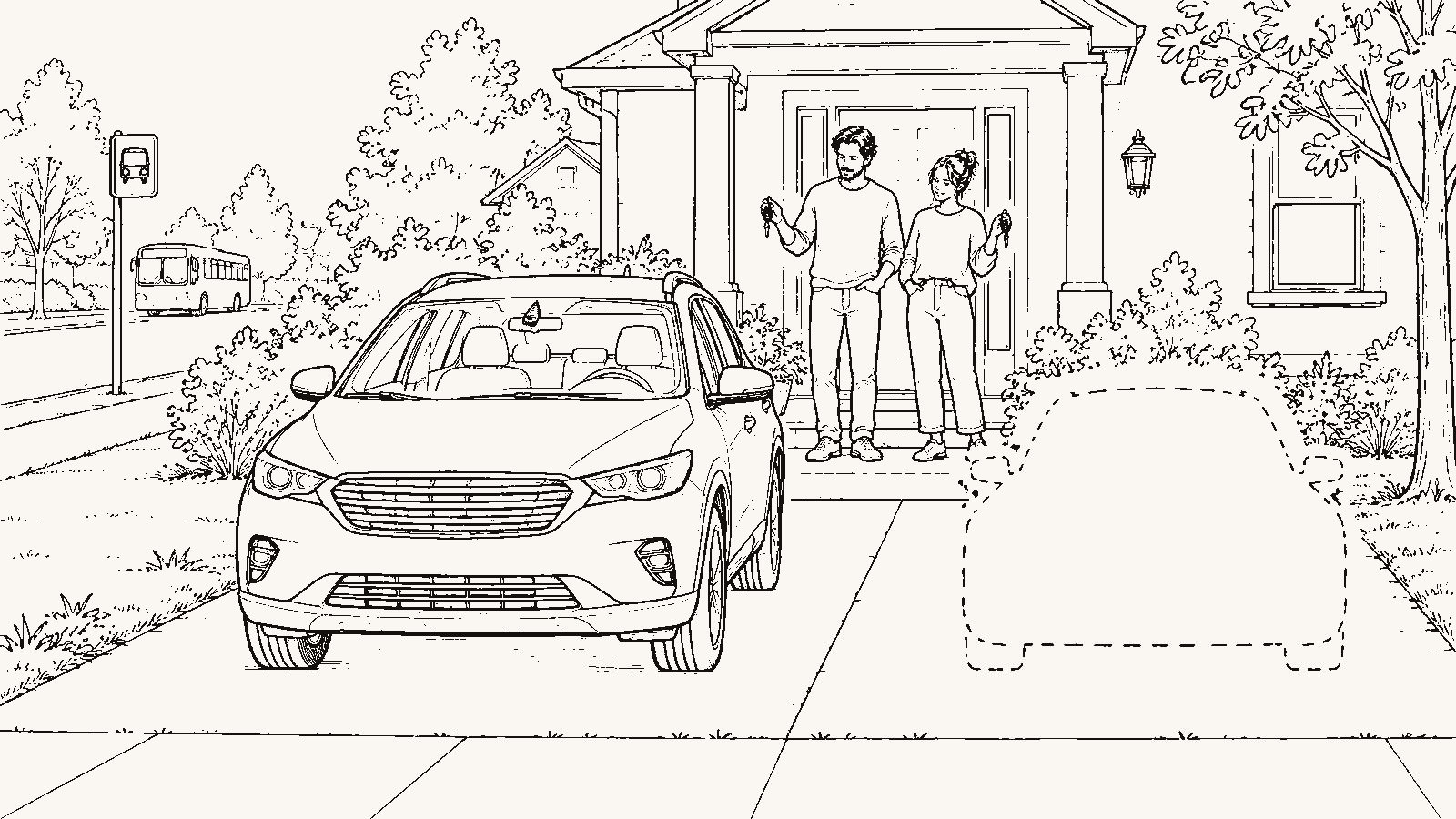
You are not deciding whether you can afford a second car. You are deciding whether the week you are moving toward runs from this address with one set of keys, and what it costs you in hours and money when it does not.
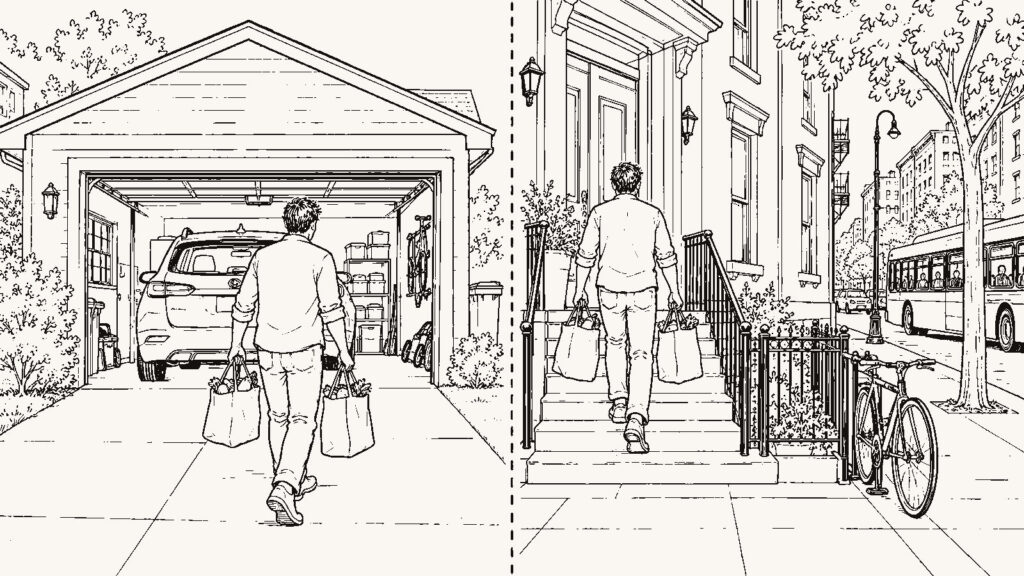
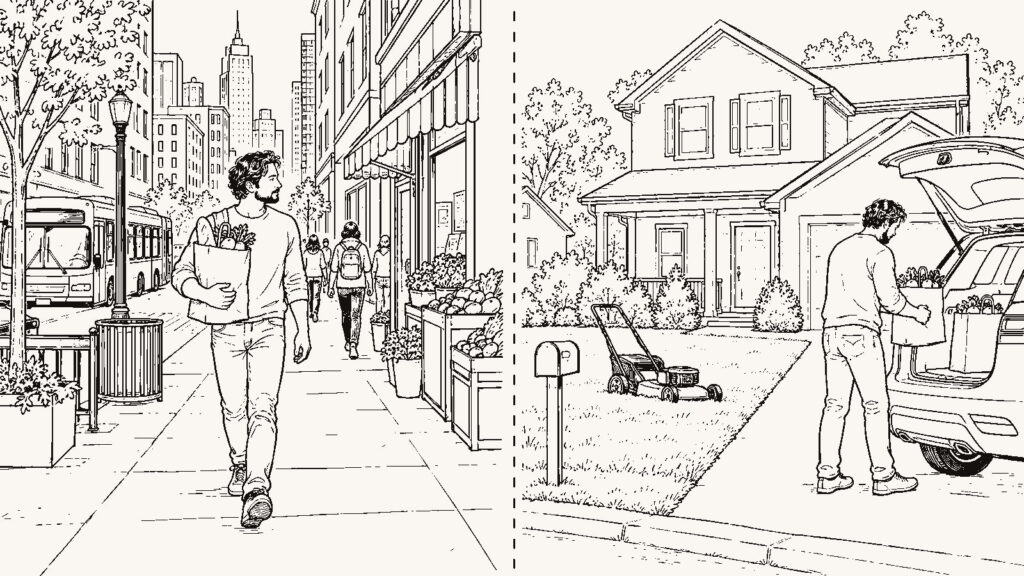
Most households do not decide this. They arrive with the cars they had, and the address decides for them. A couple that shared one car in a city where the second person walked to work buys a house on a road with no bus and owns two cars by Thanksgiving. A family with two cars moves to a street where the school is a six-minute walk and the second car sits in the driveway losing value. Both outcomes are fine if you choose them. Neither is fine if the address chooses for you.
Your housing calculator leaves the vehicle out. The mortgage payment is on the page, the property tax is on the page, and the second car, with its insurance, registration, fuel, repairs, and parking space, is nowhere. The method for deciding is below. The Second-Car Question When You Relocate gives you the arithmetic for pricing it.
Put both of you on one Tuesday with one set of keys
Take a normal Tuesday in the life you are moving toward, and write down every trip both adults make. Put times on them. The commute out and the commute back. The school drop-off and the pickup. Daycare. The grocery run. The gym, the pharmacy, the physical therapy appointment, the evening practice. Put the child’s trips on the same page, because someone drives those.
Now run the day with one car. Every hour when two people need to be in two places, and the second place is not reachable on foot, by transit, or by a ride you would accept, is a collision. Mark it. Do the same for Wednesday if it differs, and for a Saturday. Count the collisions in a normal week.
The count is your answer. Zero or one collision a week, with a fallback for it, is a one-car week. Five a week, each one a negotiation over the keys, is a two-car week even if nobody says so. Somewhere between those is the household that has to decide, and the count at each address is what it decides with. The same household gets a different count at a different address, which is why you run it per address and not once. If only one of you drives, the count is zero by definition, and the question becomes whether the non-driver’s five places are reachable, which is a section below.
The one-car version of this week saves you a second purchase, a second insurance premium, a second registration, a second parking space, and the fuel and repairs that follow a car around. It costs you flexibility. Every collision becomes a ride fee, a schedule change, a swapped shift, or a conversation at 6:40 in the morning, and one breakdown puts the whole household on foot. The two-car version buys independence and a fallback, and it costs a second set of every recurring vehicle expense, plus something less visible: it lets you pick an address where nothing is reachable without driving, and then it locks that address in.
Do your work schedules collide?
Overlap matters before distance does. Two people who leave at 7:30 and 7:45 for workplaces in opposite directions collide every weekday. Two people where one drives to an office and the other works from the kitchen table do not collide at all, until the remote job stops being remote.
Write both schedules on the Tuesday, including the days that are not typical. Shift work that starts at 5:45 may start before the first bus. On-call work means the car has to be at the house on the nights you are on. Travel days mean one person needs the car to reach an airport and the other needs it to reach everything else. A job with a one-day-a-week office requirement is one collision a week.
Look up how residents of the area you are considering get to work. The Census Bureau’s American Community Survey publishes “Means of Transportation to Work” by area at data.census.gov (Official record). It tells you what share of your future neighbors drive alone, carpool, take transit, walk, or work from home. It does not tell you whether your address works. If almost nobody there takes transit, the bus is not most people’s plan, and you find that out before you build your week on it.
Who does the school run, and can the bus do it instead?
The school run is the collision most households miss. It lands at the same hours as the commute, morning and mid-afternoon, and it recurs every school day. Find out whether a bus does it for you.
Find the district’s transportation page: which addresses qualify for a bus, where the walk zone ends, and what time the bell rings (Official record, on the district’s own site). Read it for the school this address feeds into, and then confirm the assignment itself, because the neighborhood school and the assigned school are not always the same building. School Research Beyond a Single Rating covers how to confirm the assignment. If the address is inside the walk zone, the bus is not offered, and a six-year-old’s walk is a parent’s walk.
Bus eligibility takes the school run off the Tuesday. It also puts a child at a stop at a fixed hour that the district sets and you do not, and it leaves the sick-child pickup at 11 in the morning exactly where it was: on whichever adult has the car. Daycare has no bus. Its hours are on the provider’s page (Provider-reported), and a daycare that closes at 5:30 when the second commute ends at 5:45 is a collision every day, with a late fee attached.
Which of your five places can the second person reach without the car?
Write down the five places each of you goes most in a week besides work. Grocery, pharmacy, gym, church, a parent’s house, the pediatrician. The Five-Places Test runs this for the household. Here, run it for the person who would not have the car.
For each place, find the address you would actually go to from this house, and check whether the trip works on foot, by bike, by transit, or by a ride you would pay for every week, at the hour you make it. A grocery store that is a twelve-minute walk on a map is a twelve-minute walk with bags on the way back, uphill, in August. A pharmacy that is reachable by a bus that runs every 40 minutes is reachable on a day when nobody is sick. Mark each place reachable without the car, or not. Be strict.
If three of the five are reachable without the car, the second person has a week that mostly works while the car is gone. If none are, the second person is housebound every workday, and the second person’s week pays for the one-car saving. A spreadsheet does not show that price.
Is there a transit route, and does it run at your hour?
Transit is only a plan if a route exists from this address, in the direction you need, at the time you leave, with enough frequency that one missed bus does not cost you an hour. Check all four.
The transit agency’s own schedule and route map is the record (Official record, on the agency’s site). Trip planners in mapping apps are generally built from that schedule, but they show you a trip on the day you look, not on the day the agency cuts a route, so treat them as an estimate (Estimate) and confirm against the agency’s page. The Federal Transit Administration’s National Transit Database at transit.dot.gov/ntd lists which agencies operate and what service they report (Official record), which helps when you are new enough to a region that you do not yet know the agency’s name.
Look up the trip from the address to the second person’s workplace at the real departure hour. Write down the walk to the stop, the wait, the ride, the transfer if there is one, and the walk at the other end. Then look up the last trip home. A route that gets you to work at 8 and has no return after 6:15 is half a route. Transit takes the car out of the collision and gives you a commute you can read or sleep through. It also gives you the agency’s schedule instead of your own, a walk to the stop in whatever the weather is, and a trip that stops working the year the route is cut.
What does a ride cost you at 6:15 on a weekday?
Rideshare and taxis fill the gaps in a one-car week, if they arrive. Coverage maps in the apps tell you the address is inside the service area (Provider-reported). They do not tell you how long a car takes to reach a cul-de-sac at 6:15 on a Tuesday, or whether one is there at all.
Test it. Stand at the address on a weekday morning with the app open and note the wait time and the fare. Do it again at 5:30 in the evening and again on a Saturday. That is personal verification. A ten-minute wait in the city where you live now tells you nothing about the wait at the edge of the county where you are moving. Rides cover the occasional collision without a second car in the driveway. They cost a fare every trip, the wait is whatever it is that morning, and a household that uses one three mornings a week is paying for a second car in installments.
Ask a neighbor how the street handles it. Carpools, a neighbor who drives the same route, a parent who trades school runs: those exist or they do not on this street, and a person who lives there knows (Local observation).
What does the second car cost at this address?
Price the second car at the address. Your state’s motor vehicle agency publishes registration and title fees, and some states charge an annual tax on the vehicle itself (Official record, on the state agency’s site). The number you pay now is the wrong number once you cross a state line. The Real Cost of a Location lists an additional vehicle as a location cost for this reason.
Call an insurer with the exact street address and ask for two quotes: one car and two cars, both drivers listed on each (Provider-reported). Insurers price by address, among other things, so the gap between the two quotes is a number you get from the insurer and from nowhere else.
Then look at where it parks. A driveway that fits one car, a street with alternate-side rules or a winter parking ban, and an HOA covenant that limits vehicles per lot each turn a second car into a daily problem (Official record: the city’s parking ordinance and the HOA’s recorded covenants). Ask your agent for the covenants before you make an offer. A second car buys a fallback and independence. It costs its own purchase, insurance, registration, fuel, repairs, and a place to put it, and that last item is the one that surprises people.
What happens on the day the one car is in the shop?
Every one-car household has that day. Plan it before you buy the house, because the address decides how bad it is. From a house with a bus route and a grocery store in walking distance, the shop day is an inconvenience. From a house with neither, the shop day is a rental car, a missed shift, a canceled appointment, or a child who does not get to practice.
Write down the plan: a rental from the shop, a ride, a borrowed car, a work-from-home day, or a missed day. Put a cost on it in hours and dollars. Multiply by the number of times a year your car has been in a shop. The plan is the difference between a one-car household that works and one that is one water pump away from buying a second car in a hurry, at whatever price that week offers.
Which way will your week drift?
The count you get today is the count for the week you have today. Weeks drift. A remote job gets called back to the office. A child ages out of the bus and into three practices a week in three directions. A parent nearby starts needing rides to appointments. A daycare closes and the next one is across town. Each of these adds collisions, and none of them announce themselves in the listing.
Run the Tuesday again with the drift you can already see coming. If the count goes from one collision to four when the remote job ends, you are choosing an address on the strength of a schedule you do not control. That can be a fine choice if you make it knowing the second car is coming. It is a bad surprise if you do not.
What must I verify personally
Before you make an offer on a specific address:
- Write the household’s normal Tuesday, both adults and every child, with times and directions, and run it with one car. Count the collisions. Run a Saturday too.
- Look up the transit trip from this address to the second workplace at the real departure hour on the agency’s own schedule. Write down the walk, the wait, the ride, and the last trip home.
- Stand at the address on a weekday at 6:15 in the morning with a rideshare app open and note the wait and the fare. Repeat at 5:30 in the evening and on a Saturday.
- Read the district’s transportation page for the school this address feeds into: bus eligibility, walk zone, stop location, and pickup time. Confirm the school assignment itself.
- Walk from the house to the nearest grocery store and pharmacy. Time it. Carry something back.
- Get two insurance quotes at the exact address, one car and two, with both drivers on each.
- Check the state motor vehicle agency’s fee schedule for registration, title, and any annual vehicle tax.
- Look at where a second car would park: driveway width, street rules, HOA covenants.
- Write the plan for the day the one car is in the shop, with a cost in hours and money.
What should I ask a local
- How do two-worker households on this street handle mornings?
- Does the school bus come at the time on the district’s page, and how full is it?
- When did you last take the bus or train from here, and would you do it every day?
- How long does a rideshare take to reach this street at 6 in the morning?
- Where do second cars park here in winter, on trash day, and during street cleaning?
What should I ask my agent
- Which of the addresses on my list fall inside the school’s walk zone, and which get a bus?
- Do the HOA covenants for this property limit the number of vehicles or restrict street parking?
- Have you represented buyers here who went from two cars to one, or one to two, and what changed for them?