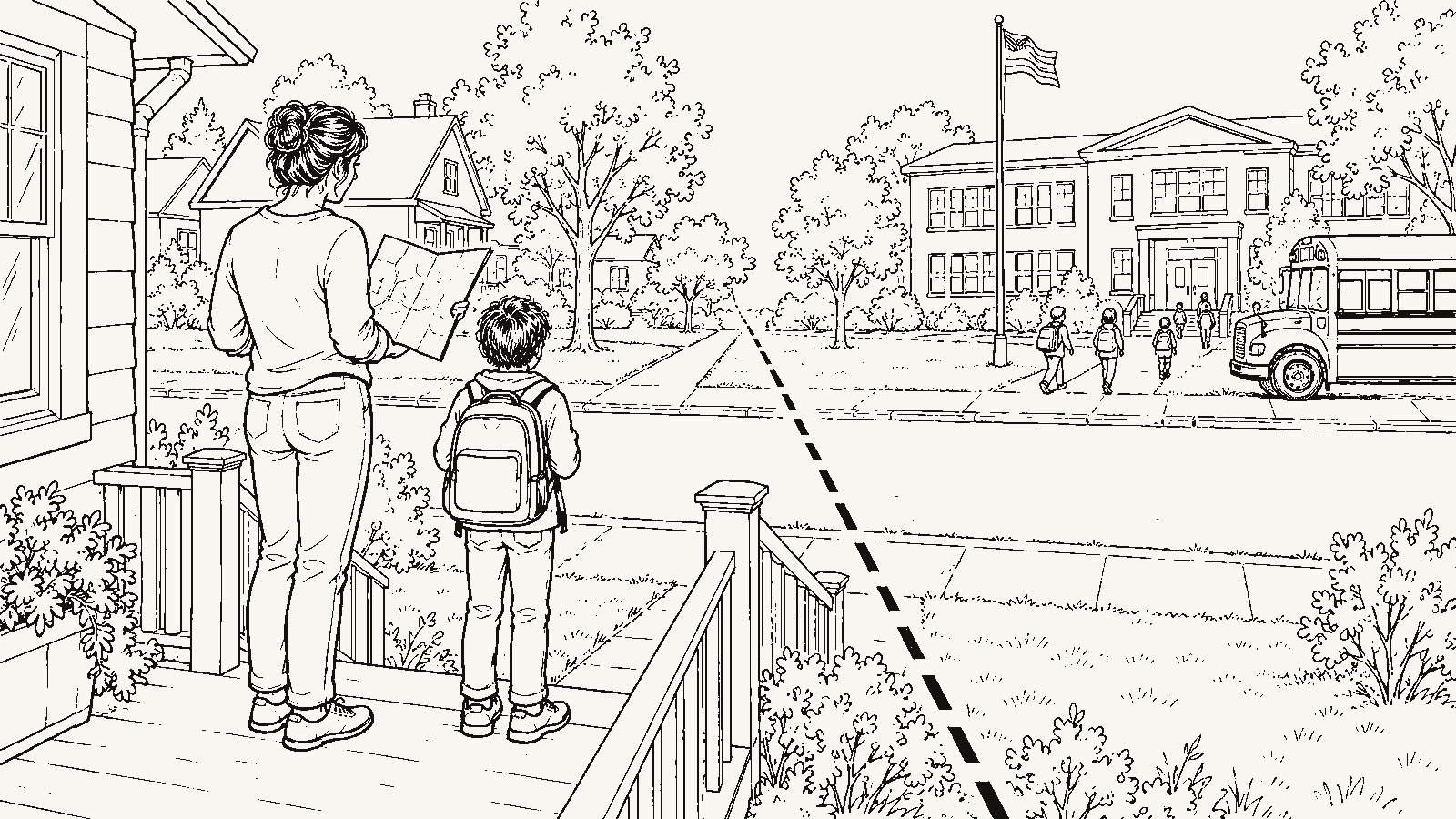
You are not trying to find out whether the school near the house has a good rating. You are trying to find out which school this exact address feeds into, and whether that school runs the program, the bus, and the calendar your kid’s week depends on.
A rating compresses test scores, and sometimes parent reviews, into one number. It cannot tell you that the house sits forty yards on the wrong side of a boundary line, that the dual-language track filled in March, that after-care has a waitlist, or that the bus stop is a twelve-minute walk and the pickup is at 6:50. Those facts decide whether a Tuesday works from this address. All of them are checkable, and none of them are in the number.
Which school does this address actually feed into?
The closest school is not necessarily the assigned one. The elementary school four blocks away may belong to a different attendance zone than the house, and the middle school on the listing may be the one the seller’s kids attended before the district redrew the map. The district’s attendance-boundary locator is the record. Enter the exact street address, including the unit number, and read the result for each grade level your household needs. Screenshot the page with the date visible. That is an Official record. It is also a snapshot: the locator tells you today’s zone and nothing about next year’s. If the district has no online locator, the enrollment office does the lookup by phone.
Then call the district enrollment office and ask two questions: does this address feed into the school the locator shows, and is a boundary study or rezoning pending. Districts redraw lines when a new school opens or an old one closes, and a house that fits the zone in July can sit in a different zone by the following August. The locator will not warn you. A person in the enrollment office usually can. That phone call takes ten minutes and costs you nothing except the chance that the answer changes your list.
If you do not know the district’s official name, the NCES Search for Public School Districts (https://nces.ed.gov/ccd/districtsearch/) lists districts by city and state and shows each one’s address. NCES also runs a school-level search (https://nces.ed.gov/ccd/schoolsearch/) that shows grades served, enrollment, and the school’s address. Both are Official record. Neither one assigns an address to a school; only the district does that.
What does the rating leave out?
Third-party rating sites compress state test data and parent reviews into one score. Label that an Estimate. The state education agency publishes the underlying data as a report card, which every state is required to produce under the Every Student Succeeds Act, and that is an Official record. A report card typically shows proficiency by subject and grade, year-over-year growth, chronic absenteeism, graduation rate where it applies, and enrollment counts. The definitions vary by state. Read the report card’s own explanation of what each number measures before you compare two schools on it.
A single number hides what those measures show. Two schools with the same score can have opposite growth trends, one can serve three times the enrollment of the other, and a school with a middling score can run the only orchestra program in the district. A school with a high score can have no bus service to the street you are considering. Pull the report card for the assigned school and write down the three or four measures your household cares about. Ignore the composite. The cost is an hour on a state website not designed for parents, and a set of numbers that will not settle the question by themselves.
The U.S. Department of Education’s Civil Rights Data Collection (https://civilrightsdata.ed.gov/) reports, school by school, which advanced courses are offered, how many students are enrolled in them, and discipline and special-education counts. It is an Official record, reported by the schools themselves on a lag of a year or more, so confirm any course you see there with the school before you let it decide between two addresses.
Does the program your child needs exist at this school this year?
If your child has a specific need, this is the question you care about most, and it is the one a rating answers least. If your child has an IEP or a 504 plan, call the assigned school’s special-education coordinator. Ask what services are delivered on site and what is delivered at a cluster site elsewhere in the district. The federal framework for an IEP is the Individuals with Disabilities Education Act (https://sites.ed.gov/idea/), which is Official record; the delivery is local and varies by school. If your kid plays in a band, needs a gifted track, wants a dual-language classroom, or is counting on a specific sport, call the school and ask whether it runs this year, at this campus, for that grade.
Ask “this year” on purpose. Programs move. A magnet track gets consolidated to one campus, a teacher retires and the AP physics section goes with him, a district cuts middle-school orchestra to balance a budget, a start time shifts forty minutes earlier. If the program lives at a transfer school instead of the assigned one, ask what the transfer process is, when the window opens, whether a lottery decides it, and whether the district provides a bus to the transfer school. Choosing a house for a program buys you the program only for as long as the district keeps offering it, and only if the transfer comes through. Put that risk on the page next to the house.
Can your kid actually get there at 7:40?
The district transportation office answers four questions: is this address inside the bus-eligible distance, where is the stop, what time is pickup, and how long is the ride. Bus eligibility often depends on the distance from the address to the school along walking routes, which the district measures its own way, so a house on one side of a street can be eligible and its neighbor across the street not. That is Official record. Call before you assume the bus comes.
If you plan to drive, run the trip yourself at the real drop-off hour on a school day. A seven-minute drive at 10 a.m. can be a twenty-minute drive at 7:40 behind the pickup line, and then you still have the drive from the school to work. Add both legs to your week. A house that puts the school on the way to work saves you a trip a day; a house that puts the school in the opposite direction adds one, and the map at noon will not show you the difference. The cost of testing this is a morning of your scouting trip spent in traffic, which is exactly the traffic you would be buying.
Does the calendar fit the household’s work hours?
Pull the district calendar and the school’s bell schedule. Note the start time, the dismissal time, the early-release days, and whether the district runs a traditional or year-round calendar. Lay both parents’ work hours next to them. A school that dismisses at 2:15 with early release every Wednesday is a childcare question, and the answer to that question is a monthly cost or a change in someone’s schedule. Ask the school what before-care and after-care exist on site, what they cost, and whether they have a waitlist. A house near a school with no after-care can cost you more per month than a house near a school with it. No listing carries that line.
What about extracurriculars, and where are they held?
Ask which activities run at the school, which require a tryout or a fee, and where practices happen, because a travel team that practices at a field across the county is a second daily drive. A robotics club that meets until 5:30 is a pickup problem for a parent whose shift ends at 5:30 across town. The front office or the athletic director can answer most of this. A parent at the pickup line can tell you which ones fill. That is Local observation. It is the fastest way to learn what the school’s page leaves out, and it is one household’s experience, so confirm anything that changes your decision with the front office.
What are the enrollment rules?
Ask the district registrar what proof of residency it requires, how soon after closing you can enroll, and whether a child already enrolled stays at a school after a boundary change. If the district has open enrollment, magnet lotteries, or charter options, ask for the application window, because those windows commonly close months before a summer move. Open enrollment and choice programs widen your options and can free you from the boundary line entirely. They also add application deadlines and waitlists. Often they add no bus, so the daily drive falls on you.
Private schools are a separate search. The NCES Private School Search (https://nces.ed.gov/surveys/pss/privateschoolsearch/) is an Official record of location, grades, and enrollment. Tuition, admissions, transportation, and the calendar come from the school itself. A private school removes the boundary question for as long as you pay the tuition, and it adds that line to the monthly total from the day you enroll.
Two houses, same district, same price
House A sits inside the boundary for the school that runs the dual-language program your daughter is in now. House B is 0.4 miles away, across the boundary line, assigned to a school without the program, and it is eleven minutes closer to work.
Price both. House B saves eleven minutes each way, which at five days a week for 48 weeks is about 88 hours a year. House B also means applying for a transfer to the program school, which the district may deny, and, if it approves and the bus does not cross zones, driving your daughter there yourself. That drive may cost you more than the 88 hours you saved, and it may cost you the program if the transfer is refused. House A keeps the program and the bus and adds 88 hours of commuting. Either can be the right answer for a household. See both columns before you choose, and choose on purpose.
Why your agent will not tell you whether a school is good
A real estate agent who characterizes a school’s quality risks steering, and HUD’s fair-housing guidance (https://www.hud.gov/program_offices/fair_housing_equal_opp) is why many agents decline to answer that question. That is an Official record and a reasonable refusal. What an agent can do is pull the boundary locator result for every address on your list and tell you which listings sit close to a line. He can also hand you the district contacts. Ask for that instead. An agent who will not do the locator check for you is telling you something about how he handles remote buyers. An agent who will do it still hands you a screenshot, and the confirming call to the district remains yours to make.
Where this article fits
The boundary check is one instance of the rule in What to Verify Yourself Before You Trust Any Relocation Guide: find the record, not the summary. The school is usually one of the five places on your list in The Five-Places Test: Can This Neighborhood Actually Support Your Week?, and the same discipline of going behind a single number runs through Neighborhood Safety Research Without Guesswork.
What must I verify personally
Before you make an offer on this address:
- Run the exact street address through the district’s boundary locator for every grade level in the household, screenshot the result with the date, and confirm it by phone with the enrollment office. Ask whether a boundary study is pending.
- Call the assigned school and confirm that the specific program your child needs runs this year, at this campus, for that grade. If it is at a transfer school, get the transfer window, the lottery rules, and the bus policy.
- Call the transportation office with the address. Get bus eligibility, the stop location, the pickup time, and the ride length.
- Pull the district calendar and the bell schedule. Lay both parents’ work hours next to them. Ask about before-care and after-care, their cost, and their waitlist.
- Drive from the house to the school at the real drop-off hour on a school day, then from the school to work.
- Stand at the pickup line at dismissal and watch how it runs.
- Pull the registrar’s list of enrollment documents and the date you can enroll after closing.
What should I ask a local
Find a parent whose child attends the assigned school and ask: What changed at the school this year? Does the bus arrive when the schedule says? Which programs have waitlists? How long does the pickup line take? Has anyone at a board meeting mentioned redrawing the boundaries? Label every answer Local observation, and confirm the ones that change your decision with the district.
What should I ask my agent
Will you pull the boundary locator result for every address on my list and confirm it with the district? Which of these listings sit near a boundary line? Does the seller’s disclosure say anything about school assignment? Will you send me the district enrollment, transportation, and registrar contacts? An agent who answers those four questions has done the part of the school research that is his to do, and he has left the judgment where it belongs, with you.