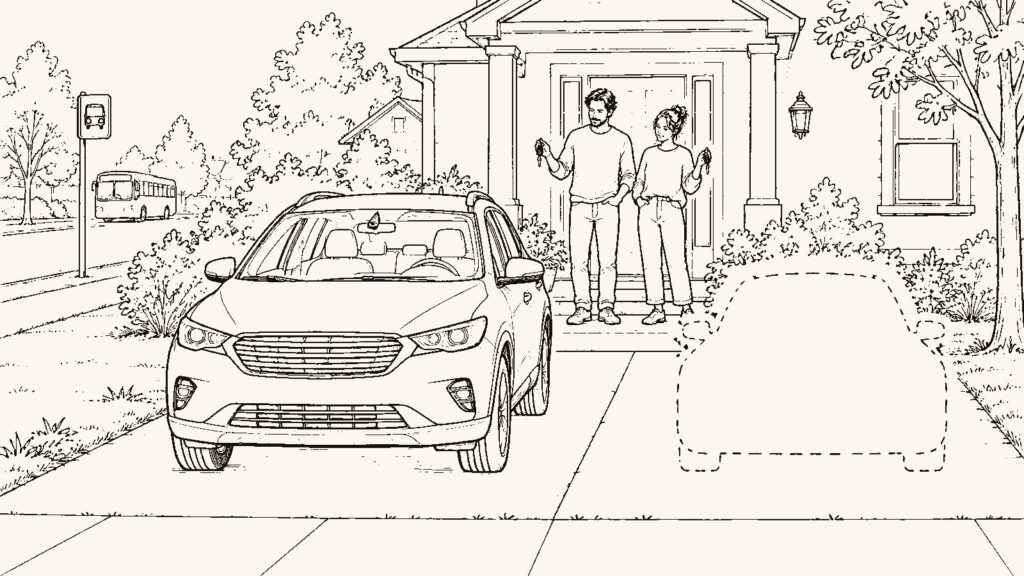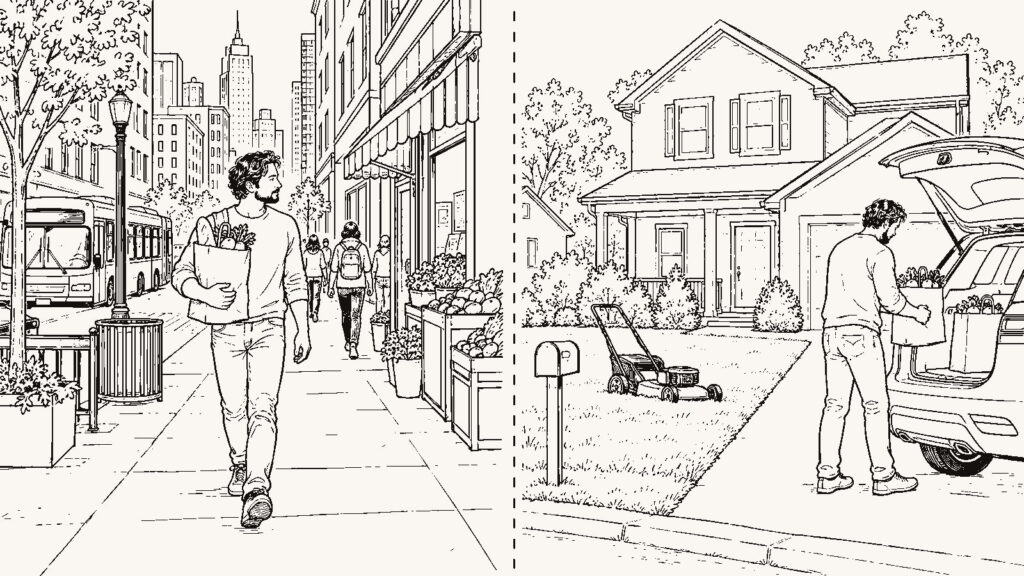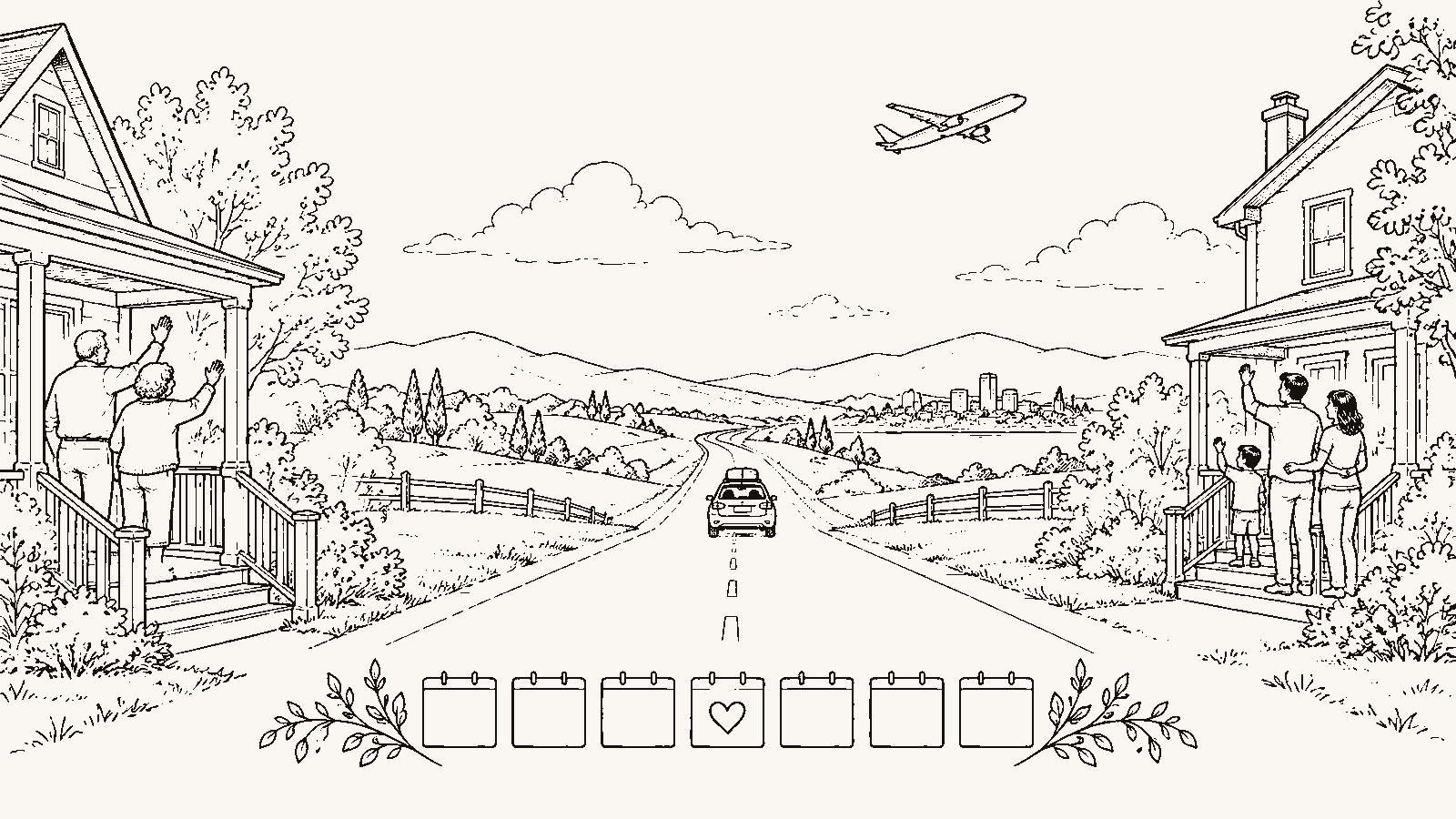
You are not deciding whether your mother matters more than the job. You are deciding whether a specific number of hours, driven or flown at the frequency your life runs, still lets the Sunday dinners, the Wednesday child care, and the midnight hospital call happen from the address you are considering.
The easy answer is a feeling. “It’s only four hours.” “We’ll fly back all the time.” Then the household moves, and the four hours becomes an overnight bag, and “all the time” becomes Thanksgiving. The National Association of Realtors reports in its 2025 Profile of Home Buyers and Sellers (https://www.nar.realtor/research-and-statistics/research-reports/highlights-from-the-profile-of-home-buyers-and-sellers) that 47 percent of buyers named convenience to friends and family as a factor in choosing a neighborhood. That is an official record of what buyers said they wanted. It says nothing about whether the distance they chose delivered it.
Count last year’s visits before you decide anything about next year’s
Open your calendar and go back twelve months. For each person you rely on, or who relies on you, write down every visit: the date, who traveled, and how long it lasted. Include the ones that were not planned, the Tuesday you drove over because the furnace quit, the weekend you took the kids so your sister could work. Use the calendar and your texts, not your memory. The cost of counting honestly is that the ledger sometimes shows a relationship already thinner than you tell yourself, and you have to decide with that in view. The alternative is to decide against a memory of a family that gathers every other weekend when the calendar shows it gathers at Easter and in August.
This ledger is the unit of measurement for the whole decision. It tells you the frequency you are trying to keep, which is different from the frequency you would describe if someone asked. The household that says “we see my parents all the time” sometimes counts fewer visits than the one that says “we hardly see them,” once the drop-ins and the shared holidays are in. The count is the baseline the new address has to match, or fall short of by an amount you have chosen on purpose. If the ledger shows two visits a year, distance is not the question this move turns on, and the cost articles will do more for you than this one.
Now write the ledger a second time, at the new distance. Go trip by trip and ask: at this door-to-door time, would this visit still happen? The furnace trip does not survive a four-hour drive, and neither does the weeknight birthday dinner. The weekend with the kids might, if your sister brings them halfway. The Easter trip survives almost any distance. The number of surviving visits is your answer to “how far is too far,” and it is a number you can argue with your spouse about, which a feeling is not.
Drive the trip at the hour you would drive it
A routing app gives you a drive time. That is an estimate, produced for the moment you asked, and the moment you asked was probably a Sunday afternoon at the kitchen table. The trip you will make leaves on a Friday at 4:15 after work, with a stop for the child who needs to eat and the dog that needs to be dropped somewhere. Drive it at the hour and day you would leave, and drive back at the hour you would return. Write both times on the ledger next to the estimate. Driving the route costs you a day you would rather spend on houses, and the drive you make once, on a clear day, still understates the one you make in November in the dark. Do it anyway, because the app cannot tell you that the last forty minutes are a two-lane road behind a truck. If you cannot drive it before the offer, run the app at those hours and days, and label the result an estimate on the ledger until you have made the trip.
The state’s 511 traveler information service, listed by state at the Federal Highway Administration’s 511 page (https://www.fhwa.dot.gov/trafficinfo/511.htm), tells you which stretches of the route have long-term construction and which close for weather or require chains in winter. That is an official record. A three-hour route with a mountain pass on it is a three-hour route from May to October and something else in January, and the hospital call does not check the season. The service shows what the state has posted, and it will not show the closure that starts the week after you looked, so check it again before each trip you are counting on.
Watch one line on the ledger. The distance at which a trip stops being “there and back in a day” and becomes “we need a bed for the night” changes the frequency more than any other single fact. A two-hour drive each way is a Sunday. A four-hour drive each way is a weekend, and weekends have other claims on them. Where the line sits depends on your household: a couple without children pushes it out, and a family with a toddler and a Saturday soccer schedule pulls it in. Find your own line, and be honest that a trip past it will happen a few times a year, however close the map makes it look.
Price the flight in hours, not dollars
When the distance is a flight, the airfare is the first number on the screen, and it is the least useful one for this decision, because it changes weekly and you can shop it. The hours do not change, and you cannot shop them.
Build the day on paper. Start at the front door of the house you are considering. Add the drive to the airport at the hour of the flight, the parking or the ride, the time you have to be there before departure, the flight, and on the other end the drive from that airport to the family’s door. Write the total on the ledger next to that person’s name. Then do it in reverse for the trip home, including the flight that lands late and the drive after it. The result is the length of a visit day, and it decides whether a weekend trip is two days with family or one day with family and two days in transit. Building it takes an evening, and the total is rarely the number you have been telling yourself.
Then check the pair of airports themselves. Look up which airport serves the address, which serves the family, and pull the airline’s published schedule for the month you would fly, since days of the week and nonstop status can change by season. That is provider-reported. A route that shows a nonstop in July may connect in February, and a connection adds hours the schedule shows only if you look. The Bureau of Transportation Statistics publishes on-time and cancellation figures by airport and carrier (https://www.bts.gov/topics/airlines-and-airports). That is an official record, and it tells you how often flights from that airport, on that carrier, left late or did not leave.
Flying keeps a long-distance family in reach, and it puts every visit behind a booking, a schedule, a security line, and a weather system. A drive can leave at nine tonight when the call comes. A flight leaves when the airline says, and you reach a parent’s bedside the next day, after you have found someone to take the kids.
List the help you give and the help you get
The ledger so far counts visits. Now add the trips that are not visits: the standing commitments that run in both directions.
Write down what you do for people. The parent’s Thursday appointment. The nephew on the nights your brother works late. These trips are fixed to someone else’s calendar, and they do not move when you move. At the new distance, each one either transfers to another person, becomes a paid service, or stops. Write next to each which of the three it will be, and for the ones that transfer, the name of the person who agreed to take it. A name you cannot write down is a trip that stops. Getting a name means asking a sibling to take on a Thursday that was yours, and that conversation is part of the cost of the move.
Then write down what people do for you. The grandparent who takes the children on Wednesday. The brother with the truck. The friend who has a key and feeds the cat. The person who sat with your kids during the last emergency. Each of these becomes, at the new address, a bill, a favor you have not yet earned from a neighbor you have not yet met, or a gap. Price the bills. Child care that a grandparent covered for free is a line on the monthly budget now, and it belongs in the location cost you calculate for the address, next to the taxes and the commute. The favors from strangers arrive in their own time, and you cannot schedule them. Counting the help you receive is uncomfortable, because it puts a number on something people prefer to think of as love. The number is there whether you write it down or not, and a household that skips this step finds it on the first Wednesday the grandparent is four hours away.
Run the emergency once on paper
Pick the call you dread and walk it through from the new address. It is 11 pm on a Tuesday in February. A parent has fallen and is in the emergency room. Write down: how you get there, how long it takes from this address at that hour and in that season, who is at your house with your children while you are gone, and who covers your work on Wednesday. Then run the reverse: you are the one in the hospital, and the people who would come are the ones on the ledger. How long until the first one arrives? This costs you an evening and an unpleasant picture, and the picture is worth having before the offer rather than after the call.
The answer is a fact about the address, the same kind as the flood zone or the school boundary, and it belongs in the decision with the same weight. Some readers run this and find the new distance turns a two-hour response into a next-day one, and they move anyway, because the job is the thing they moved for and they have decided that on purpose. Other readers find the same thing and choose a house forty minutes closer to the interstate. Either way, you decided it before the call came.
The Eldercare Locator, run by the U.S. Administration for Community Living (https://eldercare.acl.gov/), gives you the area agency on aging and the local services near a parent’s address. That is an official record of what exists locally, and it tells you what a parent could reach without you: transportation to appointments, meal programs, in-home help, and who to call. Look it up for the parent’s address, and call the agency to ask what is available now and what the waiting list looks like, because a listed program and an open slot are different things. Knowing what is there lets you see which of your trips a local service could replace and which no service replaces.
Ask who else will make the trip, and for how long
A three-hour drive is three hours on the map in both directions. Whether the other household drives it is a different question. A parent who drives three hours to see grandchildren today may not drive it in five years and may not fly it in ten. A friend with a young family may make the trip once and then find reasons. Two households traveling produced the frequency you counted last year. At the new distance, one may have to.
Ask each person on the ledger the direct question: at this distance, how often would you come, and how would you get here? Write the answer next to their name. Then ask yourself the harder one: in five years, is that still true? Adjust the ledger to match. A trip that depends on a parent in his late seventies driving alone through a winter state is a trip you will be making, in the other direction, sooner than the current calendar suggests. Asking costs you a conversation some families avoid, because the honest answer might be “less than you hope.” Skipping it costs you the discovery two years in, when the visits have thinned and nobody said so out loud.
What should I ask a local
- How long does the drive to the airport take at 5 am on a weekday, and where do people who fly often park?
- Which routes out of town close or slow in winter, and for how many weeks?
- What does the drive to the interstate look like on a Friday afternoon at 4:30?
- If a parent lived here alone, what local help exists, and which of it do people use?
Those answers are local observation. They tell you what a person who makes the trip has seen, and they tell you which of the routing app’s numbers to distrust.
What should I ask my agent
- Of the out-of-state buyers you have represented in the last two years, how many moved away from family, and how many of those are still in the house?
- Which side of town shortens the drive to the airport, and what does that side cost in commute and in price?
An agent who has closed sales with relocating buyers may have watched some of them leave. The number of buyers who stayed is a fact he can give you, and it is more useful than his opinion of the schools because you can check it.
What must I verify personally
Before you make an offer on the address:
- Drive from the exact address to each family address on the ledger at the day and hour you would leave, and drive back at the hour you would return. Write both times next to the routing app’s estimate. Personal verification.
- Check the 511 service for every state the route crosses for seasonal restrictions and long-term construction on that route. Official record, at https://www.fhwa.dot.gov/trafficinfo/511.htm.
- Find which airport serves the address, drive to it at the hour of the flight you would take, and pull the airline’s schedule for the month you would fly. Provider-reported until you have flown it.
- Check the Bureau of Transportation Statistics figures for on-time performance and cancellations at that airport and on that route. Official record, at https://www.bts.gov/topics/airlines-and-airports.
- Look up the parent’s address in the Eldercare Locator at https://eldercare.acl.gov/ and call the area agency on aging to ask what is available now. Official record.
- Run the 11 pm emergency on paper from this address, in both directions, and write down who is at your house while you are gone.
- Ask every person on the ledger how often they would make the trip and how, and write the answer next to their name.
- Add the child care, pet care, and help that family currently covers for free to the monthly cost of the address, and put that number in the location cost you are calculating for the house.
The distance to work gets the same treatment in Commute Math: What Extra Drive Time Actually Costs You in a Year (https://beforethekey.com/blog/commute-math-what-extra-drive-time-actually-costs-you-in-a-year/) and How to Test a Commute Before You Trust the Map (https://beforethekey.com/blog/how-to-test-a-commute-before-you-trust-the-map/). What replaces the help you left behind is the subject of How to Rebuild Your Weekly Routine After a Relocation (https://beforethekey.com/blog/how-to-rebuild-your-weekly-routine-after-a-relocation/).