You are deciding whether the week you would live from a city address is the week you are moving for. The listing shows you the square footage and the price; it does not show what parking, space, noise, transportation, storage, and recurring costs do to an ordinary Tuesday once the driveway is gone.
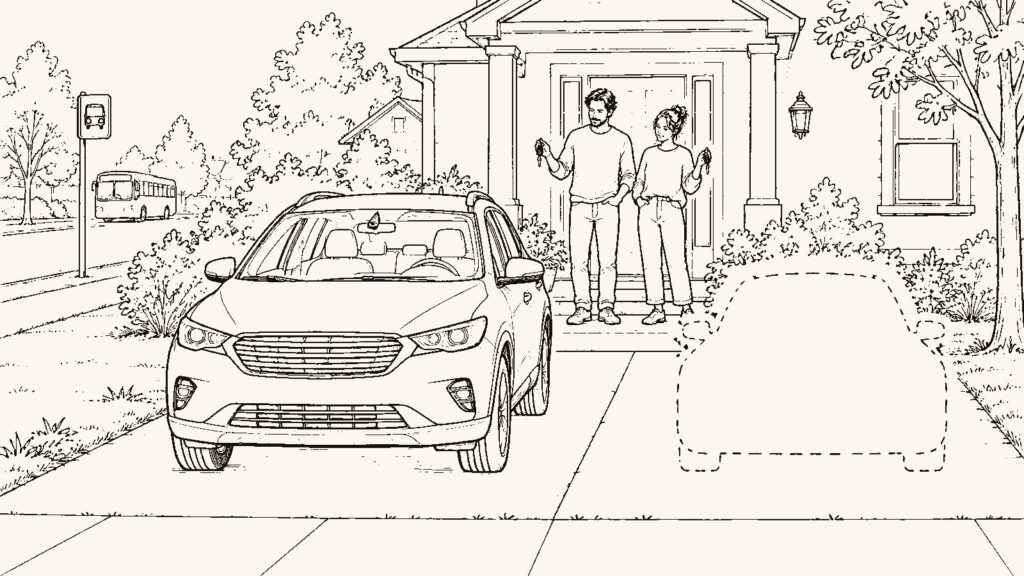
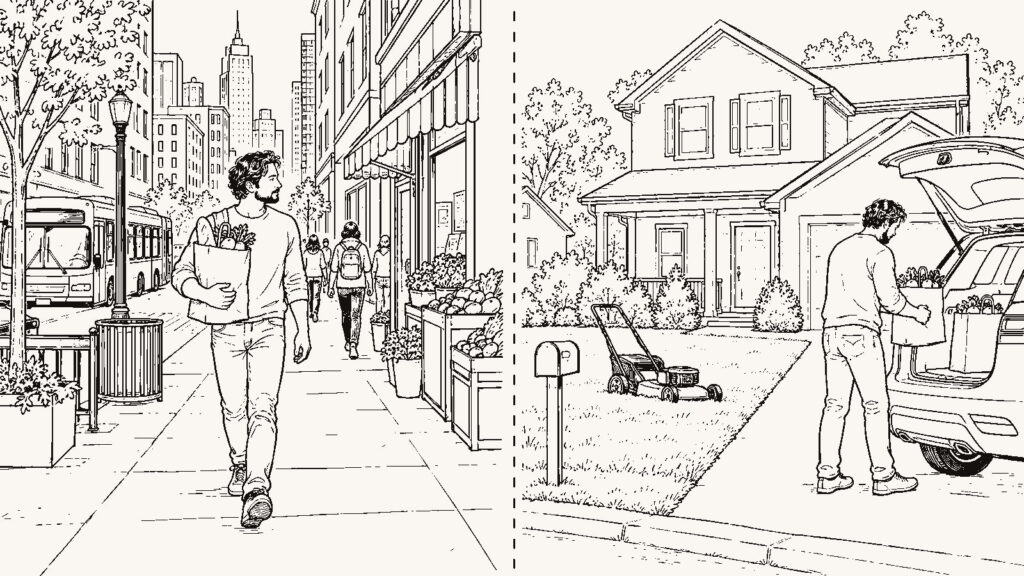
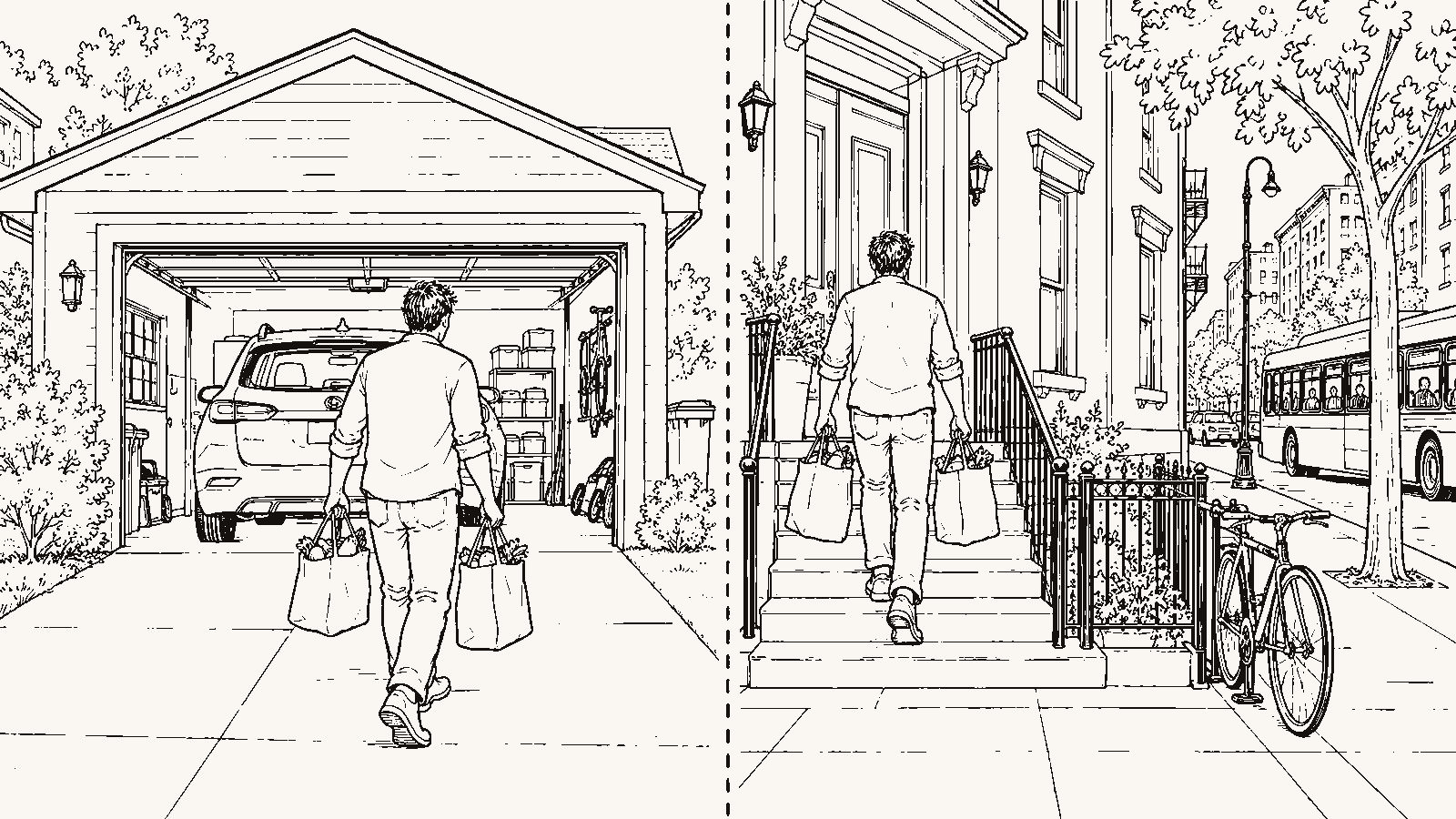
A suburban week is built around the car. You leave the garage, drive to each place, park at the door, carry the bags in from the driveway, and the quiet starts at nine. An urban week is built around the radius you can cover on foot and the schedule of whatever moves you farther than that. Both weeks work. They work for different lives, and they cost different things. The job before you look at units is to run your own week from both addresses and see which costs you are willing to pay.
Run your Tuesday from both addresses
Write down the five places you go most in a normal week: work, groceries, school or daycare, the gym or the field, the parent or the friend you see most. Then fill in this table twice, once for the house you live in now and once for the candidate address.
| Trip | From the house now | From the city address |
|---|---|---|
| Work, leaving at the real hour | ||
| Groceries, with the bags home | ||
| School, daycare, or the weekly practice | ||
| The person you visit most | ||
| The one errand you make on the way home | ||
| Where the car sleeps, and what it costs | ||
| Where the bikes, tools, and seasonal gear live | ||
| What you hear at 10 pm and 6 am |
For each row write the mode (car, walk, transit, bike, ride-hail, delivery), the minutes door to door, and whether it costs money each time. The suburban column costs fuel and time and rarely costs a fare. The urban column often costs less time and more money per trip, or the reverse, depending on the block. Time the trips yourself; a cell filled from a map is a guess. The rest of this article tells you what belongs in each row.
Where does the car go?
In the suburb the car has a place before you do. In the city the parking space is a separate asset with its own price, or it does not exist. A listing that says “parking” can mean a deeded space that transfers with the unit, an assigned space the association can reassign, a rented space in a garage two blocks away, or a street permit that entitles you to search. Ask the agent which of the four it is and whether the price of the unit includes it. A deeded space raises the price and the monthly fee. An assigned space is yours until the association says otherwise. A rented space is a line you pay every month for as long as you own the car, and a permit is cheaper and buys you the right to circle.
The city governs street parking. Its parking authority or transportation department publishes the residential permit program, the permit cost, the street-cleaning schedule, and the tow-away hours, and the municipal code on the city’s own site carries the rules behind them. That is the official record. It tells you the rules; it does not tell you whether a space is open at 6:30 on a Tuesday. Arrive by car at that hour, time the search, and repeat it at 10 on a Saturday night. What you find at those two hours is close to what you will find most weeks. Guests do the same search, and a permit for your car is rarely a permit for theirs.
Keeping the car has a cost the suburb never charged you: the space, the permit, the tickets from the street-cleaning day you forgot, the garage fee if you give up on the street. Giving up the car has its own cost. Every trip that transit does not serve at your hour becomes a fare or a delivery charge, and the trip to the parent an hour away becomes a rental. The article on whether you need one car or two after you move works through that decision. The question here is smaller: put the car’s address in the table next to yours, because the city charges rent for both.
What happens to the rooms you use every evening?
The square footage drops, and you expect that. The part you may not expect is which room goes. Walk through a normal evening at home and name where each thing happens: where you work when you work from home, where the kids do homework, where eight people sit when family visits, where the second person showers while the first one is in the bathroom. Then find each of those on the floor plan of the unit. The room that is not there is the one you will feel every weeknight.
A smaller unit moves part of your Tuesday out of the home. The office becomes the library, and the dinner for eight becomes a restaurant. For some households that trade is the reason for the move, and it pays when the places outside are close and you like being in them. It is also a monthly line each time, and a household that spends its Saturday at home has less home to spend it in. Decide which side you are moving for before you decide the unit is big enough.
What will you hear at 10 pm and at 6 am?
A shared wall, a shared ceiling, a bus route under the window, a bar on the corner, garbage trucks before dawn, the sirens on the way to the hospital. The city’s noise ordinance, in the municipal code on the city site, sets the hours and the limits. That is the official record of what is permitted. It is silent on what you hear, and the two are not the same measurement.
Stand in the unit with the windows closed at 10 on a Friday night. Come back at 6 on a weekday morning, when the deliveries and the collection trucks run. Ask which side of the building the bedroom faces and which side the loading zone is on. In many buildings the rear-facing or top-floor unit is the quiet one, and the price shows it, or the light and the view pay for it. The listing photographer came at noon on a weekday with the windows shut. You are buying every other hour.
How do the five places get reached without a driveway?
The route map shows where the transit line goes. The schedule shows whether it goes there at your hour. Pull the agency’s published timetable for the line you would ride, and read three numbers: the frequency at 7:40 on a weekday, the last trip home on the night you would take it, and the weekend service. That is the official record. Agency-level ridership and service data are in the National Transit Database at https://www.transit.dot.gov/ntd, and the Census Bureau publishes how the households in a given tract report getting to work at https://data.census.gov/, under Means of Transportation to Work. Both are official records; the Census figure is a survey estimate with a margin of error, and it describes the neighbors’ habits, not your trips.
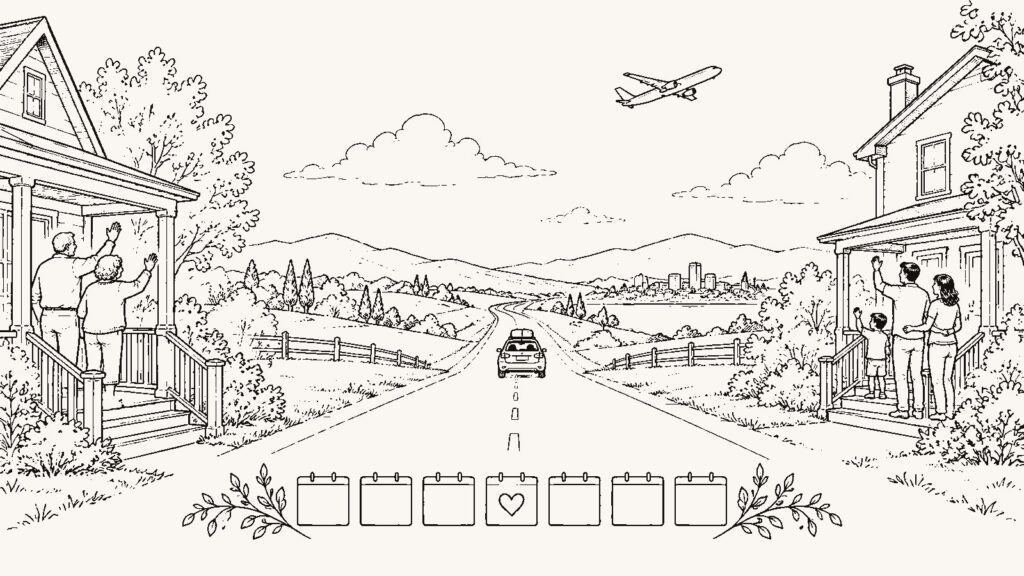
Then ride it. Board at your stop at your hour and ride to the place you would go. A line that runs every eight minutes at rush hour and every forty on a Sunday afternoon serves the commute and fails the visit to the parent. A bike lane on the map is a lane at 2 pm and a parked delivery truck at 5:30. Walking carries the groceries home in your arms. The store that is a six-minute walk is a fourteen-minute walk with two bags in the rain. Every one of those trips is cheaper and shorter than the suburban version, or it is a ride-hail fare you pay four times a week, and the table tells you which once you time it.
Where do the bikes, the tires, and the freezer live?
The garage, the basement, the attic, and the shed disappear together. So does the place the winter tires, the camping gear, the stroller, the second freezer, the tools, and the Christmas boxes were living. Ask the agent what storage transfers with the unit: a locker in the basement, a bike room, a cage in the garage, or nothing. Read the association’s rules on what the building lets you keep in the hallway, on the balcony, and in the space, because the answer is often less than you assume, and the rules are the official record of what the building allows.
What does not fit goes to a rented storage unit, which is a monthly line and a drive, or it goes away. A storage unit across town holds the tent fine; it does not hold it on the Saturday morning you decide to go camping. The cost of a smaller life is the trip to the locker, more than the rent on it, and the number of things you stop doing because they are in it.
Which monthly lines appear and which disappear?
The CFPB describes a total monthly housing payment as principal, interest, property taxes, mortgage insurance where it applies, homeowner insurance, flood insurance where needed, association fees, utilities, maintenance, and repairs, at https://www.consumerfinance.gov/owning-a-home/. That is the official record of what the payment contains. In a condo the association fee is a line the suburb did not have, and it moves. Pull the association’s current budget, its reserve study, and the last year of meeting minutes; that is the official record of what the fee covers, whether the reserves are funded, and whether a special assessment is coming. The county assessor’s record for the parcel gives you the property tax, and the city finance office lists any city-level taxes or fees that a suburb did not charge; both are official records. Get an insurer’s quote for condo or renter’s coverage at the exact address; that is provider-reported, and it is the only number that answers what the coverage costs. If you rent the unit, the association’s budget is the landlord’s problem and the fee sits inside your rent; the parking, storage, and transit lines are still yours. In a rowhouse with no association, the roof is yours again and the fee is zero, and the parking and noise rows do not change.
Then list the lines the city adds that the suburb did not have: parking, storage, transit pass, ride-hail, delivery fees, the gym that replaced the basement, the restaurant that replaced the dining room. And list the lines the suburb charged that the city may drop: the second car and its insurance, fuel, lawn and snow, a larger heating and cooling bill, the repairs on a roof that is now the association’s. We do not estimate your numbers; the article on the real cost of a location shows the full sheet for you to fill in. The sheet has more rows in the city. Some are smaller than the suburban ones, and some are new.
Good for which life, and at what cost?
Put the trade on one page. On the gain side: the commute may shrink or stop being a drive; the grocery run becomes a walk; the yard and the roof stop consuming Saturday; a second car may go; more of your week happens within a mile of your bed. On the cost side: the rooms shrink, and one of them is the one you used every evening; quiet becomes a unit you pay extra for; the car you keep rents its own space, and the gear you own rents its own room. The association fee moves on a vote you do not control. The errands the suburb absorbed into a drive now each carry a fare, a bag, a wait, or a delivery charge. If you already spend your evenings out and your Saturdays away from the house, the cost side shrinks; if the household lives in its rooms, it grows.
Some households make this trade and get their week back. They walk to dinner and do not miss the garage. Other households move for the walk to coffee and discover they lost the room where the family sat every night, and the coffee is not worth the room. The table tells you which household you are, and it tells you only after you run your own Tuesday from the actual address. The article on what walkable should mean asks the same question from the other direction: whether your errands work on foot, and what you give up for a location where they do.
What must I verify personally
At the exact address, before you make an offer:
- Arrive by car at 6:30 pm on a weekday and time the parking search. Do it again at 10 pm on a Saturday.
- Read every parking sign on the block and the two blocks either side: permit zone, street-cleaning days, tow-away hours. Compare them to the city’s published permit rules.
- Stand in the unit with the windows closed at 10 pm on a Friday and at 6 am on a weekday. Note which side the bedroom faces.
- Ride the transit line you would use at 7:40 am to the place you would go. Check the agency schedule for the last trip home on the night you would take it and for weekend frequency.
- Walk the grocery run and carry the bags home. Time it.
- Measure the unit and the storage assignment. List what you own that does not fit and decide, item by item, where it goes.
- Pull the association’s budget, reserve study, and the last twelve months of minutes. Read for special assessments and for parking or storage disputes.
- Get the assessor’s tax record for the parcel and an insurer’s quote at the address.
- Search the address on the FCC National Broadband Map at https://broadbandmap.fcc.gov/; that is provider-reported. Then call the provider and ask what is physically available to that unit.
What should I ask a local
- Where do you park, how long does it take on a weeknight, and what does it cost you a month?
- What do you hear at night, and from which side of the building?
- Which trips do you still drive, and why?
- When did the association last levy a special assessment, and for what?
- Where do you keep a bike, a stroller, or a set of tires?
- What is the one errand you cannot do on foot from here?
What should I ask my agent
- Is the parking space deeded, assigned, rented, or none, and is it in the listing price?
- What is the monthly fee, what does it cover, and when did it last change?
- Has the association levied a special assessment in the past five years, and is one under discussion?
- Which storage transfers with the unit, and is it written into the deed or the rules?