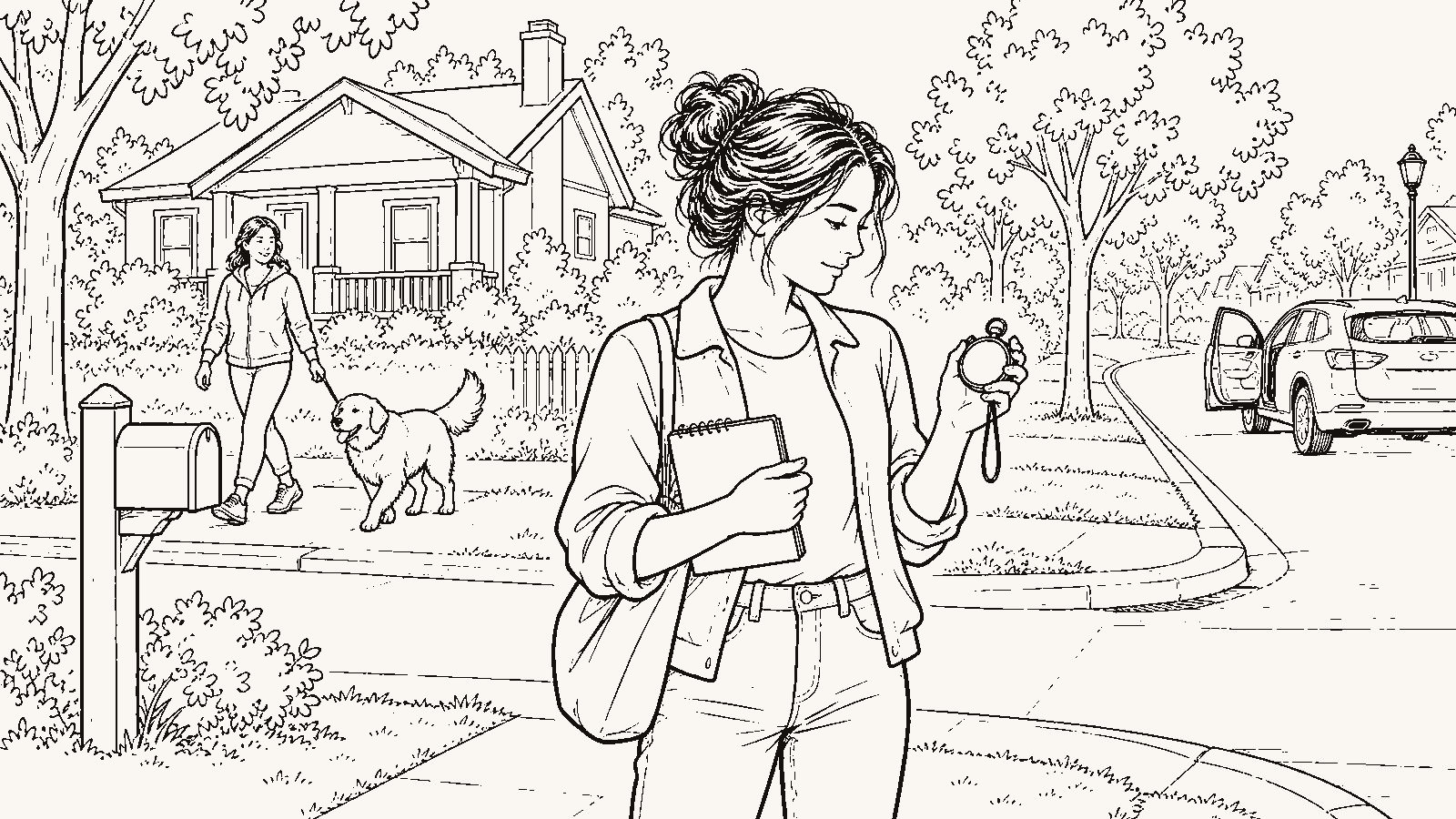
You are deciding whether this address stays on your list after half an hour spent at it. Buying the house and judging the neighborhood come later; the half hour decides whether the address earns a second, longer visit or comes off the list before you spend a day on it.
You already spend thirty minutes at an address on a scouting trip. You park, you look at the house, you say “it felt fine” or “something was off,” and the feeling goes on the list next to the price. The test below spends the same thirty minutes and comes back with four times, a page of notes, and a photo of every parking sign on the block. Six sheets line up on a page in a way six feelings do not.
Pick the hour before you pick the address
The hour changes the result more than anything else you choose, so choose it first. A block at 2 pm on a Wednesday, at 7:40 am on a Tuesday, at 10 am on a Saturday, and at 9 pm on a Friday is four different blocks. The listing photos show the first one. You will live at the other three.
Run the test at the hour that matches the part of your week you are most worried about. If the commute worries you, go at 7:40 on a weekday. If noise worries you, go at 9 on a Friday night. If you have young children, go at school dismissal and watch what the street does. The cost of choosing one hour is that the test becomes a sample of one, and a second run at a second hour costs another half hour and may contradict the first. If the two runs disagree, you have learned that the address depends on the clock, which is worth knowing before the offer rather than after.
Minutes 0 to 5: park where you would park every day
Drive to the address and park where you would park on a Tuesday evening: the driveway, the garage, or the curb. Start the clock when you turn onto the block and stop it when the engine is off. If the curb is the answer, count the cars already on it. Note how far you ended up from the door.
Then walk the block and read every sign. Permit zone, street-cleaning day, tow-away hours, “no parking this side,” the hydrant, the school bus stop. Photograph each one; you will not remember them by the third address, and the photos cost you two of your five minutes. The city’s parking authority or transportation department publishes the residential permit program, its cost, and the street-cleaning schedule, and the municipal code on the city’s own website carries the rules behind the signs. Both are official records. What you see on the block is your personal verification of whether the rules and the curb agree.
The cost of judging parking from one stop is that a block with room at 2 pm may have none at 7 pm, when everyone who lives there has come home. If the curb is where your car will live, this row needs the second run most.
Minutes 5 to 15: walk ten minutes from the door
Leave the car and walk out the front door in the direction of the nearest place you would walk to, if there is one: a store, a bus stop, a park, a school. Walk five minutes out and five minutes back. That is a small circle on purpose: the question is what ten minutes on foot from this door contains. If there is nothing to walk to, walk anyway; a ten-minute walk that reaches nothing is a finding, and it goes on the sheet.
Watch four things. Whether there is a sidewalk the whole way, and whether it continues past the block the listing is on. What you hear: the road you cannot see, a train, a dog, the back door of a business. Who is out, and what they are doing. What is open and what is closed at this hour. If the walk passes a transit stop, photograph the schedule posted there, then check the agency’s own published schedule when you get home; the posted one is an official record, and the two may not match.
The cost of the walk is that a pleasant ten minutes says nothing about the trip to work. A household can choose a block for the coffee shop on the corner and then spend fifty minutes a day getting out of it. The walk tells you what the door opens onto, and nothing about how the car leaves.
Minutes 15 to 25: drive out the way you would every morning
Get back in the car and drive out of the neighborhood the way you would on a Tuesday morning, toward work or toward wherever the first trip of the day goes. Start the clock at the driveway. Stop it at the first arterial road or highway ramp. The map’s figure for that stretch is an estimate, and a residential stretch runs on its stop signs, its school zone, and its one left turn without a signal, none of which the estimate can see. If you do not commute by car, drive to the transit stop or the park-and-ride you would use, and time that instead.
Note what slows you. The light that holds for a full cycle. The rail crossing. The school zone and its hours. The turn that requires crossing two lanes of oncoming traffic with no light, which at 7:40 is a wait and at 2 pm is nothing. If the route has a second way out, drive that one too and time it; if the neighborhood has one exit, whatever blocks it blocks your commute.
Your figure is a personal verification, and it is a sample of one. Drive it twice at the real hour before you believe it; the article on how to test a commute before you trust the map runs the full version of that check.
Minutes 25 to 30: run the one errand you make most weeks
Finish by running one errand the household makes almost every week. Milk, a prescription, a package drop, a tank of gas, the pediatrician if that is your week. Drive to the place you would actually use from this address, get out, go in, come back, and time the whole loop door to door.
Choose the errand you make most often, not the one that is easiest from here. The cost of choosing the easy one is that the sheet flatters the address; the cost of choosing the honest one is that you may find the errand that took eight minutes at your current house takes twenty-two here, in the opposite direction from work. That number goes on the sheet either way. If you have already written down your five places, this errand is the one you visit most, and the five-places test article shows how to run the other four.
Put the four times on one sheet
One address, one page. Write the date and the time you started at the top. Then four rows:
| Row | What you time | What you note |
|---|---|---|
| Park | Turn onto the block to engine off | Where the car ended up; every sign on the block, photographed |
| Walk | Five minutes out, five back | Sidewalks, what you hear, who is out, what is open |
| Drive | Driveway to first arterial or ramp | What slowed you; second exit if there is one |
| Errand | Door to door | Which errand, which store, which direction from work |
Under the table, two lines. What surprised you. Who would dislike living here, and whether that is you.
The sheet is what makes six addresses comparable. Without it, the third address blurs into the second by dinner, and the one you remember is the one with the nicest kitchen. The cost of the sheet is that it records what a curb can show and nothing else; it cannot see a flood zone, a school boundary, or a tax bill.
Run the sheet a second time at a different hour before you drop or keep an address. The second run costs another thirty minutes and another trip. It is also the only way to find out whether the first run was the neighborhood or the hour.
If you cannot be there, who runs it for you?
An out-of-state buyer can hand this sheet to a friend, a relative, or a hired local and get the same four times and the same photos back. Ask the person to run it at the hour you name, to photograph the signs, and to write down what surprised them rather than whether they liked it. The cost is that you are asking for a half hour at 7:40 on a weekday, and a friend who runs it at 2 pm because that was convenient has run a different test.
What comes back is a local observation with times attached, which is the useful kind. Your own reaction stays home. Your stand-in does not know that you cannot sleep through a train, that a missing sidewalk on the walk to school ends the conversation for you, or that twenty-two minutes to the pharmacy is fine for you and not for your spouse. The cost of delegating the test is that you get a record without the reaction, and the reaction is part of what you are moving for. Use the stand-in’s sheet to cut the list, and run the sheet yourself at the two or three addresses that survive.
What thirty minutes cannot tell you
The test rules an address in or out for the reasons a curb can show. Flood, school, broadband, crime, and tax are invisible from the curb, and the test does not replace the records that hold them.
Flood status lives in the FEMA Flood Map Service Center at https://msc.fema.gov/portal/home, an official record, and in an insurer’s quote for the exact address, which is provider-reported. Internet service is two checks: the FCC National Broadband Map at https://broadbandmap.fcc.gov/, which is provider-reported, and a call to the provider with the street address. The school the address feeds into is in the district’s attendance boundary lookup, an official record. Nothing on the sidewalk tells you which school that is. Crime data is whatever the police department publishes, an official record where it exists, and a quiet street at 10 am is not a substitute for reading it. The assessed value and the tax history sit in the county assessor’s parcel record, also an official record.
None of that fits in thirty minutes, and you cannot guess any of it from the block. The speed has a cost: a full sheet can make an address feel settled before the record checks have happened. Run the records before the offer, whatever the sheet says.
Good for which life, and at what cost?
The test buys you a half hour per address that ends in a sheet, and sheets can be laid side by side. Six addresses in a morning become six sheets, and the ones with a twelve-minute crawl to the ramp or a curb that was full at 6 pm come off the list before you spend a day on them. For a household with two scouting days and nine addresses, that is the difference between seeing all nine badly and seeing the three that matter properly.
Thirty minutes is one hour of one day, and a second run doubles it. The sheet records what the curb shows and is silent on everything in a county record. Running it on nine addresses eats a day that could have gone to two addresses in depth, and a stand-in’s sheet arrives without the reaction that would have told you to stop reading the times. On a rural address the walk row is empty and the drive row is most of the commute; the sheet still works, but two of its four rows carry the weight. Some households run it and drop half the list before lunch. Others run it and learn only that the address deserves the longer visit laid out in the neighborhood scouting trip article.
What must I verify personally
At the address, at the hour you chose:
- Park where you would park every day and time it from the turn onto the block. Read and photograph every sign on the block.
- Walk five minutes out from the front door and five back. Write down whether the sidewalk continues, what you hear, who is out, and what is open.
- Drive from the driveway to the first arterial or ramp the way you would at 7:40 on a weekday and time it. Note the school zone, the rail crossing, and any left turn without a signal. If there is a second exit, drive and time that one.
- Run the errand you make most weeks, to the store you would use, and time the loop door to door.
- Put the four times, the notes, the date, and the hour on one sheet. Run the same sheet at a second hour before you keep or drop the address.
- Before an offer, check what the curb cannot show: the FEMA flood map, the FCC broadband map and a call to the provider, the district’s attendance boundary lookup, the police department’s published data, and the county assessor’s record for the parcel.
What should I ask a local
- What time does this block fill up with cars, and where do you park when it does?
- Which way do you leave in the morning, and which turn do you avoid?
- What do you hear at night, and from which direction?
- Where do you go for milk or a prescription, and does it take you as long as it just took me?
- What happens on this street on Friday and Saturday nights?
What should I ask my agent
- Will you run this sheet at the address at 7:40 on a weekday and send me the four times and photos of the parking signs?
- Which of the listings you are showing me have you driven out of at rush hour yourself?