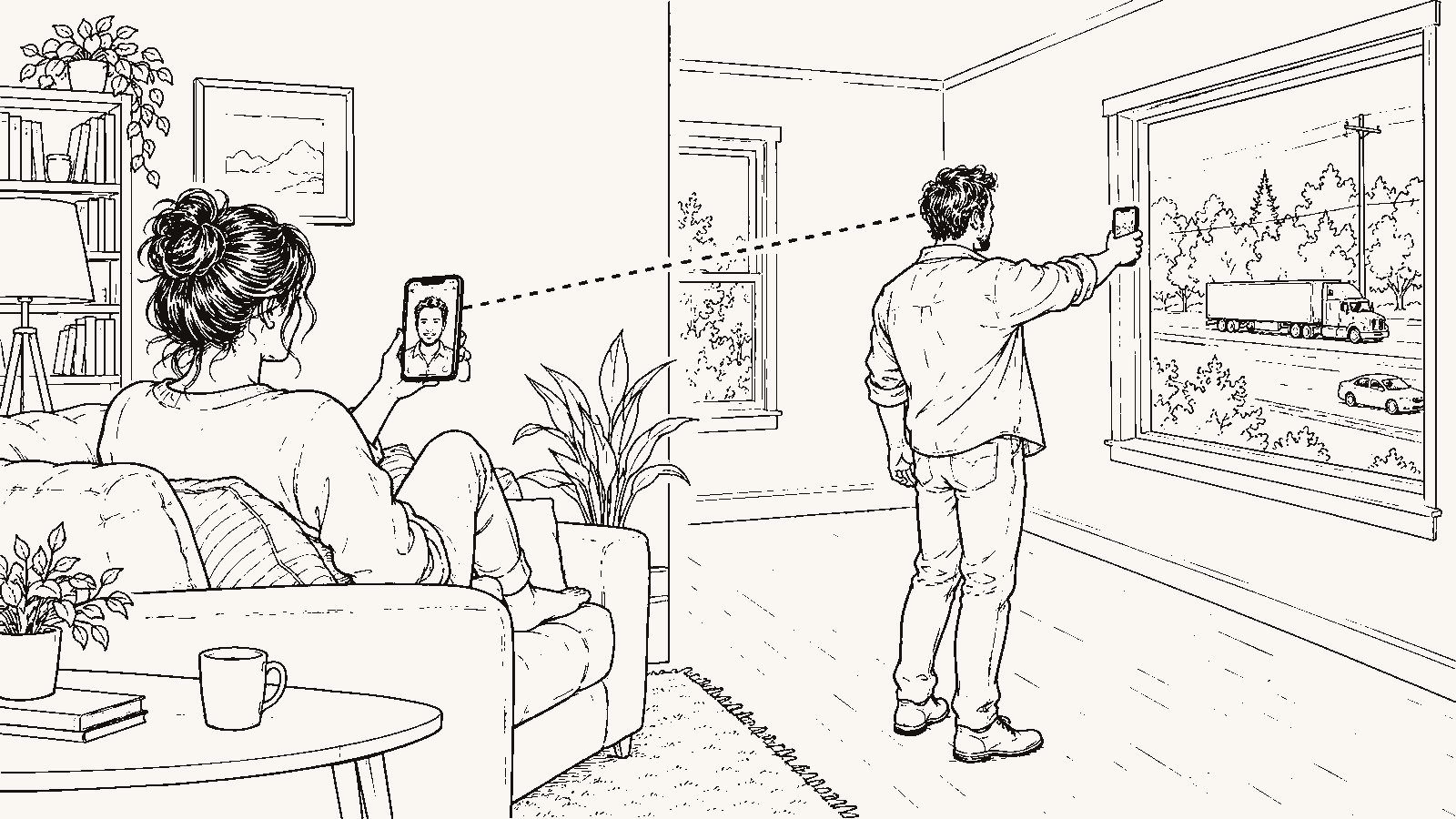
You are deciding whether to write an offer on a house you have never stood in. The question is what the person holding the camera has to show you before a video tour counts as evidence, and what no camera can show you at all.
A listing is a set of photographs someone chose. The lens points at the fireplace and away from the road, at two in the afternoon on a clear day, with the neighbor’s truck moved. You see what the photographer wanted seen, then ask a person you have met once to go stand in the house for you. That person is your local eyes.
What does a video tour let you do, and what does it cost?
A live tour by someone who lives there lets you see a house within a day or two of it listing instead of flying out every other weekend, and it lets you make an offer on the same timeline as a buyer who lives across town. It also puts the camera in someone else’s hands. The person holding it chooses where to point it, usually gets paid only if a house closes, and cannot smell or hear the house for you. Each item the tour covers is a question you can price before you write the offer. Each item it skips is one you pay to learn about after the offer is accepted, when walking away costs money.
So treat the tour as a procedure. Write the list below in the order the person will walk and send it before the appointment. An agent who has toured for remote buyers before will follow it. One who has not may find it tedious, and you will learn something about the agent at the same time you learn about the house.
Ask for the approach before the front door
Ask the person to start the video in the car, two blocks out, at the hour you would come home. You want the street as you will see it every evening: the condition of the houses on either side and across, what is parked at the curb, whether the sidewalk exists and continues, where the block ends. Ask the camera to turn a full circle at the driveway and take in the view from the front step, including whatever the listing photo cropped out. This adds fifteen minutes of someone else’s time and a longer video for you to sit through. Skipping it means you learn what the front step faces on the day you move in.
Then ask for the back fence. The listing shows the yard. It does not show what the yard borders, and a drainage easement, a commercial lot, a road you cannot see from the front, or a neighbor’s second-story deck looking down into your patio all live behind that fence. Confirm what you saw on the county’s parcel viewer, which shows the owner of each adjacent parcel and, in many counties, its zoning. That is an official record. Its lot lines are drawn for tax purposes and are not a survey, so use it to learn what the neighbor is, and leave the exact boundary to the survey or the title work.
Ask for the sound with the camera still
Ask the person to stop talking for a full minute each in the front yard, the back yard, and the room you would sleep in with the window open, then tell you what he heard and what time it is. A road that is quiet at eleven on a Wednesday morning is a different road at 7:40 and at school pickup. A rail line, a flight path, a highway a quarter mile off, a neighbor’s dog, a generator: none of it appears in a photograph. Three minutes of silence feels awkward on a live call. The listing agent standing nearby will try to fill it. Ask anyway.
That minute of silence is a local observation, and it is only good for the hour it was recorded. Ask for a second stand in the yard at nine on a Friday night, or ask a local who lives on that side of town what the street sounds like on a weekend. The second visit costs the agent an evening and costs you goodwill if you ask for it on every house. Ask for it on the house you are about to write on.
Point the camera where the photographer did not
Listing photography has a grammar. Wide lens, low angle, lights on, doors open, camera at chest height looking straight ahead. Ask your local eyes to break it, and expect the cost before you ask: an hour instead of twenty minutes, an impatient listing agent, and a seller who may refuse the attic hatch or the crawlspace on a showing.
- Ceilings. Every ceiling, corner to corner, with the lights off and daylight on. Water stains, bowing, patched drywall, and a crack that follows a seam show up here first and appear in no listing photo.
- Floors. Ask him to walk each room and say whether the floor moves, then film along the baseboard where floor meets wall. Gaps, warping, and a slope toward one corner are things a person feels through his shoes and a camera misses from chest height.
- Under the sinks, around the windows, behind the washer. Open every cabinet with plumbing in it and put the camera inside. Run a finger along the bottom of each window frame and show it to the camera.
- The attic hatch and whatever is below the house. Open the hatch and put the phone through it with the flashlight on, then do the same at the basement or crawlspace door. He can stay on the ladder. What you need is proof the hatch opens and a look at the first three feet.
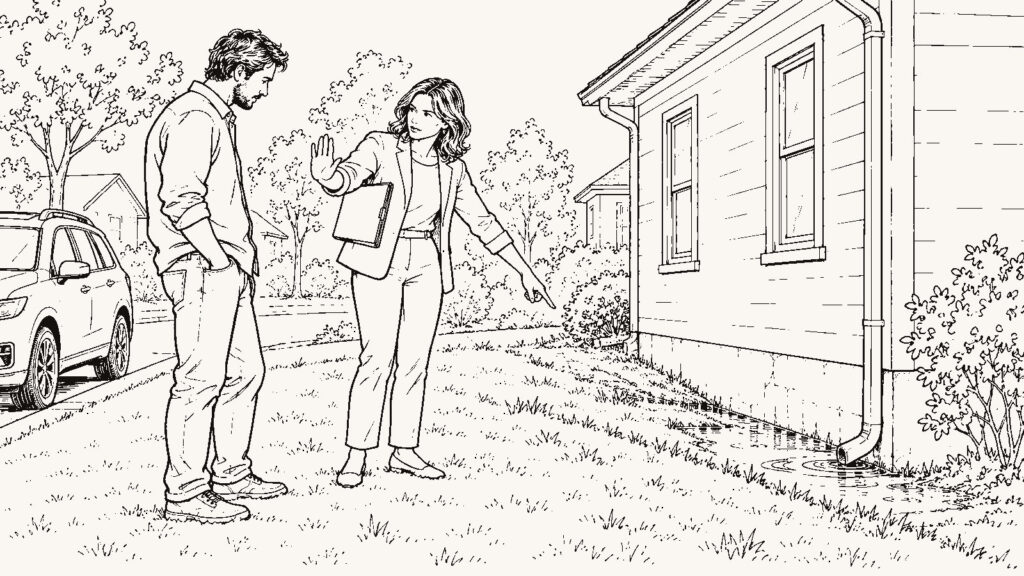
- The exterior, the whole perimeter. Roof from the ground on all four sides, gutters, and where each downspout drops. Then the ground at the foundation: does it slope away from the house or toward it, and where does the bottom edge of the siding sit against the dirt.
A refusal on any of these proves nothing by itself. Treat it as a line item for the inspection and a reason to make sure the inspection happens with someone you trust in the room.
Ask for the age and the sound of every system
Ask for a close, readable shot of the data plate on the furnace or air handler, the water heater, the outdoor condenser, and the electrical panel with the cover on. Manufacture dates and model numbers are printed on those plates, and you can look them up yourself. A phone camera struggles with a plate in a dark closet, so ask him to read the numbers aloud as well. Then ask him to turn each system on and let the camera listen for thirty seconds. Running every system stretches the showing, and a seller can refuse. A furnace that bangs and a water heater that pops are things an inspector will note later and things you can hear now.
Ask what is not on, and why. A heat pump idle in July, a fireplace with the damper wired shut, a sprinkler system with the valve closed, a well pump with the breaker off. A seller can reasonably decline to run the furnace in July or the air conditioning in January, so some of these answers wait for the inspection, and you should write them down now so they do.
Compare what you see against the permit record. The city or county permit office will tell you, usually by address, what permits were pulled for the property. That is an official record. If the listing says the roof was replaced three years ago and the permit office shows nothing, one of them is wrong, and you want to know which before you price the offer. Pulling the record costs a phone call or an online request and some waiting. Some jurisdictions keep thin records for older work, so an empty result does not always mean unpermitted work. Treat it as a question for the seller, not a verdict.
Ask what the house smells like, and then do not trust the answer
Ask him to describe the smell at the front door, in the basement, in every closet, and in the garage, out loud, on the recording. Mildew, cat, cigarette, sewer gas, fresh paint over any of those. The person holding the phone may be polite, or may have walked into so many houses that week that nothing registers. Smell is a local observation from one nose on one day.
This is the first of three things you should not accept on video alone. If the tour reports fresh paint and an air freshener in every room, send a second person, or make the inspection contingency the thing you will not give up in negotiation. A second walker costs you a favor or a fee. Keeping the contingency can cost you the house to a buyer who waives it. Giving it up to win a bidding contest costs you the only professional look the house will get.
Ask where the water goes
Ask for the yard after it rains if the timing allows, and for the low spot if it does not, then the gutters, the downspout ends, the grade at the foundation, and any stain line on a basement wall or garage floor. Efflorescence, the white mineral crust on concrete, marks where water has been. So does a dehumidifier running in a finished basement during a dry week. Timing rarely cooperates. A dry-week video of a yard tells you little, which is why the stain line and the downspout matter more than the grass.
Then check the official flood information for the exact address at the FEMA Flood Map Service Center, https://msc.fema.gov/portal/home. The map tells you the designated zone. That is an official record. It does not tell you what a policy at that address costs, or what happens on that lot when a storm drain backs up. Call an insurer with the address for the quote; the insurer may ask for details about the house you do not have yet, so expect a second call. FEMA’s National Flood Insurance Program states that standard homeowner insurance generally does not cover flooding and that flooding happens outside designated zones. A house outside a mapped zone with a downspout dropping at the foundation is still a house with a water question.
Ask for the view from every window and the signal in every room
Ask him to stand at each window, look out, and hold the camera there for five seconds. Every window. Whatever it faces is what you will see every morning: a wall, a neighbor’s bathroom, the road, a transformer, a parking lot. The listing photographs the room with the window as a light source. You want it as a window. Every window is a stop, and the listing agent standing behind him will notice, so tell your local eyes in advance that this is on the list.
In each of those rooms, ask him to pull up his phone, read you the carrier and the signal bars, and place a call from the room you would work in. If you work from home, this is the second thing you should not accept on video alone. His carrier may not be your carrier and his phone may not be your phone. Check the FCC National Broadband Map, https://broadbandmap.fcc.gov/, for the exact address to see which providers report wired service, the technology, and the advertised speeds. That is provider-reported, and the map has a challenge process because reported information can be wrong. Call each provider with the street address. Ask what tier is physically available to that house and what upload speed comes with it. The full procedure is in How to Verify Internet Service Before You Buy a House: https://beforethekey.com/blog/how-to-verify-internet-service-before-you-buy-a-house/. The calls cost you an hour on hold. Skipping them costs you finding out on your first Monday that the fiber on the map stops two houses down.
Ask for the drive, from the driveway, at the real hour
This is the third thing you should not accept on video alone, and the one most tours skip. Give your local eyes the addresses of your five places: work, the school, the grocery store you would use, the gym or the church or the parent’s house, whatever your normal Tuesday requires. Ask him to record the drive to the two that matter most, from the driveway, at the hour you would make them, in the direction you would make them. Two recorded drives cost an agent most of a morning, and you will pay for that in goodwill or in a fee. Put a morning of someone’s time on one side of the page and every weekday of that drive on the other.
The map’s time is an estimate, and it behaves like an estimate of a Sunday afternoon. The recording gives you a local observation from one day, which is one more day than the map has. If the agent cannot do this, ask a local you have found through the neighborhood or the school to do it, or fly in once and drive it yourself.
Read the disclosure before the offer, and put a person at the inspection
Ask your agent or the state real estate commission which seller disclosure form applies where you are buying. Where one is required, it is an official record of what the seller declares. It is not an inspection. Read it before you write the offer, with the tour recording open beside it, and mark every item where the two disagree. The cost is an evening. The alternative is reading it for the first time at the closing table, when every question is a delay you are paying for.
Then make sure someone you trust is at the inspection, and ask the inspector to call you from the site with the camera on. An inspector narrating to a phone moves slower, and an agent who gives up a morning for it will remember the favor. Ask the agent now whether he will attend when you cannot, and notice how long the answer takes. The questions that separate a yes from a hesitation are in What to Ask a Realtor When You Are Relocating: https://beforethekey.com/blog/what-to-ask-a-realtor-when-you-are-relocating/. On every house, ask the agent the last question on the list: what about this house would you not buy. An agent who cannot name anything is either looking at a rare house or not looking. What a Good Real Estate Agent Should Tell You Not to Buy explains why candor is a qualification: https://beforethekey.com/blog/what-a-good-real-estate-agent-should-tell-you-not-to-buy/.
What should I ask a local
- What is on the other side of the back fence, and what is it like there at night and on weekends?
- What does this street sound like on a Friday night and a Saturday morning?
- Where does the water go on this block when it rains hard, and whose basement gets it?
- Which carrier works in this part of town, and which one drops?
- What happens on this road at school pickup?
- Who lives on this block: long-term owners, long-term renters, or short-term rentals?
Everything a local tells you is a local observation. It is one person’s experience, worth more than a summary score and less than standing there yourself.
What should I ask my agent
- Will you do the tour live, in the order I send you, and record it so I can rewatch with the sound up?
- Will you attend the inspection if I cannot, and have the inspector call me from the site?
- How many out-of-state buyers have you represented in the last two years, and how many of your closed sales are in this neighborhood?
- What about this house would you not buy?
What must I verify personally
Before you write the offer on a specific address:
- Search the exact address at the FCC National Broadband Map, then call each provider listed with the street address and ask what tier and what upload speed are physically available at that house. Personal verification.
- Search the exact address at the FEMA Flood Map Service Center, then call an insurer with the address and ask what a policy costs. Personal verification.
- Pull the parcel on the county assessor or GIS viewer. Identify what borders the back and side lot lines and look up the zoning of each adjacent parcel. Personal verification.
- Request the permit history for the address from the city or county permit office and compare it line by line against what the listing says was replaced. Personal verification.
- Rewatch the tour recording with the sound up and the list of smells he read out beside you. Write down every item the camera did not reach.
- Get the drive to work and to one other recurring destination recorded from the driveway at the real hour, or drive it yourself on a scouting trip.
- Read the seller’s disclosure with the tour recording open, and mark every disagreement.
- Confirm in writing who will be standing in the house during the inspection, and that the inspector will call you from the site.