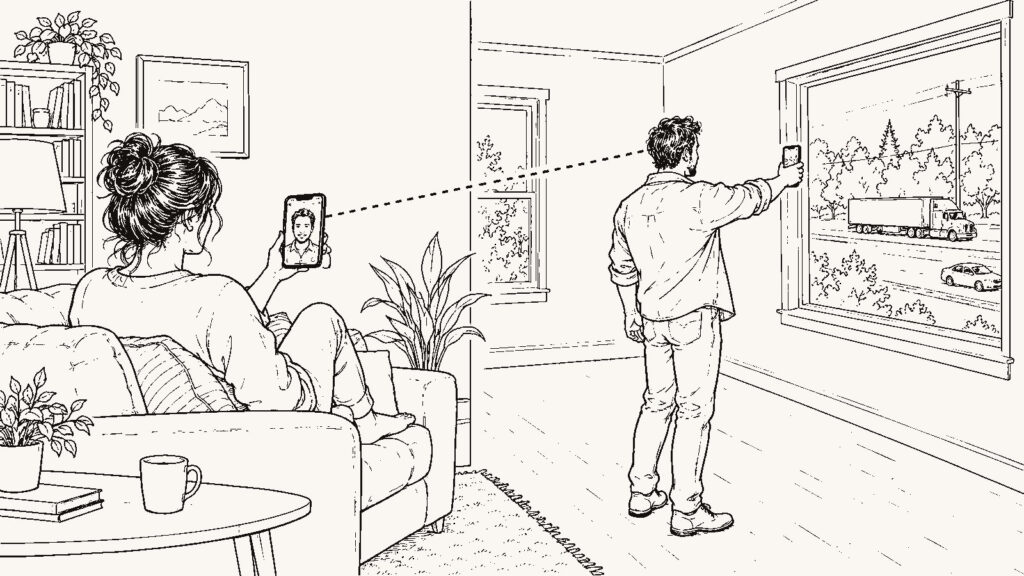
You are deciding whether this agent has done the job you need done: representing a buyer who is not in the room, in the two or three areas you are considering. You are not deciding whether he is well liked or the first name the portal showed you.
Reputation is a summary of other people’s transactions, most of them local buyers who could drive past a house on their lunch break. You cannot. Every question below is built so that the answer is a number, a name, an address, or something you can watch happen on a video call. An answer you cannot check is a compliment, and you are not hiring compliments.
Interviewing this way costs you three agents, three calls, a week of your evenings, and a fair chance that the agent who passes every test is booked for the month you want to buy. You can skip all of it by signing with the first responsive agent. What you give up is the one person whose eyes stand in for yours at the house, and you find out what that cost you after you move in.
How many houses have you closed in these specific neighborhoods, and what were the addresses?
Name the two or three areas you are considering, by neighborhood or ZIP code, and ask for closed sales there in the last two years. Ask for addresses. An agent who has closed forty houses across the county and none in your three areas has forty pieces of experience that do not apply to you. Insisting on this narrows your field: an agent with deep experience in two neighborhoods may know nothing useful about the third area you add next month, and the agent whose numbers are strongest in your areas may be the one with the least time for you. Decide whether you want depth where you are looking or breadth in case you look elsewhere, and say which one you chose.
A passing answer sounds like a list: three addresses on two streets you recognize from your own research, with the months they closed. A failing answer sounds like a territory: “I work the whole east side.” Everything the agent tells you about his own record is provider-reported. Take three of the addresses to the county register of deeds or property records office for the target county and confirm the sale dates. That is the official record. It costs you twenty minutes on a county website that was not built for you, and some counties still charge for a search or make you request records by mail. The deed shows the sale and the date. It does not name the agent, so this check catches an invented address, and the former-client call in the next question catches an invented role.
How many out-of-state buyers have you represented in the last two years, and may I call one?
Representing a buyer in another state means describing a house to someone who cannot smell it, and saying “do not buy this” over the phone to a person who has already fallen for the photos. Ask how many buyers the agent has represented who were living in another state during the search. Then ask for one name and one phone number. You are asking for a reference before the agent has shown you anything. Some agents take that as an insult on a first call, and some need a day to ask the client’s permission, which is a fair answer. The ones who treat it as a normal question are the ones you want.
The call to the former client is where you learn things the agent will not volunteer. Ask what the agent missed that the client found after moving in, and whether the agent stayed for the whole inspection. Then ask what the client would do differently. This is local observation from someone who ran your exact experiment a year ahead of you, and it costs you one awkward phone call. The former client is also chosen by the agent, so expect a satisfied one, and listen for what the satisfied client complains about anyway.
An agent who cannot produce a single out-of-state client is telling you that you will be the practice run. That is not always disqualifying, and a newer agent with more time may serve you better than a veteran who returns calls in three days. It means you carry more of the verification yourself, and you should price your own hours into that choice.
Will you do a live video walkthrough this week, on a house I will not buy?
Asking whether the agent does video tours gets you a yes and tells you nothing, so ask for one instead: on the first call, on a listing you have no intention of buying, this week. Then watch what you get. A walkthrough that stands in for your own visit covers the approach to the property, the neighboring houses, the street and its traffic, the exterior, ceilings and floors, the mechanical systems, the smells, any sign of water in the basement or at the foundation, the view from every window, cell reception at the kitchen counter, and the drive from the front door to at least one of the places you will go every week. We lay out that standard in full in Buying From Out of State: What Your Local Eyes Need to Check. The cost is forty minutes of the agent’s time on a house that earns him nothing, and some agents decline on that basis. You are about to ask this person to spend two hours at an inspection for you, so an agent who will not spend forty minutes on a test tour has answered the inspection question early.
A passing walkthrough is slow, and it lingers on the neighbor’s yard. A failing walkthrough looks like the listing photos with motion. Schedule the test at the hour you would be home, a weekday evening or a Saturday morning, so the street sounds like it will sound when you live there. Holding out for that hour can mean waiting a week for a slot, and if the listing sells in the meantime you pick another one and wait again.
Will you attend the inspection when I cannot, and stay for all of it?
Ask three things: whether the agent attends inspections on your behalf, whether he stays from the first ladder to the last outlet, and whether he sends you the report with his own notes rather than forwarding the inspector’s PDF. An agent who leaves after the first hour sees the roof and misses the crawlspace. Ask him what he does when the inspector finds something, and listen for whether the answer includes calling you before the inspector packs up, so you can ask the inspector your own questions while he is still standing in the house. You are asking for three hours of a working day, and some agents will offer a junior colleague or an assistant instead. Decide before the call whether a stand-in for your stand-in is acceptable to you.
Your agent at the inspection is your personal verification by proxy. It is still not the same as being there, and if you can fly in for the inspection and nothing else, that is the day to fly in. A second flight is money and a day off work you may not have, and asking the agent to stand in for you is the tradeoff you make when the budget does not stretch to it.
What will you refuse to tell me, and where do I go instead?
Ask this one plainly, because the answer separates an agent who knows the law from one who will get you both in trouble. The Fair Housing Act prohibits discrimination in housing based on race, color, national origin, religion, sex, familial status, and disability, and the U.S. Department of Housing and Urban Development enforces it. That is the official record. An agent who tells you a neighborhood is “safe,” “good for families,” or “the kind of place where people like you live” is steering, whether he means to or not.
A passing answer sounds like a referral: “I cannot characterize the neighborhood for you. Here is the police department’s public data portal, here is the school district’s boundary map, and I can drive you through it on video at nine on a Friday night.” That agent is doing the job. An agent who answers freely feels more helpful on the call and is the one whose judgment about a place you should trust least, because he is substituting his impression for data you can check yourself. The cost of hiring the careful one is that you do more of the work: crime data comes from the police department and school assignment from the district, with your own eyes at the address as the last check.
What have you told a buyer not to buy in the last year, and why?
Candor is a qualification, and it is checkable. Ask for one house in the last year that the agent talked a client out of, and the reason. A passing answer has a street and a defect: a house backing onto a road that becomes a truck route at six in the morning, or a basement that smelled fine in July and floods in March. A failing answer is a philosophy about how every house is right for someone.
An agent who says no often will cost you houses, including some you would have been happy in. That is the tradeoff you accept when you hire for judgment instead of for volume. We take this up in What a Good Real Estate Agent Should Tell You Not to Buy.
What does the buyer agreement commit me to, and how do I end it?
Since August 17, 2024, agents who participate in a Multiple Listing Service must have a written agreement with you before touring a home, under the practice changes the National Association of Realtors adopted. That is the official record, and it means you will sign something before the first showing, in person or on video. Read it before you sign it. Find the term, whether it is exclusive, how the agent is compensated and by whom, what happens if you buy a house the agent did not show you, and how either of you ends it. Reading it takes an evening. That delays the first showing by a day, and an agent working with three other buyers may fill that slot with one of them.
Ask the agent to walk you through those clauses on the call. An agent who explains his own agreement in plain words and offers a short initial term is showing you how he will explain a purchase contract later. Pushing for a shorter term or a narrower exclusivity costs you some of the agent’s attention, since he is less sure you will stay, and it buys you the right to leave without a fight if the video walkthrough test turns out to have been the high point.
What in my plan do you think is wrong?
Tell the agent your five places, your maximum drive, your budget, and the three areas you have picked from a thousand miles away. Then ask what you have gotten wrong. A relocating buyer’s plan is built from maps and listings, and an agent who has driven those streets at 7:40 on a Tuesday knows which of your assumptions do not survive the trip. This is local observation, and it is the reason you are hiring a local at all. It costs you a plan that looked finished, and a good answer will send you back to the map for another evening.
A passing answer has a specific correction: that the twenty-minute drive you measured is thirty-five when the school lets out, or that one of your three areas has two houses a year in your price range. A failing answer is agreement with everything. Someone who agrees with your whole plan on the first call has either not listened or will not push back later, when pushing back is the service you are paying for.
What must I verify personally
Before you sign a buyer agreement with this agent:
- Look up the agent’s license by name at the real estate licensing authority for the target state. ARELLO, the Association of Real Estate License Law Officials, links to each state’s lookup. Confirm the license is active, note the expiration, and read any disciplinary history. Official record.
- Take three of the claimed closed addresses in your target areas to the county register of deeds or property records office and confirm the sale dates fall in the last two years. Official record.
- Call the former out-of-state client. Ask what the agent missed, whether he stayed for the whole inspection, and what the client would do differently. Local observation.
- Run the test walkthrough on a house you will not buy, at the hour you would be home, and check it against the list in the article on local eyes. Personal verification.
- Read the term, exclusivity, compensation, and exit clause of the buyer agreement before you sign it, and ask the agent to explain each one aloud. Personal verification.
- Ask the agent to drive from a candidate house to your workplace on video at 7:40 on a weekday, both directions. Personal verification.
What should I ask a local
The agent is a local. So is the former client. Ask each of them:
- Which of these two streets would you not buy on, and why?
- What did your last out-of-state buyer find after moving in that nobody caught before closing?
- Which of my five places is farther than the map says, and at what hour?
- Former client: what did the agent tell you not to buy, and were you glad?
The answers are local observation. They tell you what a person who lives there thinks, with the reasoning attached, and that is worth having before you trust a number. Total sales volume tells you the agent is busy. Closed sales in your target neighborhoods, a former client who will take your call, a walkthrough you watched happen, and an agent who told you where to find what he cannot say tell you whether the agent is right for your move. We take the volume question further in Why “Top Producer” Does Not Automatically Mean “Right Relocation Agent”.
Sources
- Association of Real Estate License Law Officials (ARELLO), license verification: https://www.arello.org/. Official record.
- National Association of Realtors, practice changes and written buyer agreements: https://www.nar.realtor/the-facts. Official record.
- National Association of Realtors, Code of Ethics and Standards of Practice: https://www.nar.realtor/about-nar/governing-documents/the-code-of-ethics. Official record.
- U.S. Department of Housing and Urban Development, Office of Fair Housing and Equal Opportunity: https://www.hud.gov/program_offices/fair_housing_equal_opp. Official record.
- Consumer Financial Protection Bureau, Owning a Home: https://www.consumerfinance.gov/owning-a-home/. Official record.
- County register of deeds or property records office for the target county: search the county name with “register of deeds” or “property records.” Official record.